
This week I finished:
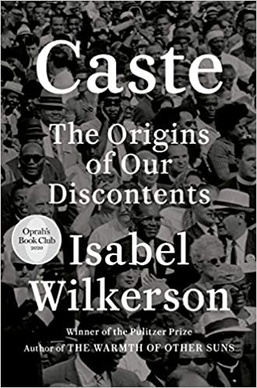
Caste: The Origins of Our Discontent, by Isabel Wilkerson: I don’t know if or when I’ll meet Isabel Wilkerson, but I can’t wait. Her book begins and ends with significant talk about sustainability. I think she sees her work on caste, race, and racism as relevant, but I suspect it’s far more relevant than she expects. I think we’d enjoy learning from each other. I think she’d see new ways to apply her work and inspiration to make that application.
That said, this book approaches caste from a historical approach I consider too limited. That is, the caste system it describes starting in historical times existed long before. I took notes while finishing the book. I’m going to take the prerogative as a blogger not publishing for peer review or professional publication just to write the notes here. If anything looks interesting and you want more or more clarity, ask and I’ll deliver.
Like reading biology before Darwin, like Melville describing whales as fish or Bible including bats in list of birds. If you don’t understand relationships and mechanisms, all you can do is describe what you see. But as evolutionary biologist Theodosius Dobzhansky wrote, “nothing in biology makes sense except in light of evolution.” I would say that nothing in racism—or, in this book, caste—makes sense except in the light of knowing dominance hierarchies and how they work.
Describes phenomenology, implies she’s describing causation but doesn’t show why people acted as they did. People at top just did. She implies because they are white or European, but if race is social construct, not biological, no explanation why they behaved differently.
Her eight pillars are just description of what she sees, not causality, nor in the direction of solving.
I didn’t see empathy for people at top who acted cruel. If they are human, why not try to understand them and realize you would have done what they did? If they are different, how so, if skin color doesn’t make a difference. She doesn’t explain or even acknowledge that she doesn’t attempt to explain why people act as they do, but clear implication is that white or European people are different, contradicting herself.
She switches consistently into passive voice for caste. Active voice almost every place else. I read as she is trying to avoid saying white people do it.
She conflates skin color with cause of caste.
She treats three cases US slavery, Holocaust, and Indian caste system, and only a few others in passing, like ancient Greece and Rome. She doesn’t treat slavery in USSR gulag, Arab/Muslim, Aztec, China, etc.
- Regarding Arab/Muslim slavery, which predates Christian/European:
- She says the curse of Ham rationalization comes from Christians, but the paper I posted about last week says from that it came to Christians from Arab/Muslim slavery
- She says US started slavery and racism, but other history books trace it to Inquisition and Arab.
She gets causation between slavery and racism backward. She doesn’t get Eric Williams quote:
“A racial twist has thereby been given to what is basically an economic phenomenon. Slavery was not born of racism: rather, racism was the consequence of slavery.”
Only looks at whites dominating. Neglects white abolitionists, white southerners who fought for Union, whites who sacrificed their lives for equality, my experiences growing up. Also blacks who owned slaves, black dictators, Cherokee who owned slaves even after Thirteenth Amendment, North Korea, Slavs after whom the word slavery was coined, Japanese imperialism, imperialism from many places in the world besides Europe, dominance hierarchies all over.
People trying to climb hierarchy weren’t trying to be white. They were trying to access resources. Source of domination is control over resources with no alternatives. People fear that if they lose control over resource, they risk dying, even bringing down society.
Misses that she is near top of dominance hierarchy—that is, a caste system—with resources controlled including energy, justice, education, and most of all, ability to pollute and deplete with impunity. She talks about flying all over the world over and over, contributing as much to others’ suffering as people buying cotton and sugar.
NY Times described as “persuasive,” but persuasive of what? That caste isn’t race? So we have more words. She offers no solution. My upcoming book does.
Attributes alpha male-ness to personality. Misses control over resources, as exhibited by her controlling food. The Lucifer Effect shows that dominance hierarchy results from conditions, not personality.
Her stories of people being dominated resonate with many of mine growing up, but nothing in her book acknowledges that a life like mine could have existed.
Attributes domination to America or dominant caste, as if monolithic, as if all whites are one.
Suggests that because white people in past had rank then white people today feel entitled and are dying from loss. Ignores that just because Napoleon and Hitler were white doesn’t mean I should feel I should be ruler too. Can she imagine I empathize with people with different skin color as much as she does? Why shouldn’t I? She recognizes it’s a trivial difference. Why should I associate with powerful white people and not oppressed black people? Should I consider her closer to blacks than to whites just because of her skin color? Does she see that her choices and behavior, treating remote people’s lives less important than her flying around and rubbing our noses in flying to a conference for a single day, put her more in line with dominant caste than lower?

Margaret, written and directed by Kenneth Lonergan, starring Anna Paquin: Powerful movie. I loved the acting, writing, and directing.
The main character starts off finding herself able to manipulate people by being something society gives leeway to: a pretty young girl. People like her mom, her high school teachers, and a boy try to connect with her or help her and she brushes them off with passive aggression. Everyone will come back. She’s a pretty young girl. If they don’t, someone else will.
Then she plays a role in a bus running a red light and killing an innocent pedestrian, who dies in her arms. She feels guilty. To her credit, nobody understands her. She doesn’t try to make herself understood in a way others could understand, but no teenager could. Instead she ratchets up the passive aggression by manipulating, condescending, and mouthing off in various ways to everyone around her.
Most reviewers treat the movie as exploring her expression and relationships. I see those elements. They probably are the main ones, but they fall under my main criticism: their intensity detracts from nuance. She yells. Everyone yells. Everyone maxes out on being distraught. I saw in an interview that the writer/director knew someone who experienced something similar. It’s believable, but outside most of our experience. Most of us experience something similar: we contribute to a tragedy that hurts someone, we don’t know how to handle it, the intense emotion influences choices and actions that affect all our relationships, and so on, even without someone dying in our arms, blood all over, grieving people everywhere.
I saw the movie as showing her crying out for boundaries and structure at the start, then understanding after the accident. Her teachers want to help but only know how to manage, not lead. Her math teacher is a caricature who too-obviously likes her. Her literature teacher doesn’t know how to handle disagreement with a student, just calling a teenager “wrong” over and over. Her debate teachers don’t know how to lead students to disagree with each other, just watching them spiral into yelling. Her father lives a continent away, doesn’t know how to connect with her, and can’t handle talking to her and his second wife at the same time. Her mother is her main foil when she figures out how to push her (the mom’s) buttons.
It may be too simple to say that she has no father figure or people with calm, confident masculine energy. I don’t see how you can blame a young girl for exploring her boundaries with everyone. What she misses is someone who can handle her lashing out, give her understanding and space to make sense of what happened, listen, and let her expend her energy. It seems to happen in two scenes through her experiencing art, which seems plausible, but still, I see the movie as revealing a lack of structure and calm strength in our culture, or at least among the emasculated bicoastal liberal elite world of the movie’s creator.