
This week I finished:
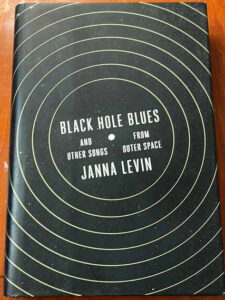
Black Hole Blues and Other Songs from Outer Space, by Janna Levin: Somehow I started receiving Janna Levin’s Substack (that Is, Substack spammed me, though I doubt Levin caused it). I looked her up. She teaches physics at Barnard. I got my PhD at Columbia and worked with a professor at Barnard, who was one of my main reasons for returning there after starting graduate school at Penn.
This book describes the path in the physics and to a degree astronomy communities to detect gravitational radiation. Its descriptions of developing and building detectors at the frontiers of science reminded me of my time at Fermilab and helping build XMM, the x-ray observational satellite I worked on.
On the experimental side, though, detecting gravitational waves was a new branch of detection. They’re not electromagnetic waves or particles. Detecting them is new. Then again, I took a class with a guy who won a Nobel prize for creating a neutrino beam.
On the theory side, it reminds me of a course I took as an undergraduate on general relativity. I didn’t get much of it, but a little. I loved my teacher, Edward Spiegel. He was funny and blunt. I took an earlier class with him in chaos theory that I struggled with as my first advanced class. I did well on the first test. He called me out and said I had a knack for it, which was one of my first pieces of positive feedback.
Back to Levin’s book, she pursued the human side of this history. I liked knowing names like Kip Thorne from my studies (you can’t study general relativity without coming across his book). I wonder what this book would be like for people who didn’t spend the better part of a decade in that world. In any case, I did, and it felt familiar.
Also, I consider the book cover design one of the best I’ve seen.
If You Can Keep It: The Forgotten Promise of American Liberty, by Eric Metaxas: If I didn’t know myself as well as I do, I wouldn’t understand why I like Metaxas’s work as much as I do. I found him through his book Amazing Grace when I started learning about abolitionism. That book was about William Wilberforce and abolishing the slave trade, then slavery, in the British Empire. It also covered Wilberforce’s mission to restore virtue to a culture lacking it.
I can’t keep up with all his books, but I watch his videos and listen to his interviews. He describes himself as a Jesus freak. He went to Yale, which put him in a non-Jesus freak zone, though that period was before his second birth.
He also loves America. He loves Trump. He was a guest on my podcast and we had a lovely conversation. I met him in person a month or two ago and we had another lovely conversation. I suspect we’ll converse again.
This book came out in 2016. He wrote that he was motivated by America’s division and the lowering of its virtue. I found the beginning and end moving and touching. He wants to restore many things missing from modern America. He tells several stories about America, about him growing up, and about him raising his kids.
I recommend this book. If you’re not used to Jesus showing up a lot, it may throw you, but his passion and mission seem genuine. I found the parts about what this nation stands for compelling, even inspirational. I felt choked up more than once. I found what he writes about love insightful. It reminded me of something I learned about great insights: You can tell a great truth because when you say it, it sounds ordinary. He pointed out that loving someone or a nation doesn’t say they’re perfect. You love them knowing they’re flawed.
How Does Libertarianism Deal with the Problem of Pollution?, by Matthew Zwolinski: I wrote about this paper yesterday: Libertarians confused on pollution, sacrificing their core values. At the root: lack of hands-on practical experience.
The Study of Administration and Socialism and Democracy, by Woodrow Wilson: two 1887 essays, the first published in the Political Science Quarterly, the second unpublished. I have to comment first on the writing style, the opposite of Strunk and White. Instead of omitting needless words, it adds them, repetitive, difficult to follow, I think trying to show off how smart the writer than communicate meaning. Double negatives, triple negatives, passive voice, etc. Argh.
Now I see why conservatives become so infuriated at what they call the “deep state” and what provokes them when people call the founding documents “living and breathing.” In these essays, Wilson describes how he says times have changed from when the Constitution was written, so it should change too. He wanted to study administration, which he saw being studied and advanced in Europe. He suggested that the founding of a nation and figuring out the theory of who does what is easier than the doing. He wanted more administration and bureaus, which he distinguished from politics.
The President of the United States, by Woodrow Wilson: I read this chapter in his book, Constitutional government in the United States, published in 1908, while he was president of Princeton University, four years before he was elected President of the United States. He describes how the difficulty of the position changed and became more complicated since the nation’s founding. The President has to do a lot. It’s the only position elected by all the people.
I didn’t realize I’d read it just after Edward Bernays’s Propaganda, but they overlapped. Wilson describes the new role of the President as more bureaucratic, but also as a thought leader.
The White man’s task, by Jan Smuts: a 1917 essay by a South African leader who Gandhi conflicted with. I read that in one of the times Gandhi had been jailed in South Africa, he made a pair of sandals and gave them to Smuts. On Gandhi’s 70th birthday, many years later, Smuts said, “I have worn these sandals for many a summer, even though I may feel that I am not worthy to stand in the shoes of so great a man.” He continued, “It was my fate to be the antagonist of a man for whom, even then, I had the highest respect”.
I was curious to learn more about him. I couldn’t resist reading this essay, given the title that today would appear inflammatory. It’s useful to remind ourselves how ordinary it felt for many people to speak racist ideas. The ideas seemed normal then. It forces me to ask myself what things I believe because everyone around me does so they seem normal but that future generations will see as we see segregation by skin color.