
This week I finished:
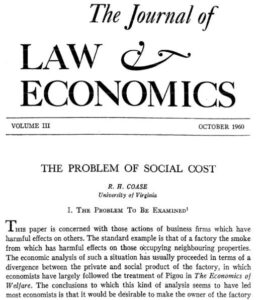
The Problem of Social Cost, by R. H. Coase: I heard about this paper months ago, or maybe years. I read it because it came up in the Cato Institute podcast I wrote about in Libertarians confused on pollution, sacrificing their core values. At the root: lack of hands-on practical experience.
I believe I see Coase’s starting point that conflicts don’t necessarily mean one person harming the other so the person harming is wrong. Conflicts can go in both directions. The two or more sides can negotiate resolving the conflict.
Still, I read the paper for seeing how it applies to pollution. I think this paper misunderstands pollution, maybe because it’s from 1960 and people didn’t have the experience with pollution we do. This paper treats it as something that can be compensated for. It doesn’t treat cases that money can’t resolve, like someone being born with birth defects or hundreds of millions of people made homeless when coastlines move inward from sea levels rising.
Coase also seems to want to prioritize economics over politics and law.
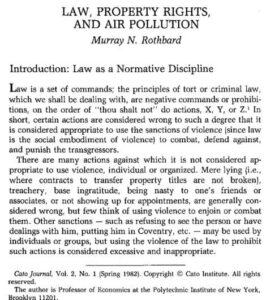
Law, Property Rights, and Air Pollution, by Murray Rothbard: I read this paper also because the podcast in the episode I linked to above referred to it. Again, I think this paper, from 1982, misunderstands pollution similarly, as if its harms can be rectified by compensation or punishment. Some can, but the ones that can’t are the big ones, such as those that could end society or cause hundreds of millions of home to be lost, along with the ability to rebuild them, and situations like Cancer Alley or PFAS.
It builds up a whole legal groundwork with which to frame pollution (referring to Coase, the author above), but I don’t think the framing works. The podcast I linked to also found fault with it, which I agree with: loosely speaking the difference between visible and invisible, among other criteria, don’t work. He starts libertarian but becomes consequentialist or utilitarian.
I don’t find this paper relevant today, though I’m glad to have read original libertarian writing.