
This week there wasn’t much sun, so I read and listened more than usual since they take little to no power. I finished:
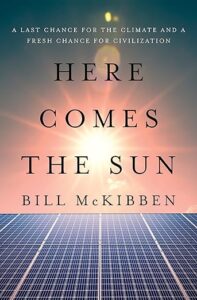
Here Comes the Sun: A Last Chance for the Climate and a Fresh Chance for Civilization, by Bill McKibben: I’ve met Bill and support his environmental work. Bill writes in this book that he doesn’t believe people will change their levels of consumption so concludes that only by producing more clean, green, renewable energy can we avoid catastrophe.
For the rest of the book he relays his optimism that solar and wind can replace fossil fuels and save us. We only need big government support for renewables, he conveys, and to stop supporting fossil fuels.
I’ve written many times in this blog that solar and wind are not “clean,” “green,” or “renewable.” Well, except in a few cases:
- Plants photosynthesizing
- Sailing
- Windmills like Don Quixote fought
- Warming things like yourself from being in sunlight
I’ve switched to solar, but only after reducing my pollution and depletion, which came after restoring values that result in stewardship. I’ve concluded you have to change values before implementing new tools or the tools will accelerate the course culture is already on. That is, our current culture, with extra solar and wind won’t reduce polluting and depleting. It will accelerate it. By contrast, if we restore lost values to prevent us from hurting each other, even when our impact is mediated by the environment, we’ll keep innovating, but those innovations will help.
I enjoyed the book but my research shows that first you have to change values, then, as a part of restoring liberty, freedom, equality, and democracy, which require protecting life, liberty, and property, reducing pollution and depletion to zero, switch to solar and wind.
Sorry, what I wrote above is incomplete, but the book I’m finishing writing now covers what I would say in more detail. I hope you don’t mind waiting a bit for a thorough and I hope engaging, exciting, liberating explanation.
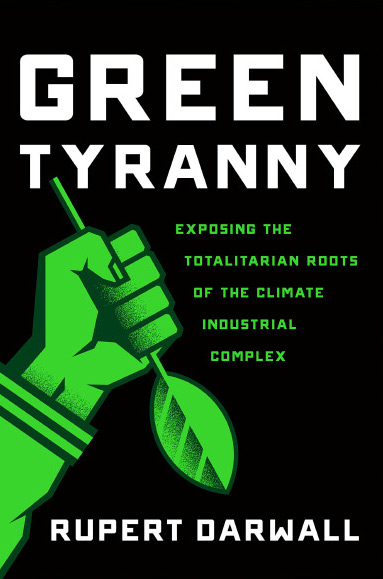
Green Tyranny: Exposing the Totalitarian Roots of the Climate Industrial Complex, by Rupert Darwall: I’m always glad to see the names of people I know in a book. Mark Mills has been a guest on the podcast several times and we’ve spoken beyond the recordings. He appears in the book several times for his research.
The book opens by saying it’s about freedom, a value I share. Darwall leans heavily on describing big-government strategies and tactics of what he calls the Climate Industrial Complex. He traces them to Nazis. He points out that they promoted wind power. It looks like he’s trying to make people who believe in global warming guilty by association.
He recounts how their work was followed up by Greens and their allies in Germany and especially Sweden, which he describes as socialist, promoting centralized power—that is, tyranny. He describes them as wrong, ignoring science or making it up, often self-dealing for profit, power, or both.
Nearly any science in favor of global warming he dismisses. Any science contrary to it, or suggesting problems with windmills, solar farms, or other proposed solutions, he accepts without question.
I picked up the book as part of my practice of reading things by people I don’t understand or disagree with and I’m glad I read it. To clarify, since environmentalists seem to struggle distinguishing listening to someone from agreeing or supporting them, I didn’t say I agree with or support it. I learned a lot from it, though the history he recounted wasn’t the important part.
People are seriously afraid of overly powerful centralized governments. The strategies of his Climate Industrial Complex are that. There are serious problems with those strategies that undermine them.
I do not conclude what he does, that somehow because of their flaws that fracking improves the situation, but I agree that they are promoting solutions that won’t achieve the goals they want to.
Still, there are huge, gaping, unconscionable flaws in this book. The second to last chapter, Spiral of Silence, suggests that they are silencing dissent, risking effectively overturning freedom of speech. In a world dominated by over eight billion people polluting and depleting, especially through fossil fuels, to suggest the voice of “more fossil fuels please, and shut up about renewables” is at risk of being silenced seems a bizarre attempt to play the victim. I can count on one hand the number of people I’ve heard of whose behavior doesn’t promote more fossil fuel use.
The book mostly corroborates the pattern I’ve seen that when people insult, they’re usually describing themselves. If I granted him everything he says in the book, and frankly I agree that environmentalists ignore plenty of science and promote totalitarian antidemocratic plans that I don’t see working, still, everything he says applies much more to polluters and depleters. They grow government more, they corrupt it, push for more centralized authority, motivate people to create global government, self-deal, ignore science, and so on.
I would love to see him apply his passion and thoroughness to the equivalent book about fossil fuel and uranium industries: a Fossil Fuel Tyranny. I doubt he would, but I think the result would be significantly more condemning. I’d love to read that book if he wrote it.
I wonder if I should invite him to my podcast. Some listeners objected to bringing Mills on, not liking policies he promoted. I don’t agree that since there are problems with solar and wind that we should use fossil fuels (they often say hydrocarbons) since I know both undermine liberty, freedom, equality, and democracy, as my upcoming book covers. Still, I find talking to people of many views essential for my work.
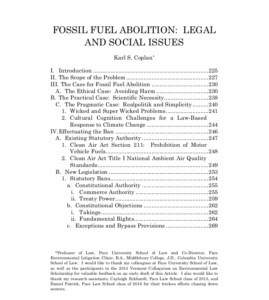
“Fossil Fuel Abolition: Legal and Social Issues“, in the Columbia Journal of Environmental Law, by Karl S. Coplan: I met a professor and dean at Pace University who pointed out that Pace’s environmental law school ranks near the top in the field. He sent me this piece 2016 piece by a professor in that school.
Years ago I approached sustainability like this piece: we have to protect the environment and government action seemed the most effective way. I’ve come to see protecting the environment important but, as important as it is, a distraction from solving the problem causing the environmental issues. That problem is our behavior that causes those results.
Like nearly all environmentalism I know of, this paper misses the strategy I see as necessary: that polluting and depleting deprive people of life, liberty, and property, violate consent of the governed, and do other things that US founding documents already require.
He writes about ethics and tries to connect environmentalism with movements based in civil disobedience, but I don’t see those strategies working.
One big plus: he clarifies the problem of environmentalists not living the values they promote. I only read the free preview online and some of his blog, but he wrote a book on living with a small carbon footprint. He still connects it with saving the planet as opposed to not hurting people, but you can tell he learned from hands-on practical experience.
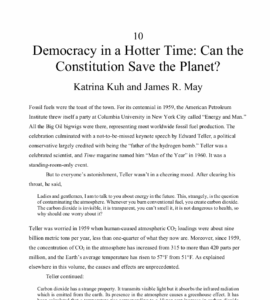
“Can the Constitution Save the Planet?“, chapter in Democracy in a Hotter Time: Climate Change and Democratic Transformation, by Katrina Kuh and James R. May: Another paper from another Pace professor in environmental law, or rather a chapter from a book
This chapter laments what it sees as fundamental, structural challenges from the US Constitution in protecting the environment. As I wrote, if you frame the challenge as protecting the environment, you miss that people are hurting people.
I’m so deep into my new book that I have to ask your patience again for it to come out for a thorough treatment of my approach to the Constitution versus pollution and depletion.
You will find the wait worth it.
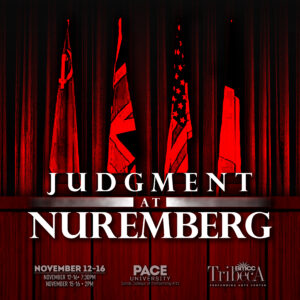
Judgment at Nuremberg, by Pace University at the Tribeca Performing Arts Center: I told myself recently to look for chances to watch more community theater to support local art, which I expect will lead me to participate more in local art and community. I also expect it to decrease my time in front of screens or on headphones.
I avoid social media and sites that update faster than daily. I also avoid times where I don’t know what to expect but hope to find something as opposed to looking up something specific. Nonetheless, with the books and podcasts I listen to and movies I get from the library, I still spend a lot of time on screens and listening to headphones. These activities still isolate.
Then, at the library, browsing a local newspaper, I saw a listing for a local stage production of Judgment and Nuremberg. I had just watched the movie for the first time this year, recommended by a friend. I put a screen shot of the digital copy of the listing below, which I’m glad I found even though it spelled Nuremberg with two u’s instead of two e’s.
I didn’t know until I arrived, but the play was produced by students at Pace University. Talk about coincidence, given my being introduced to Pace’s environmental law school that I mentioned above. I only know it was being shown at a place called the Tribeca Performing Arts Center, which is a 35-minute walk.
I’m glad I went. The play reminded me of the movie. In person felt more dynamic. Since watching the movie, I’ve learned more about the process of people being induced to act against their values by society. Seeing something a second time, knowing the characters and situations more enabled me to pick up on more subtleties.
Being in person also meant interacting with people. The production was two-and-a-half hours, with an intermission. During the intermission, I spoke to the people sitting behind me. They were the mother and sister of the actress playing Frau Bertholt. We got to speak about acting, drama, and subtlety.
I’m not sure if the director asked for it, since it was so consistent, but nearly all the actors played their characters as angry. I think it was immaturity in the actors, though. I had to try to imagine the characters being more nuanced, but I’m not complaining. I loved attending and plan to participate in more community theater and arts.
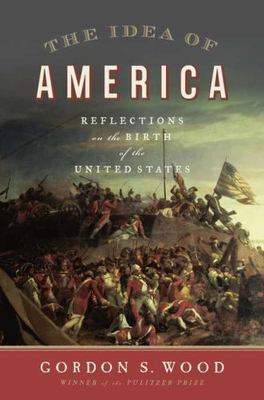
The Idea of America: Reflections on the Birth of the United States, by Gordon Wood: I’m surprised I finished this book this week, with all of the above. Actually, I think I finished Here Comes the Sun last week.
I came to Gordon Wood through Akhil Amar praising his work so much. I found Wood’s Radicalism of the American Revolution more accessible. This one was a series of essays that felt targeted to historians. Some of its ideas appeared in Radicalism.
I don’t have to say that Wood’s understanding of the revolutionary period and all history related to it is encyclopedic. He approaches it in many ways, many of which I bet few to no one thought of before, and many enlightening. I learned a lot. I came to it partly to learn, but mainly to learn relevant things for my upcoming book.
I learned more than I expected. My understanding of the revolution is transforming from knowing key events and people to learning more complexity, depth, nuance, conflict, and process. The revolutionaries were real people facing real challenges. They had a lot to fall back on, like ideas from Locke and Montesquieu, but were also in uncharted territory. Their risked their lives.
Probably my biggest lesson is how much the American Revolution differed from others. It didn’t involve the oppressed overcoming those oppressing them. They acted more on principle.
Wood doesn’t account for material conditions as much as I would, though he knows more than I do about the period. For example, the king controlled a dominance hierarchy, which meant he controlled necessary resources without alternative. Arable land was a big one, the main source of energy (genuinely sustainable solar). In Europe (and Asia and Africa), nearly all the arable land was blocked off, and controlled, plus a state built to enforce and extend that control.
In North America, a huge amount of arable land lay to the west. Also, wood (stored solar power, also genuinely sustainable for a population in balance) was a resource mostly necessary and controlled but dwindling in Europe but plentiful in North America.
These material differences contributed to the cultural change that I don’t see Wood crediting enough. I think he sees people’s dispositions and characters creating change that I see resulting more from their situations.
Also, he credits European Enlightenment thinkers for many of their ideas that differed from monarchy, but I think didn’t credit Native American contribution enough, which is to say, at all. On a book talk online, he mentioned that the ideas that founders implemented that others have credited to influence from Native Americans were implemented before they heard of them from Native Americans. To clarify, one example is what Benjamin Franklin promoted in 1754 in the Albany Plan. Wood says that colonists were already doing those things. Maybe, but Native Americans had influenced colonists before Franklin. Also, the Europeans who influenced the colonists could have been influenced by Native Americans.
There wasn’t much democracy or republicanism practiced in Europe before 1492. It seems more than plausible that Native American practice influenced the Enlightenment. There’s plenty of evidence for it.
Anyway, I value learning more details of the founding of the nation of my birth and home. I wish I learned more of it earlier, though I’m glad I learned as much physics as I did too.
This Post Has 0 Comments