
Peter Singer
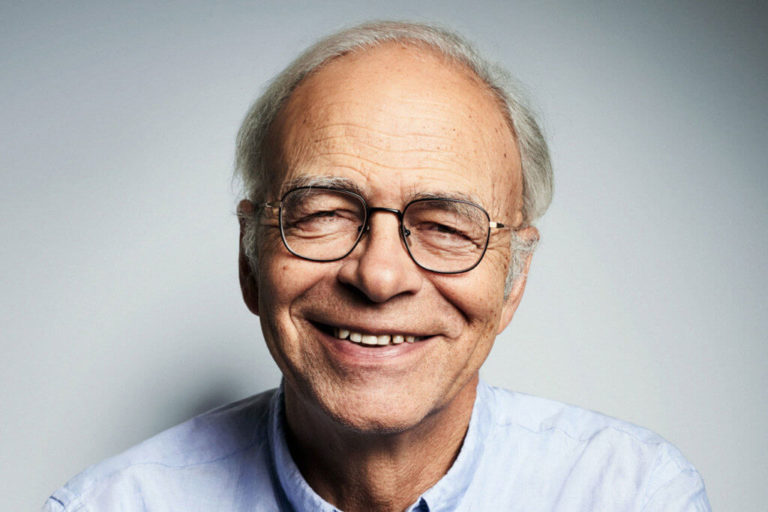
From Peter’s About page:
Journalists have bestowed on me the tag of “world’s most influential living philosopher.” They are probably thinking of my work on the ethics of our treatment of animals, often credited with starting the modern animal rights movement, and of the influence that my writing has had on development of effective altruism. I am also known for my controversial critique of the sanctity of life ethics in bioethics.
In 2021 I was delighted to receive the Berggruen Prize for Philosophy and Culture. The citation referred to my “widely influential and intellectually rigorous work in reinvigorating utilitarianism as part of academic philosophy and as a force for change in the world.” The prize comes with $1 million which, in accordance with views I have been defending for many years, I am donating to the most effective organizations working to assist people in extreme poverty and to reduce the suffering of animals in factory farms.
Several key figures in the animal movement have said that my book Animal Liberation, first published in 1975, led them to get involved in the struggle to reduce the vast amount of suffering we inflict on animals. To that end, I co-founded the Australian Federation of Animal Societies, now Animals Australia, the country’s largest and most effective animal organization. My wife, Renata, and I stopped eating meat in 1971.
I am the founder of The Life You Can Save, an organization based on my book of the same name. It aims to spread my ideas about why we should be doing much more to improve the lives of people living in extreme poverty, and how we can best do this. You can view my TED talk on this topic here.
My writings in this area include: the 1972 essay “Famine, Affluence, and Morality” in which I argue for donating to help the global poor; and two books that make the case for effective giving, The Life You Can Save (2009) and The Most Good You Can Do (2015).
I have written, co-authored, edited or co-edited more than 50 books, including Practical Ethics, The Expanding Circle, Rethinking Life and Death, One World, The Ethics of What We Eat (with Jim Mason) and The Point of View of the Universe (with Katarzyna de Lazari-Radek. My writings have appeared in more than 25 languages.
I was born in Melbourne, Australia, in 1946, and educated at the University of Melbourne and the University of Oxford. After teaching in England, the United States, and Australia, in 1999 I became Ira W. DeCamp Professor of Bioethics in the University Center for Human Values at Princeton University. I am now only teaching at Princeton for the Fall semester. I spend part of each year doing research and writing in Melbourne, so that Renata and I can spend time with our three daughters and four grandchildren. We also enjoy hiking, and I surf.
758: Peter Singer, part 2: A philosopher approaches sustainability
I started by sharing my experience giving after reading Peter’s book The Life You Can Save. I confess I only read it after our first conversation, but loved it. I feared reading a book by an academic philosopher arguing a point would be dry and boring. Instead it led me to donate to causes. Then, even though I didn’t donate for recognition or personal benefit, the organizations I donated to contacted me with gratitude, connected to me, and one even invited me to its annual dinner.
Then we talk more about flying, following up our last conversation. From Peter’s perspective, I view flying too black-and-white, not considering someone’s reason for flying or what benefit it might provide. I don’t challenge that perspective. I’m just looking to learn from my guest. My book treats that perspective.
Then I share my new take on his drowning child analogy as it relates to sustainability.
Other topics too, but we close with our mutual appreciation for calm conversation and democracy, both lacking these days.
702: Peter Singer, part 1: Calm, reflective talk considering not flying
With Peter Singer, I could have picked several topics relevant to sustainability leadership: veganism, vegetarianism, and charity come to mind, as does my post about him six months ago, Fixing Peter Singer’s drowning child analogy for sustainability. The day before recording, I saw him speak live and asked during the question-and-answer period at the end about not flying.
He answered thoughtfully and reflectively, not with the usual reactivity and emotional intensity most people do, protecting their feelings of guilt and shame, as I see them (I wrote The reason you feel judged isn’t because environmentalists are judging you. It’s because you have a conscience.) Several audience members told me they appreciated my asking the question. So when we spoke after he finished his stage performance, I asked if he’d mind following up the question in our podcast conversation.
So we spoke in more depth about flying versus not flying. I think I can safely say we both learned from each other, though I think he hasn’t spoken with many people who have stopped flying to gain from their experience.
Coincidentally, his talk on stage was fireside chat-style with podcast guest AJ Jacobs. Small world. If you like intelligent, thoughtful conversation, check out Think Inc., the company that organized the talk. They host events with many speakers who are peers.