
This week’s selected media, December 28, 2025: On Tyranny, White House Effect, Two Lomborg articles

December 28, 2025 by Joshua
in Tips

This week I finished:

As of today, Sunday, my usual day to post on what I finished this week, my solar battery is very low (as I posted yesterday: And just like that, I’m almost out of power for a couple days. Batteries have a lot of problems), so I’m limiting my time using the computer. For now, I’ll just post the works. When there’s more sun, I’ll write more. As of Sunday evening, that time looks like Tuesday at the earliest.
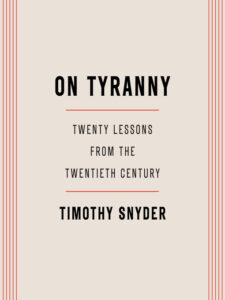
On Tyranny, by Timothy Snyder: I’ve seen this book near check-out registers of book stores for years. I keep leafing through it because it’s so short. I finally got it from the library.

I finished it twice. The first time I found it academic and didn’t see what to do, practically. It stuck with me, prompting thoughts, though.

Snyder’s background is in tyranny in Europe, including leading up to World War II, through to the Iron Curtain, and to today’s decline of freedom. Some of his advice, like to connect with neighbors, sounded abstract at first. On reflection, I realized how practical it was. He was describing how the experience of the decline of freedom feels. It sounds like it can feel almost seductive. That’s how corruption feels.

It still feels abstract and academic, but insightful and more practical on reflection than on first reading.

The White House Effect, directed by Pedro Kos, Jon Shenk and Bonni Cohen: This documentary shows how George H. W. Bush changed from claiming to value sustainability and wanting to work on it to becoming a stooge for fossil fuel interests.

It makes his environmental advocate look ineffective and his chief of staff, John Sununu, look conniving and effective.

It paints Exxon and its peers as the main bad guys. They learned the global-warming consequences of their products but avoided acting on them in favor of profits.

Yet it said nothing about the people buying their products—that is, every single American. Once the consequences were on the front page of the New York Times, everyone knew too. We all kept acting, as if we didn’t know. We did.

The movie is compelling and engaging. I wouldn’t say skip it, but I didn’t learn much from it, except that environmentalists point fingers more than take responsibility.

To be clear, Exxon and its peers knew. Government officials knew. They all allowed themselves to be corrupted, then acted on that corruption. I don’t think the people making this movie targeted that audience. I think they targeted environmentalists seeking outrage. Those environmentalists could be motivated to take responsibility to act where they can over blaming others. Taking responsibility doesn’t mean others aren’t responsible. One the contrary, it gives you the integrity and credibility to lead them, not just blame them for what you are doing too: funding pollution and depletion.

A Vindication of Bjorn Lomborg, by Marian Tupy inQuillette and Climate Change Might Have Spared America From Hurricanes, by Bjorn Lomborg in the Wall Street Journal:

I recently wrote about a plot by Bjorn Lomborg. I also read Tupy’s book Superabundance and mentioned it in mine, Sustainability Simplified. I found these articles before, but both were behind paywalls. I also joined Lomborg’s newsletter. His year-end newsletter’s links bypassed the paywalls, so I got to read them this week. The links above are his, that bypass the paywall.

Environmentalists paint Lomborg as a stooge for fossil fuel interests, a fool, ignorant, or maybe just valuing profit over people and the planet. He’s none of those things. As best I can tell, he genuinely wants to help people and the environment. He’s intelligent and does his research.

That said, I think he’s misguided. He keeps looking at irrelevant data, such as how many people have died from heat or cold and number of hurricanes. He focuses on climate to the near (though not complete) exclusion of many other ways people are hurting other people through behavior mediated through the environment.

His approach is academic and economic, but as far as I can tell, he misses that when a government doesn’t protect people’s life, liberty, and property, we obtain a coercive market, not a free one. Nearly all governments go beyond not protecting life, liberty, and property, they gain revenue, power, and size from it.

The result: the mechanisms he supports, like research and carbon taxes, miss the main problem: that polluting and depleting move governments away from liberty, freedom, equality, democracy, and national security. Growing the GDP under these conditions grows tyranny and exacerbates dominance hierarchies. The innovation he envisions will repeat what Eli Whitney’s cotton gin and James Watt’s steam engine did: they will accelerate our existing results.

I love market mechanisms, research, and some other of his proposals only after restoring liberty, freedom, equality, democracy, and national security, which requires ending pollution and depletion (at least Type 2, which I explain in my upcoming book) as surely as it required ending slavery.

Lincoln learned after generations of Americans trying to balance or compromise that a nation can have freedom or slavery, not both. Likewise, we can have freedom or pollution and depletion, not both.

Like slaveholders and people living in a slave culture, we can’t imagine preferring a world without our vice. Like them, we’re wrong.

Decade of Fire, directed by Vivian Vazquez Irizarry: I suspect most New Yorkers know the phrase “the Bronx is burning” or something like it. I hope most Americans know of the difficult times the Bronx faced, as part of a nationwide problem in cities, in the 1970s especially, but into the 80s with crack, and continuing today.

Not everyone knows the causes. It’s tempting to blame racism, either that people of color in the areas or white people setting the rules, as the cause, but there is no scientific basis for race.

This movie does two things. It reveals the rules:

  1. Redlining, which trapped people of color in small regions
  2. Creating suburbs with restrictive clauses based on skin color, which gave whites a place to escape
  3. Creating highways into cities, which facilitated that escape and wreck the areas they went through, such as the Cross Bronx Expressway through the Bronx, the first highway into an inner city
  4. Setting up an insurance system that financially rewarded arson
  5. Media that blamed the people there for the effects of the greater forces buffeting them

Next, it personalized the experience. Irizarry lived through the experience. She recounts and illustrates her story, along with family members, neighbors, and footage.

The combination gives gravity and emotion. I’d already read The Color of Law and brought its author, Richard Rothstein, to the podcast, along with his daughter. They cowrote the follow-up book. I lived in a redlined neighborhood in Philadelphia growing up. This movie expanded my understanding and compassion for a situation still plaguing many cities in this nation.

The movie isn’t just history. It also recounts how now that cities are revitalizing, similar forces that created ways to profit in wrecking them are now finding ways to profit in displacing people to redevelop them. It’s despicable, fed by ignorance.

Here’s the movie online: (here’s the Roger Ebert review)

Read my weekly newsletter

On initiative, leadership, the environment, and burpees

We won't send you spam. Unsubscribe at any time. Powered by Kit

Leave a Reply

Your email address will not be published. Required fields are marked *

Sign up for my weekly newsletter