
This week I finished:
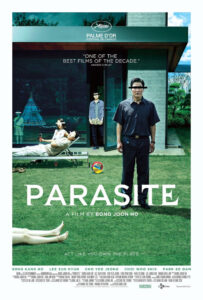
Parasite, directed by Bong Joon-ho: I had heard people and critics liked this movie. I hadn’t heard much detail about it. The title didn’t sound appealing.
While watching it, I didn’t find it credible. Too many suspensions of disbelief caused me to pop out of being lost in the story to saying, “Okay, that part wasn’t believable, but let’s imagine it was and go with it” or “Is the movie trying to be believable or maybe commenting on other movies, because it’s too far removed from life.”
At the end, I felt I understood what it was about, but didn’t think much of it. It reminded me of the Christopher Nolan Batman movies the second times I watched them. The first time, I was caught up in the movies. The second time, I kept seeing how the movie both tried to make details work and be consistent, which I liked about Inception and Memento, but too many things were impossible even for a human at peak potential with maximum motivation and billionaire resources, which I thought Nolan was trying to show that Bruce Wayne was. He created a device that used all cell phones to create a sonar of everywhere by himself? He created a fiery bat signal as part of preparing to take back the island?
In Parasite, too many parts were too over the top, but not intentionally. When she sat on the toilet smoking the cigarette while the toilet was slopping up sewage, then she was back at work? How was the guy in the basement supposed to know when someone was walking up the stairs?
But the biggest problem, which wrecked everything, was that this family that worked together and figured out how to get jobs at this other house, all totally productively and synchronized, indulged in totally unproductively getting drunk and throwing stuff around the house that was their best way up. All the later problems stemmed from this act which was out of character for all of them. If not for this indulgence, the other housekeeper and husband wouldn’t have become enemies, they wouldn’t have lost as much of their own home, they wouldn’t have had that long walk home and had to struggle at the party.
You might be tempted to say their not knowing better resulted from their class limitations, but in the movie they’re able to make everything else work when they needed to. It was just poor scripting.
Still, there was a greater message of mutual dependence and classes being stuck where they were misunderstanding, divided against shared interests, etc. I didn’t find the movie showed anything new or interesting. It didn’t seek or explain causes for the problems. I didn’t see it showing an interesting or compelling story about it because the central characters kept behaving inconsistently and outside the movie’s reality. Also, I thought the staircase/up/down/underground illustration was interesting until it stopped being subtle. Likewise with the smell and food differences. I like being lectured about things I don’t know. I don’t like being lectured about things I know, that everyone knows, and that everyone knows that everyone knows.
After watching it, I looked up a bunch of reviews, criticisms, and essays. They all praised the movie as one of the greats of the year, some of the decade, some of all time. Since I just watched Brighter Summer Day after The Wrestler, On the Waterfront, and Yi Yi, plus I’ve meant to watch again Grand Illusion, I’m prepped to find life-changing or best-ever movies. The language of the reviews, criticisms, and essays on Parasite matched the tone of descriptions of these other movies, but it wasn’t close.
I read and watched many reviews, criticisms, and essays because I hoped to find something I missed, but I didn’t. I got the movie. It was just okay. It wasn’t insightful or deep.
As a side note, several places commented on its being the to win an Oscar in I forget exactly the qualification since it’s not the first foreign-language, but something implying diversity. Maybe that’s nice for the Academy, but I think they were implying something positive about diversity, as usual using skin color or ethnicity as a measure. As a Korean movie, all the characters were of one skin color and ethnicity. The most diversity it showed was pizzas, but they aren’t Italian anymore as much as bland homogenization of global culture. Where were the criticisms of what in the US in the past would be a movie with only white people (which has in the past for decades, especially among the cultural elite)?
This Post Has 0 Comments