This week’s selected media, October 19, 2025: The Radicalism of the American Revolution, The Wave (1981), Die Welle (2008), Lithium Extraction and “Green Capitalism,” Anything You Want, Hell Yeah or No
This week I finished:
The Radicalism of the American Revolution, by Gordon Wood: Wow, what a book. I’d never read a history like it. It didn’t just present dates and events. It talked about how people lived, how their lives changed, how culture changed.
I found it fascinating. I learned plenty, including areas I thought I knew well before. His perspective put me more in the moment, understanding changes from their perspective.
The book contrasts with Howard Zinn’s history of America. Wood’s coverage seems as comprehensive and he seems as thoughtful, but he paints a very different picture. Wood loves America, though not blindly.
His description of life in the colonies and how things worked before the revolution reveals how it differed from any other. There wasn’t poverty, hyperinflation, or violent repression. People wanted more liberty. Then after the revolution, democracy differed from what the revolutionaries expected.
One thing he missed: most of the material conditions leading to the change. In America, people had a greater freedom to walk away than anyone in Europe. Wood got that people could pack up and start a new life, but didn’t translate it into freedom from domination due to a necessary resource under someone else’s control.
This passage from chapter one, on monarchy, shows what he missed. When he writes that “The inequalities of such a hierarchy were acceptable” he misses that nobody chooses to live at the bottom of a dominance hierarchy. People didn’t collectively agree to live in a monarchy. They were born into a hierarchy based on control of those resources. One of the big ones then, before fossil fuels, was arable land. North America had plenty, which contributed to the decrease of dominance. So did the distance from the king and his troops.
“They may not have known much of real kings and courts, but they knew very well the social hierarchy that the subjection and subordination of monarchy necessarily implied. Monarch presumed what Hum called ‘a long train of dependence,’ a graduation of degrees of freedom and servility that linked everyone from the king at the top down to the bonded laborers and black slaves at the bottom. The inequalities of such a hierarchy were acceptable to people because they were offset by the great emotional satisfactions of living in a society in which everyone, even the lowliest servant, counted for something.”
The Wave, about Ron Jones: I saw this after-school special as a kid when it came out in 1981. You can watch it on YouTube. First read Ron Jones’s account of the story, which he wrote before this video. Here’s Wikipedia on the 1967 event:
The Third Wave was an experimental movement created by the high school history teacher Ron Jones in 1967 to explain how the German population could have accepted the actions of the Nazi regime during the rise of the Third Reich and the Second World War.[1][2][3][4][5]
While Jones taught his students about Nazi Germany during his senior level Contemporary World History class, Jones found it difficult to explain how the German people could have accepted the actions of the Nazis. He decided to create a fictional social movement as a demonstration of the appeal of fascism. Over the course of five days (or nine, according to student Sherry Toulsey), Jones – a member of the Students for a Democratic Society (SDS),[6] Cubberley United Student Movement sponsor[7] and Black Panthers supporter[8] – conducted a series of exercises in his classroom emphasizing discipline and community, intended to model certain characteristics of the Nazi movement.
As the movement grew outside his class and began to number in the hundreds, the experiment had spiralled out of control. He convinced the students to attend a rally where he claimed that the classroom project was part of a nationwide movement and that the announcement of a Third Wave presidential candidate would be televised. Upon their arrival, the students were presented with a blank channel. Jones told his students of the true nature of the movement as an experiment in fascism, and he presented to them a short film discussing the actions of Nazi Germany.[9]
The project was adapted into an American film, The Wave, in 1981, and a critically acclaimed German film, Die Welle, in 2008.
Die Welle (The Wave), directed by Dennis Gansel: This 2008 movie tells a version of the 1967 high school experiment but happening in Germany in the present day.
I didn’t mean to watch the whole movie right away, but I couldn’t stop watching for what I figure must have been the bravery to broach the topic in Germany. It could have gone wrong in many ways.
I’m learning about the experiment as part of my new book, which explores how people become corrupted. Again, click the link above for Ron Jones’s account. It’s a few pages and fascinating. His impromptu experiment, plus the Stanford Prison Experiment, the Milgram obedience to authority experiments, Arendt’s Eichmann in Jerusalem, and the Nuremberg trials with their “just following orders” defense changed our understanding of how humans become corrupted and how much.
I hope its relevance to today, where we are collectively hurting far more people every year than the Holocaust did in several, is obvious. The kids in these two stories aren’t trying to violate their values. They’re enjoying being human in groups that make them feel great and perform great. We aren’t trying to undermine liberty, freedom, equality, and democracy. We’re just ordering takeout and vacationing abroad. But we know we’re killing people, or at least that we’re depriving them of life, liberty, and property.
Lithium Extraction and “Green Capitalism,” by Thea Riofrancos in the New York Review of Books: I only read the extract, but downloaded a bunch of videos of presentations by the author. A couple quotes:
“Green capitalism does not mean that capitalism is becoming ecologically sustainable. Instead it refers to the emergence of new economic sectors and supply chains labeled as “green” because of their potential—proven or unproven—to help address the climate crisis, whether by decarbonization or adaptation. It likewise refers to a worldview. Promoters of green capitalism, from EV executives to mainstream policy wonks, see profit-maximizing firms and business-friendly governments as the main protagonists in the drama of the energy transition. Market-driven innovation, they insist, can save the planet without major changes in how our economy works.”
To call our culture “green” is wishful thinking and marketing to promote continuing to do what got us here.
“Today it almost seems like history is running in reverse. Neither policymakers nor downstream firms trust those bywords of globalization, “free trade” and “open markets,” to ensure reliable access to lithium battery supply chains. Instead world powers like China, the US, and the European Union are actively encouraging lithium mining to take place within their borders. When I traveled to Brussels in late 2019, I learned that European policymakers aspired to “self-sufficiency” in critical minerals—a bold, perhaps unachievable goal for a continent that currently depends almost entirely on metals imported from abroad.”
To understand our situation requires understanding control over necessary resources with no alternative. As long as they exist, it’s tempting to call markets without price controls and other regulation free, but that view misses at least two big factors.
First, necessary resources that can be controlled with no alternatives lead to dominance hierarchies, which lead to coercion and violating consent of the governed, so goodbye free market.
Second, bringing these resources from outside the biosphere to into it deplete and pollute, so they deprive people of life, liberty, and property, if not outright destroy them. Goodbye liberty, freedom, equality, and democracy.
We could overlook these problems as long as the levels of pollution were low enough not to kill people in the moment, or the reservoirs we were depleting weren’t close to empty, but we crossed those thresholds decades ago.
Anything You Want and Hell Yeah or No, by podcast guest Derek Sivers: Derek emailed his list that he was making his five books free for a week. I like his message so he didn’t have to tell me twice. I got all five audio books. So far I finished two:
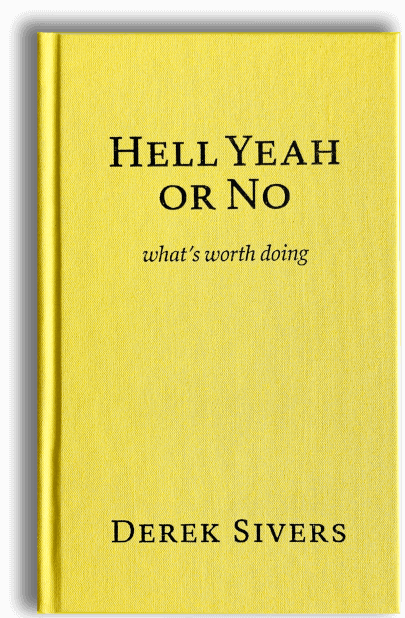
Our conversation on my podcast led to a big new understanding for me of my role. He clarified that he was less a leader than an explorer. The roles overlap, but differ. It helped me see my role as explorer of new territory too, complementing my leadership role.
The books remind me of a different time of my life. They’re words for people early in their careers from someone who succeeded at that stage while bucking some mainstream advice. He favors self-awareness, staying true to yourself, and service to others.
Read my weekly newsletter

On initiative, leadership, the environment, and burpees
Pingback: Movies that spoil me for other movies » Joshua Spodek
Pingback: This week’s selected media, November 16, 2025: Here Comes the Sun, Green Tyranny, Fossil Fuel Abolition, Democracy in a Hotter Time, Judgment at Nuremberg, The Idea of America » Joshua Spodek
Pingback: My favorite books and movies of 2025 » Joshua Spodek