
I enjoyed reading Bill McKibben’s latest book Here Comes the Sun. I found much of it well researched. Still, I don’t think it made clear what I consider its starting point. Before you read the critical stuff I start with about the book, I end on a high note.
I’ve written many times how tools like technology, market incentives, and legislation aren’t good or bad. They implement and augment the values of the people and culture wielding them. As long as our culture rewards behaviors that pollute and deplete, it will bend the use of any tool to accelerate itself. Whatever your intent with, say, solar panels, if you don’t change culture, however much solar panels decrease emissions in one area, overall, they will enable and empower (no pun intended) culture to achieve what it already is more and faster, including polluting and depleting.
Big historical examples include Eli Whitney’s cotton gin, designed to decrease labor needs but which accelerated slavery’s growth, and James Watt’s steam engine, which produced power from coal more efficient but led to more coal use. Artificial intelligence is leading companies like Microsoft and Google, which probably were sincere when they pledged to reduce emissions, to pollute and deplete faster than ever and abandon their pledges.
The good news is that if you change culture, you’ll get different results, which we can. I have personally, as have alumni of my workshop, calling it “What I’ve been looking for my entire life.”
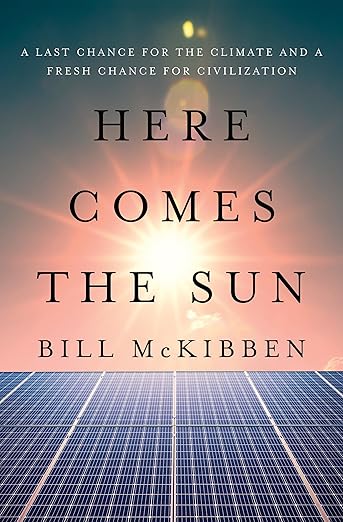
McKibben goes in the opposite direction. As I read this book, he capitulates on the idea of changing culture. On page 20 he wrote, “The history of the Industrial Revolution convinces me that we won’t make that goal of cutting our use of energy in half—I doubt that we will, at least in significant numbers, change our behavior speedily enough to matter.“
Changing culture requires leadership, I believe, plus role models, as abolitionism had in Thomas Clarkson and William Wilberforce, among others. To say, “I doubt that we will, at least in significant numbers, change our behavior speedily enough to matter” is close to the opposite of leadership. Imagine Eisenhower before D-Day saying “I doubt this invasion will work enough to matter.” Imagine FDR saying during the depression instead of that the only thing we have to fear is fear itself, “I fear we won’t get out of this situation.”
He said similarly on page 52, “People simply do not change their desires that fast.”
I can’t tell you how glad I am to have left today’s American culture to restore our Constitution’s statement that “No person shall … be deprived of life, liberty, and property without due process of law” and Our Deepest Values: “Do, Leave, Live, Love”:
- Do unto others as you would have them do unto you.
- Live and Let Live.
- Leave it better than you found it.
- Love your neighbor as yourself.
Imagine Lincoln approached slavery believing abolition was impossible
Lincoln expressed the opposite of McKibben about slavery. The thirteenth amendment ended it immediately, ending generations of people promoting cockamamie schemes like only freeing slaves when a plan could be made to colonize Liberia with them and Diffusion Theory, which said that expanding slavery over more territory would cause it to diffuse and end.
More trouble: acting like environmentalists and the fossil fuel industry don’t overlap
On page 6, he wrote “The fossil fuel industry has read the numbers too, and so they’ve girded for the fight.”
He refers to the fossil fuel industry as “they,” but on page 15, he wrote “In the fall of 2021, I made my first post-Covid overseas trip, to the global climate conference, which was held that year in Glasgow, Scotland.”
He is funding the fossil fuel industry, its lobbyists, advertisers, executives, and politicians. I’ll bet more of his spending funds increasing fossil fuel extraction than necessities like food or clothing, or near necessities like phone and computer use, especially considering that they all use plenty of fossil fuel.
Before you say individual action doesn’t matter, missing the necessity of leadership, on page 34, he wrote, “In 2015, while all the world’s environmentalists were at the Paris climate talks…” Beyond just him, ‘ll bet more of all environmentalists fund increasing fossil fuel extraction food, clothing, phone, or computer use. When environmentalists refer to fossil fuel interests as different than their own, watch your wallet.
Energy versus electricity versus pollution and depletion
Throughout the book he refers to electricity, especially in the rosy parts when he talks about how much energy solar and wind produce. He doesn’t adequately, in my opinion, distinguish electrical energy from overall energy. He mentions steel manufacture and a few other things that today require fossil fuels. I don’t remember if he mentioned the impossibility of flying without fossil fuels today, with no meaningful hope of alternative, but he did mention flying a fair amount.
So what about all these other polluting, depleting activities he doesn’t treat?
He also doesn’t distinguish between producing energy, polluting, and achieving the value of what the energy and pollution were for without polluting or depleting—for example, living close to your family so you don’t need to fly to them or never buying doof again.
Back to culture
Recapitulating his capitulation on changing culture, he wrote on page 25 that he envisions accelerating our current culture, not changing it: “Sun and wind promise a new flood of electricity. But for that flood to put out the fires of global warming, we have to do more than just put up a lot of panels and turbines. We also have to convert our economy to use all that electricity.”
To clarify, he wants to use more electricity. As long as producing that electricity pollutes and depletes, which harms people without their consent, which means it violates the fifth amendment, the Declaration of Independence’s principle of the consent of the governed, and other founding principles of this nation, and requirements for liberty, freedom, equality, and democracy, he is promoting their opposites.
News you’ll like
A small piece of news I liked was on page 50: “Forty percent of the world’s ship traffic, for instance, consists of moving coal and gas and oil back and forth across the ocean to be burned.” It shows the huge snowballing of savings when we pollute and deplete less.
The big news you’ll like is that humans have changed culture on the scale we need to in the time we have, we’ve loved the change, we wish we’d changed earlier, and essentially no one wants to go back. The big examples are democracy (speaking of the Declaration and Constitution) and abolitionism.
This nation was founded on replacing tyranny with democracy. We made big steps. We have more steps and we’ll do them. As evidence we can, one of those steps was abolitionism.