Success through values, meaning, purpose, importance, and passion
Do you have people you can't avoid that annoy you and want to handle them more effectively? Normally I think of this situation at work, but I'm sure it applies to some people with their families on Thanksgiving. I build on the following two principles and apply them to personal relationships: Great teams are built on strengths. Don't look for blame but take responsibility for improving things to the extent you can. You behave differently in different situations and with different people. So does everyone else. I think of it as everyone having facets -- different faces they show different people. As with a gem, each facet shows more complexity to a person than you could possibly exhaust. Since people keep growing and changing, you…
A reader wrote, after reading a few of my posts about not using Facebook and LinkedIn, yet following up discussions from Reddit here: Josh, I have a silly question that I can not stop thinking about. What is the difference between ReddIt and FB or LinkedIn? For me it sounds like a valid preference. A preference that is similar to preferring CNN in the early 80's over the major networks, or today preferring YouTube and streaming vs old bundled cable TV. There are differences in all the media but the biggest one I see is their position on their development cycle. ReddIt is probably younger more hip and more active than LinkedIn or FB but that's why we have notification settings on our phones and…
Part of this site's new functionality that my awesome web designer is creating (he isn't accepting my linking to him possibly partly from humility, but mostly because his career is taking off beyond web design into other areas and probably can't work much on the web any more) is series, a list of which you can see by clicking on "Blog" in the navigation bar above. Knowing me and how much I extol the benefits of burpees, you had to expect a series on them. Today I created one. Click here to see it. When you view it, you can read multiple posts without jumping from page to page.
Many people make the mistake of thinking that some things they think are beliefs and others are not beliefs but facts. Or that they are just right. For example, if you ask them who they think might be the next President, they might say it could be Hillary Clinton. They'd say that was a belief because they can't prAove who will become the next President. They just have to wait until it happens. If you ask them what one plus one is they'll say two. If you ask them if that's a belief, they'll say no, they don't believe one plus one is two, it's a fact they know. What you believe isn't reality, it's your belief about reality Even if something is objectively true,…
I coached a client recently who felt like she had a lot on her plate. She was trying to figure out plans for the next year, where many decisions depended on each other and she couldn't figure out which to do first. When she explained them to me it seemed clear the order in which she had to do each, but she was swimming in so much information she couldn't figure out where to start. For that matter, each time I suggested the order that made sense to me, she kept talking about all these details of each, how long each would take, the resources each needed, and all these other things she didn't need to think about now, but was, which was holding her…
Most of my posts try to present ways to create more happiness and emotional reward. For once I'll write the opposite, from which one can learn just as much. In the list below the items seem to clearly hurt relationships and your mood. For some reason when people do these things on their own they act like they're acting productively, like when they give people unsolicited advice, they genuinely seem to feel like they're helping others, as much as they push back when others give them unsolicited advice. I think my first tip covers most of the rest that involve relationships with others. The second tip covers most of the rest that involve yourself. You can thank me later for this excellent advice. 1. Impose…
Different people mean different things by the term justice. I think of the term having at least four meanings or purposes. To deter people from committing crimes To punish people who committed crimes To give crime victims a sense of retribution To keep criminals away from society if society expects them to commit crimes again These four purposes don't always work in concert. In any case, the United States seems focused more on retribution and punishment than other places. We put more people in jail than any other country, with the possible exception of North Korea, putting us or them in dubious company, depending on how you look at it. Before anyone jumps on me about North Korean prison camps, I'll remind you of the…
Yesterday I showed two models for introversion and extraversion. The model you believe filters how you see the world, which will influence your feelings and behavior. I found the following test to see if you're introverted "or" extraverted from a book. You can see it's based on an Or model, I believe designed to show empathy for people who consider themselves introverted. From the And model it's almost painful to read in how it reinforces weakness and constraint. I'll translate it in two ways to reveal other ways of looking at it I suspect you'll find empowering or that undercut this one. First the base test. (By the way, I'll be happy to reject the And model if anyone shows me a reason to that…
Here is a common belief for the relationships between introversion and extraversion. I'm going to show how it worsens your life and offer an alternative you will resist and fight against, but if you keep an open mind you'll realize explains your world more effectively and helps you to improve your life. I call it the "Or" model of introversion and extraversion for reasons you'll see below. It says that introverted people have certain properties and abilities, extroverted people have complementary properties and abilities, and you either have one set or the other, but not both. It says some people may lie somewhere in the middle of the axis, having some introverted traits and some extroverted traits, but not the full amount that a pure…
I saw the following essay on the great geek forum Slashdot, a site that a decade ago published a story on the company I co-founded. The site isn't as important as it once was, but it's still big. I don't know the real-world identity of the essay's writer. I presume he or she wrote it quickly, not aiming for accuracy or to withstand heavy criticism, but to get people thinking. I prefer not quoting others at length, but the essay provoked my thought too much not to. If you read it overly critically you'll miss its meaning. The writer plays loosely enough with details that you know not to take them too seriously, but has enough of them to realize there's something meaningful. That is,…
Doing business based on a handshake with someone you share mutual trust and working habits is such a joy. Working relationships like that rank with the best relationships you can have. Trust, as I don't have to tell you, can take years to build but you can lose it in seconds, sometimes impossible to rebuild. Today I'm not going to talk about lessons. Only to commiserate on how awful doing business with people who undermine their credibility -- whom you can't trust. When someone says one thing and does another, it shakes your idea of what people can do. Having to protect yourself costs so much resources -- time, money, energy, relationships, etc -- and decimates your potential emotional and material reward.
I met with a friend I've known over a quarter-century. Like everyone, we're getting older. You can see the younger person you first met in them. You're reminded of your aging too. So I'll share a few thoughts. If you're a younger reader and this doesn't resonate yet, one day it will. First, aging has become my main source of learning acceptance and celebration -- recalling my tenet that anything you can't avoid you can learn to accept and anything you can accept you can celebrate. In this sense I value it because that lesson helps in many areas of life outside just aging and we all age equally, so you don't feel bad for being singled out. You can choose many things about your…
I've noticed this pattern: People who suck at things tell you how awesome they are. People who are awesome at things tell you about the disasters they went through to get their skills. And those stories are usually funny, though you can feel the pain they must have felt when they happened. I think it happens more among geeky types, which I know a lot of and am one, but I see it a lot. People like to show off, at least until they realize the challenges they need to overcome to master something. People who mastered something seem more humble, maybe from the pain of the disasters they went through. It's one of the ways I figure out how good at something someone is.…
Here's how to never look back at your life with regret. Do what you love. Conserve resources as much as you can so you don't get distracted from what you love. Stick with it until you're done. Ignore people who tell you to do something more reasonable. Be confident knowing that if you love it, others will love it too. Not everyone, but enough to form community. Then when you stick with it long enough, you'll end up doing something people love, appreciate, respect, and have never seen before. Now they see you as inspirational. Repeat as often as you like. Some people ask at this point, what if I don't know what I love. For them I offer a step before step 1. Figure…
Wired Magazine recently published a piece by Bill Gates called "Here's My Plan to Improve Our World — And How You Can Help." He wrote 40 percent of Earth's population is alive today because, in 1909, a German chemist named Fritz Haber figured out how to make synthetic ammonia. Another example: Polio cases are down more than 99 percent in the past 25 years, not because the disease is going away on its own but because Albert Sabin and Jonas Salk invented polio vaccines and the world rolled out a massive effort to deliver them. Thanks to inventions like these, life has steadily gotten better. More people living doesn't necessarily mean people living better lives. In a finite world with limits to growth, relaxing one…
Yesterday I wrote about how leadership creates community, which, if you persevere, leads to living freely and by your values and experiencing deep emotional reward. Your life improves by doing so. It creates effects I can only call problems, but they are problems you want to have because they help you learn and grow even more. The "problem" with knowing how to make your dreams come true -- in making your fantasies reality As you develop your skills in leading others and creating the social worlds you want, you learn that your deepest emotional reward comes from your relationships with the people closest to you, including yourself. As a leader, you find yourself surrounded by people you mutually appreciate, respect, love, support, challenge, open up…
Remember when I wrote "You can't "create your world" but you can do better"? I've been meaning to expand on this aspect of leading your community. The more you learn to lead, the more you can make your community how you want it. The more you do so, the more your behavior, thoughts, and beliefs take on two properties. You behave, think, and believe more freely and more by your values. Sounds great, doesn't it? Who doesn't want to live more freely and by their values? Funny that more people don't do it, often scared to start the process. Since we're such social creatures and our communities feel like our social worlds, when we create our social worlds the way we want, it's easy to…
People talk about things being right, wrong, good, or bad as if these properties had absolute or objective standards. They don't and it matters to leaders and anyone else trying to influence someone with different values. If you want to motivate someone you disagree with and you call them wrong or bad, you can bet they don't consider themselves wrong or bad. They consider themselves right and good. Your suggesting otherwise will undermine your credibility with them, no matter how good and right you feel. Without credibility, you lose your ability to motivate them. Today I'd like to undermine the universality some people imagine right, wrong, good, and bad to have beyond being opinion. Opinion is important, but we understand different people have different opinions,…
As part of this page's new functionality, today I introduce its first series: "Communication skills exercises for business and life." Click the link to view the series as a single page where you can jump between posts without losing the page or having to reload it. Posts in that series rank among the most read on this page. If you haven't read them and you want to improve your social skills -- since they improve our lives, who doesn't? -- check out the series.
I've been coaching clients one-on-one for a few years, as readers have noted from my references to clients. I've coached nearly a hundred clients by now, most of whom found me through word of mouth. I added a new coaching page to this site to help people find coaching with me. Why? My clients succeed. That's why I love coaching. You can achieve more too. Because coaching works. I have a coach who helps me Identify my priorities Tell me how I look from an outside perspective (the one person you can't see from another person's perspective is yourself, the one you wish you could see that way most) Hold me accountable to finishing important tasks. I recommend you get one too. If you like…
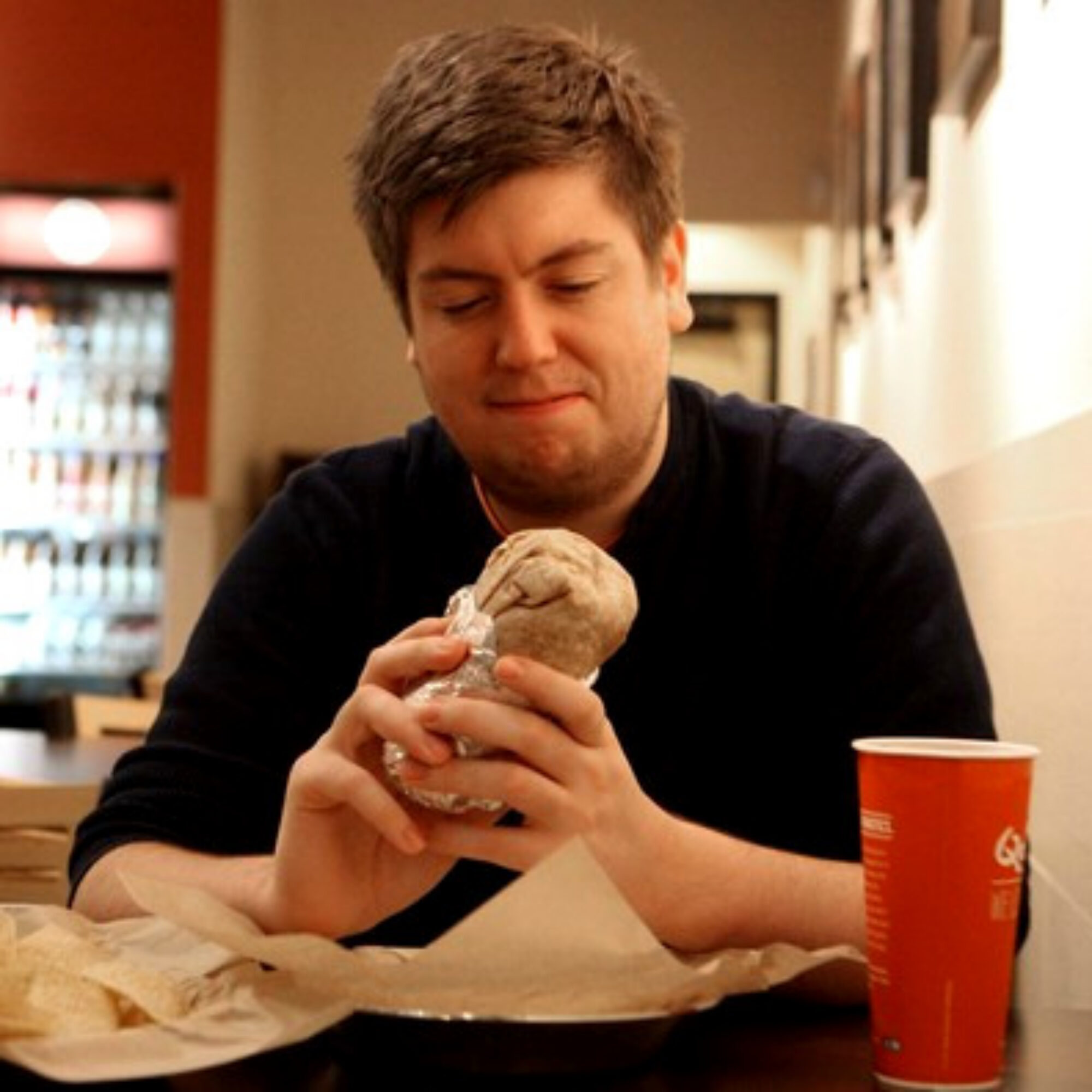
Gerrit, moments before entering a brief, fleeting world where nothing at all matters except for a giant chicken burrito.
The great satirical online newspaper The Onion illustrated one of my favorite stepping-stones to creating the life you want. I wrote about it in this relevant post, "A model that will bring you happiness." They didn't realize they were onto something more effective than they thought, but their description of how deeply changing your environment can change your mood shows a great way to start changing your life -- whether you want to get more things done, feel happier, avoid feeling miserable, or whatever. It's a big deal to realize things in your environment you can directly control can consistently, predictably, and reliably create emotions you want. Combine that with knowing you can control your beliefs and behavior and some practice and you can create…
I read a story with a lesson for anyone who creates anything too helpful not to copy. As much as I didn't want to copy something you can find elsewhere, I couldn't stop myself. I hadn't read it before so I hope it's new to you. It's from a book called Art and Fear on creating art, but you'll find it useful for creating anything -- products, beliefs, rules to live by, ways to motivate yourself and others, or whatever. Enjoy: The ceramics teacher announced on opening day that he was dividing the class into two groups. All those on the left side of the studio, he said, would be graded solely on the quantity of work they produced, all those on the right solely…
There's no getting around that deciding if something is positive or negative means judging it. If you want to avoid judging, thinking positively undermines your goals. If you can't think of an alternative, you'll conclude thinking positively is your best option because it's your only option. But that conclusion just indicates sloppy or incomplete thinking. Sloppy thinking like that reminds me of some criticism someone gave me when I was learning to present my company for funding. When asked why someone should pick our technology over a competitor's, I said "Because it's better." The guy helping me stopped me and said Never tell me your technology is better. Tell me it's faster, cheaper, stronger, more durable, or whatever. But don't call it better. Everyone says…
Fred Wilson, a prominent New York City based venture capitalist, wrote about the size of the New York City technology sector in terms of number of jobs. I couldn't help but think about a major issue about New York's technology sector compared to other markets -- the competition for talent with money coming from banking, finance, media, etc. While some people love working in start-ups and would never do otherwise, the lure of high pay from other sectors pulls great talent away from young start-ups. I've heard this series of statements too many times: First: "I love your project. I've been looking for something I can commit sweat equity to that I care about. I want to be a part of it from the ground…
A reader contacted me and suggested I read the book "Why Does the World Exist?: An Existential Detective Story," by Jim Holt. The author writes for the New Yorker among other things, which implies I'll enjoy his writing. The book promised to explore the question why the universe exists as opposed to not existing. Why being and not nothingness. I borrowed the book from the library. I hadn't considered its main question much before, so it got me thinking about why the universe exists. It's an interesting question that twists your mind just to think about it. Once you posit that the universe exists with the laws of physics we know, I can see how the Sun, Earth, life on Earth, and humans followed from…