
Ela Bhatt passed yesterday.
She knew me when I was a baby and I had lunch with her a couple years ago when she visited her family in New Haven. My parents knew her in Ahmedabad, India before I was born. My father remained very close friends with her until she passed, meaning over half a century. She acknowledges him in her book Anubandh: Building Hundred-Mile Communities.
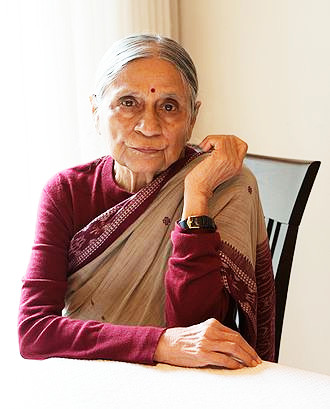
The Times of India wrote:
Elaben Bhatt, the ‘gentle revolutionary’ who pioneered the movement to empower women in India and won global acclaim, died here on Wednesday. She founded Self Employed Women’s Association (SEWA), one of the biggest women-led cooperatives and national trade unions with 2.1 million-strong membership across 18 states. . .
Bhatt’s influence inspired many world notables, including former US secretary of state Hillary Clinton, who called Bhatt her ‘personal hero’. Clinton visited SEWA’s office in Ahmedabad twice and has publicly lauded SEWA’s micro-finance work.
Ahmedabad was the crucible of Bhatt’s mission. After completing her law degree, she joined Mahatma Gandhi inspired Textile Labour Association (TLA), India’s oldest labour union, in 1955. After fighting for workers in the organised sector, Bhatt founded SEWA in 1972 to advocate for ‘unprotected labourers’ in the informal sector, who constituted 89% of the workforce back then. A majority of such workers were poor women. In 1974, Bhatt set up a cooperative bank to provide micro loans to women. She went on to co-found Women’s World Banking (WWB), a global network of microfinance organisations, of which she was the chairperson from 1984 to 1988.
In 1986, she was nominated to the Rajya Sabha. In Parliament, she chaired the National Commission on Self-Employed Women, which was established to investigate the conditions of poor women workers. . .
In 2007, she joined The Elders, a group of world leaders founded by Nelson Mandela to promote human rights and peace.
Knowing someone who was a peer of and friends with Mandela, Kofi Annan, Jimmy Carter, and Desmond Tutu took them out of history books and into regular life. Who can be the father of a nation or hold the most powerful position in the world? Well, if an old friend of my parents can, so can anyone. So can I. It takes work, vision, and so on, but for all her timeless achievements, she’s just Elaben, whose name came up around the dinner table my whole life. I had lunch with her.
Ironically, my parents misunderstand my work in sustainability and discourage me more than possibly anyone else, but they don’t inhibit Elaben’s legacy from reaching me.
In my upcoming book, which she read and helped edit drafts of, I wrote this anecdote about her:
Many consider the situation hopeless. Is it? It’s tempting to think so, to “conclude” that one person’s actions don’t matter, that only governments and corporations can make a difference, and not change. This book describes my journey finding the opposite and shows how to lead people to take responsibility and expect from acting not deprivation, sacrifice, burden, and chore, but joy, fun, freedom, community, connection, meaning, and purpose.
Ahmedabad factors in. Two years ago my father emailed that his friend from Ahmedabad, Ela-ben, was visiting her family in New Haven. Would I care to take the train to visit her? Ela-ben was one of the names I’d heard around both houses all my life. Both parents knew her as a good friend in the 1960s as a labor organizer. Of course I would visit her. I did. She told me about times before I was born, what my parents were like then.
The suffix –ben means sister in Hindi. Indians add it to women’s names. The rest of the world knows Ela-ben as Ela Bhatt, founder of the Self-Employed Women’s Association—SEWA, which means service in several Indian languages. It began as an offshoot of the Textile Labor Association, founded by Mohandas Gandhi, whom she had seen in person though hadn’t formally met. Achieving SEWA’s goals of representing women laborers seemed impossible because the women she organized didn’t work for an organization. They did odd jobs around their communities, mending, delivering, selling, and doing what they could. Ninety-three percent lived in slums. Ninety-seven percent were illiterate.
How do you organize people who don’t work together to negotiate compensation and benefits from a scattered set of people who aren’t employers? Frankly, I don’t know. She was Ela-ben to me, not the renowned Ela Bhatt, but she did it. SEWA has represented millions of workers to global recognition for solving a problem no one considered tractable. Many viewed the situation before her as good and right. A woman then shouldn’t have been able to make a difference, let alone influence the world. For decades she led the organization to organize and change the role of women in India, improving income, health, education, child care, housing, rights, and more. Her honors from global leaders and institutions are too numerous to mention.
At lunch in New Haven, besides describing my mom, dad, and Gandhi, Ela-ben spoke of her friends and peers in The Elders, an illustrious group that has included Nelson Mandela, Jimmy Carter, Desmond Tutu, and Kofi Annan.
That my parents happened to know this woman tilting at windmills in a remote city I can’t even figure out why they were there, whose poverty was off America’s scale, means to me that Bhatt, Mandela, and Gandhi aren’t historical figures. They were people like you and me, as were Martin Luther King, Confucius, Laozi, Benjamin Franklin, and Aristotle. They struggled. We face struggles with our environment. But as I sat across Ela-ben’s daughter’s lunch table in New Haven, I heard not how great her challenges but how much she loved the work.
Here’s a screen shot of the part of her book’s acknowledgments with my dad’s name:

News stories and videos on Elaben
Noted women empowerment activist and SEWA founder Ela Bhatt passes away at 89 – The Economic Times
Hillary Clinton identifies activist Ela Bhatt as one of her ‘heroines’
Ela Bhatt, The ‘Gentle Revolutionary’? – NBC
Ela Bhatt – Creating Emerging Markets – Harvard Business School