
Blake Haxton
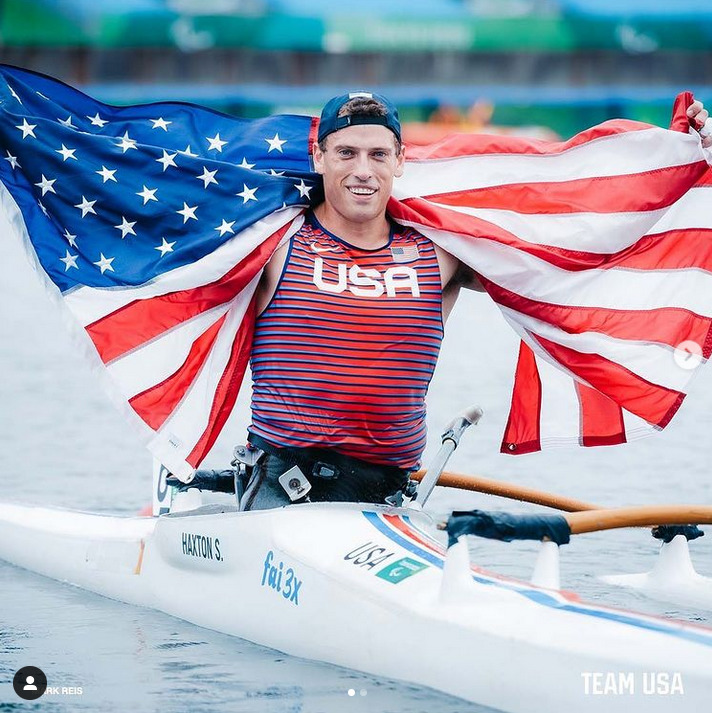
In March of 2009 Blake Haxton was in his senior year of High School in Columbus, Ohio when he contracted Necrotizing Fasciitis, more commonly called the flesh-eating disease. Over the course of three days Blake went from being the captain of his school’s rowing team and a division one rowing recruit to suffering major organ failure and the amputation of both of his legs. Blake was released from the hospital after over twenty major surgeries and three months of inpatient care.
Life-threatening medical complications notwithstanding, Blake enrolled at The Ohio State University the following fall and earned his B.S. in finance in 2013. Blake then enrolled at the Ohio State University’s Moritz College of Law and returned to the sport of rowing, making the U.S. National Team in the Arms and Shoulders single event. Blake has made four consecutive U.S. Rowing Teams including the 2016 Paralympic Team competing in Rio de Janeiro, where he placed 4th. Following the games in Rio, Blake’s fellow Olympic teammates and coaches voted him as the Male Athlete of the Year, making him the first ever para-athlete to win the honor.
Blake earned his law degree from Ohio State in 2016 and currently works as an Investment Research Associate for Diamond Hill Capital Management in Columbus, Ohio. He continues to row and is training for won a silver medal in the 2020 Paralympic Games in Tokyo, Japan.
International Race Results:
- 2014 Crash-B World Championships: Placed 1st (Set new American Record).
- The 2014 World Championships in Amsterdam, Netherlands: Placed 4th.
- The 2015 World Championships in Aiguebelette, France: Placed 5th.
- The 2016 Paralympic Games in Rio de Janeiro, Brazil: Placed 4th.
- The 2017 World Championships in Sarasota, Florida: Placed 6th.
- The 2018 World Championships in Plovdiv, Bulgaria: Placed 4th.
- The 2021 ICF Paracanoe World Cup in Szeged, Hungary: Placed 4th, qualified for 2020 Tokyo Paralympics.
- The 2020 Paralympic Games in Tokyo, Japan: Placed 2nd, Winner of the Silver Medal (Sprint Canoe).
Awards and Honors:
- 2020 Tokyo Paralympic Games, Silver Medalist
- 2016 United States Rowing Male Athlete of the Year (first ever para-athlete to win the award)
- 2016 Golden Oars Award Honoree
Blake winning silver in Tokyo:
540: Blake Haxton, part 3: Exploring nature from a wheelchair with a shotgun
Blake shares his results about acting on his commitments from last time. He couldn’t work much with rowing with temperatures barely above freezing, but he could act on his diet. He also dusted off an old habit of shooting, which he shared about.
We also got to talking about nuclear and alternative energy sources. He asked me my views, so I shared the long-term results I saw from it based on humanity’s past.
We also spoke of the Bible, Job, and ponder the meaning of having dominion over nature in the context of causing extinctions globally.
Beneath all the content, I think you’ll hear a friendship growing. I find the discipline of athletes, artists, leaders, and others in ASEEP fields develops the skills and experience to act thoughtfully and effectively.
521: Blake Haxton, part 2: Teamwork is crucial. How to solve that we’re divided
I loved Blake and my conversation so much, I’m releasing our first two conversations back to back. Also, our first one didn’t reach to The Spodek Method, so he hadn’t taken on a commitment based on his environmental values, so we recorded a week later instead of having to wait for him to finish the commitment. He takes on a commitment in this episode, so he’ll come back a third time at least.
We talked about how life brings us challenges. In his case a disease led to losing both legs. For everyone, generations of a polluting culture led to the risk of human population collapse. We won’t be able to live as before, and possibly billions won’t be able to live at all.
Blake is coming to grips with the extent of the situation and what anyone can do about it. We talk about value, teamwork, training, and how his experience and lessons could help everyone. By the end, you’ll hear how he starts considering potential roles he could take on sustainability. As you can hear in the last episode and this one, I see his experiences, beliefs, and lessons could help everyone, especially Americans, who treat changing our behavior and the culture driving it as deprivation, respond with enthusiasm instead of the usual “what I do doesn’t matter” or “only governments and corporations can act on the scale we need.”
He’s thoughtful and shares thoughts he’s had before our conversation. You can hear him developing and reconsidering his perspectives during the conversation.
I envision Blake taking a leadership role in sustainability leadership. No one has to act on it. Nearly everyone has chosen not to, to hope someone else will take care of things. Only people who want to make sustainability leadership their calling are doing so—nearly no one. But I see him seeing his potential for reaching people in ways no one else can.
520: Blake Haxton, part 1: This Paralympic silver medalist shares the mindset we can all use to face our environmental crises
I learned of Blake through the mailing list of the maker of my rowing machine, Concept2. Their piece on him described him as a Paralympic bound athlete. I was impressed, but only thought of him as a potential guest on watching his TEDx talk.
I think my message to his agent describes what I saw in him and when we talked about in this episode:
In Blake’s case, I heard a message I’ve never heard with such clarity and experience I wonder if he realizes how much it applies to stewardship and the environment. It’s almost the exact message nearly everyone needs. I can’t put it as well as he can, but what he shared starting around minute 3 of his TEDx talk of a system breaking down, where most people would be ready to give up, technology being important, but relationships, faith, support, and laughter being the core of what worked.
I see roughly 350 million Americans and 7.9 billion humans ready to give in and accept a system breaking down. Then I see Blake living the opposite of their resignation leading to a better life, and there’s been almost a decade since leading to what I read as yet more improvement.
In my book coming out next year, I quote Churchill’s speeches during the blitz — that it’s bad, it will get worse, but we will fight on the beaches, we will never surrender, it will be our finest hour. I heard in Blake’s message from a decade ago what America and the world would benefit most from hearing today. I expect it’s stronger today.
Since he also just won a silver medal, I also ask him about the training and competing.