
I recently interviewed Olympic gold medalist and Crossfit Games champion Anna Tunnicliffe Tobias, whom I met through America’s Cup winner and podcast guest Dawn Riley. Given Anna’s achievements, she’s remarkably down to Earth (as is Dawn).
In researching her, I found that last year’s Crossfit Games included a rowing marathon—that is, rowing 42,195 meters. The athletes learn what events they’ll do only hours before competing, so they just had to do it.
Why not?
I figured if they can, I can. I decided to try rowing a marathon.
I made a couple concessions. I’d never rowed more than 45 minutes or about 7,500 meters at once before, which may have been five years ago. For a 47-year-old, five years means meaningful aging.
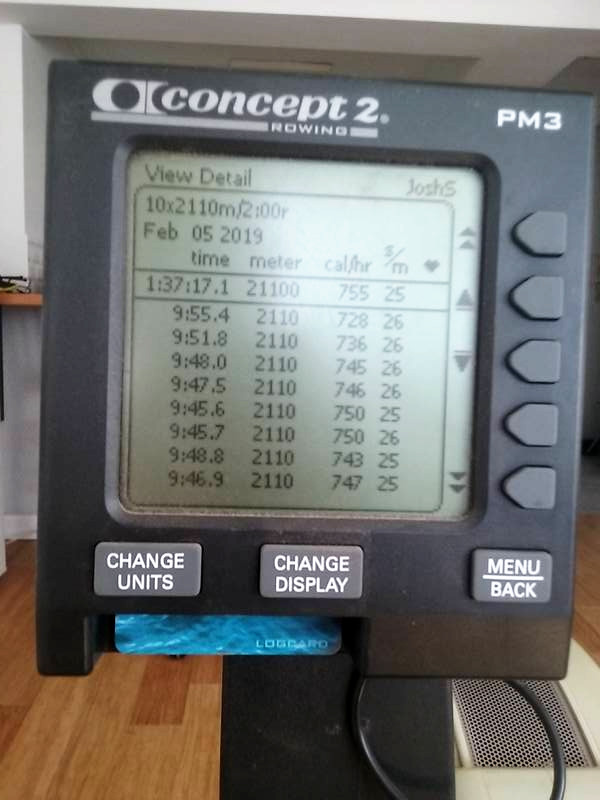
So I decided to start with a half marathon and to row it in 10 intervals of 2110 meters with 2-minute breaks between.
I looked on my schedule for when I could do it. There was no time to do it, so I had to make time. That’s what priorities mean: you figure out how to do what you want.
Here is my result (EDIT: three weeks later I rowed a full marathon):

Before you think I rowed the whole thing at a 2:10 pace, that was only the last tenth. I rowed the first 9 intervals at 2:20, or about 740 calories per hour. That’s slow for me, but I have low standards the first time.
To my credit, I had some digestion issues, so had to deal with gastro-intestinal discomfort.
I found rowing a half-marathon for the first time easier than running one, maybe because of the nine 2-minute rests, maybe because of the modest pace, maybe because rowing uses more of the body than running, maybe because rowing doesn’t pound the body like running does. Maybe the activities aren’t as comparable. Still, it’s 1,200 calories.
Toward the end, I started chafing where body parts rubbed other body parts or the shoes. I put Vaseline on, but I think chafing issues will make a marathon harder than just double a half-marathon.
Here’s part of the overall readout:
Anyway, I put off doing my morning burpee-based calisthenic routine until after the row, so it’s time to do them. Today is a cold shower day too, so I’ll take one after the calisthenics.
EDIT (February 6): I’m more sore today than I’ve been in years, maybe a decade. Holy cow!
Moreover, despite feeling fine after rowing, my fatigue grew. Hours before I normally sleep I was wrecked. My “morning” calisthenics, which I did after rowing, mid-afternoon, weren’t hard, but my evening ones, I could barely do.
I thought I’d sleep like a log. Unfortunately not. By nighttime, soreness crept in so that moving during sleep woke me up and I barely slept. Since rowing works so much of your body, I’m sore everywhere. At least unlike running, there’s no pain from impact.
In other words, it was as glorious today as yesterday.
Here’s the Crossfit rowing marathon competition:
Hows that possible? I can only do 1 or 2 minutes of rowing on the machine (a little under 2 min pace) and then I stop and start huffing and puffing. I can do 3 or 4 sets of those and that’s it. It’s far harder than running that same distance.
How long did it take to get to half-marathon fitness?
2:20 is a lot easier than below 2:00. I couldn’t keep up below 2:00 very long either. Now that I know how this distance feels, I could probably bring my pace to 2:15 next time and maybe 2:10 for the whole distance with practice, assuming still taking those 2-minute breaks, but I don’t plan to row long distance much more.
I haven’t been building up. I just decided to do it, though I exercise daily and row or run once every five days. I felt inspired by the Crossfit competitors. They didn’t train specifically to row, but they didn’t complain at having to row a marathon. They just did it. Sure, they’re at their peaks, but I wasn’t going to go nearly as fast and I would take nine 2-minute breaks. I’m also motivated by reading how among our ancestors, average people’s fitness was at the level of elite athletes today, such as
I used to row 20 minutes at a time to see how far I could get in that time as my default cardio exercise when it was too cold to run outdoors, reaching my record two and a half years ago with 5,016 meters. As proud as I am with that achievement, I don’t think I’ll equal it again. It’s hard. I haven’t rowed more than 5,000 meters at a time in years.
Lately I’ve favored intense intervals, usually Tabatas: 8 intervals of 20 seconds as intense as I can with 10 seconds rest between, with six or seven minutes light warm-up first.
I’ve worked on my form with friends who did crew in college and watching videos online. Form counts for a lot on the erg. I don’t know your form, but if it’s off, improving it may bring you quick gains.
Here are some rowing posts of mine for background: