
Last week I wrote about my latest step in going a month off-grid in Manhattan: buying (used, off Craigslist) the solar panels to power the battery I bought last year.

First: solar panels and batteries are not sustainable. They require fossil fuels and other non-renewable resources for manufacture, with no end in sight for that dependence. I don’t pretend using them is clean. Cleaner than burning oil or coal isn’t clean. I see them like methadone: as part of a plan by someone intending to quit an addiction, they can help. But giving methadone to addicts with no intent or plan to quit is just giving them more opiates. They’ll use the old stuff and the methadone. Likewise, humans with solar and wind power are using both.
I have intent and a plan. So far, I’ve reduced my footprint over 90 percent and I’m keeping going.
Today I used the battery, powered by the sun, to power my pressure cooker to make my first solar-power-cooked famous no-packaging vegan stew. I had tried it before, having powered the battery from the wall outlet. I expected it to work, but you never know until you do it.
The stew tasted as delicious as ever. This one contained lentils (green and red), carrots, and a mix of greens: collard, several colors of chard, and kale. I pressure-cooked them with water, then added nutritional yeast, salt, and pepper corns, and topped with onions and nuts. I should note, the plants and yeast were powered by the sun without requiring fossil fuels or nonrenewable resources.
How much energy I needed
I didn’t fill the pressure cooker as much as usual since Q = M c ΔT, so the less mass I heat, the less energy needed. I’m mainly using the energy to heat water. I didn’t use hot water, which would have lowered the energy the battery needed, but would have used fossil fuels in the building’s water heater. I expect I’ll need less energy when the weather warms up and I start with warmer water.
Since it’s winter, I didn’t take the panels and battery to the rooftop to recharge in direct sunlight. Instead, in my room, I only got a few hours of direct sunlight, filtered through the window, plus some cloudy days. This limit meant about a week to charge the battery. I expect warmer months of more direct sunlight for more hours will charge the battery faster.
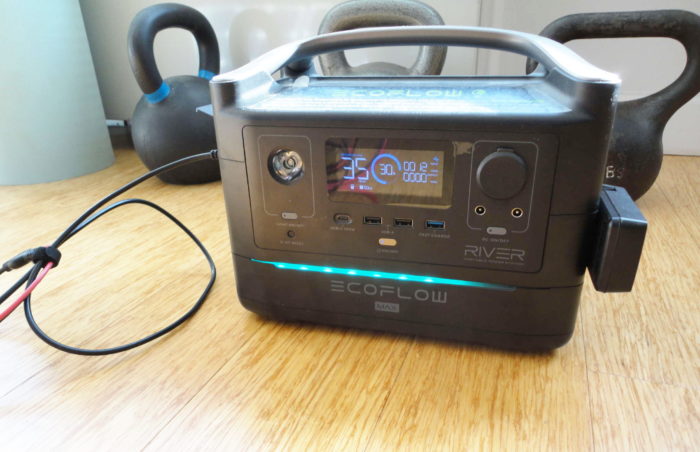
My challenge: this amount of stew will last a couple days of meals. Will I be able to recharge the battery consistently every couple of days, or find enough meals that require no power to reduce how often I want to use the battery at near full charge?
The battery still had twenty percent left after cooking, which I think would have powered my phone, computer, and floor lamp the rest of the day, so I think I should be able to pull this off.
Cooking without energy
I’ll add that separately from cooking this stew, I also chopped greens and added salt to ferment into sauerkraut; chopped fruit, beets, sunchokes, and onion and added salt to make chutney, and sprouted mung beans. All of these processes make food edible, more delicious, and cheap without even solar cells, let alone fossil fuels.
What I lost
Since the average American watches five hours of TV and some comparable amount of cell phone screen time, I’m nowhere close to their commitment to their passions. I still haven’t seen Game of Thrones or Tiger King. So that’s my loss: missing TV, scrolling, and paying for those things.
I wish I had their time and money to spare. Do I wish I had the ability to forget about how my behavior pollutes others? No, but I can see the appeal, if I’m willing to sacrifice my humanity, at least. Instead I connect with nature more, though a long way to go.
I was glad to find a packaging-free bulk store in the city that made it easy — https://fulfilledgoods.com/. It takes a lot to provide food without packaging, and it has to go against the grain of economy of scale. I salute this business owner’s efforts. I imagine there are other similar bulk stores in other towns.
Thank you for sharing. Places like that are appearing more. It helps to remember that plastic packaging didn’t exist for 300,000 years of human history until about a century ago and most of their diets were healthier, at least until agriculture and industry, despite popular misconception. I posted about the places I found near me.
For those without access, money, or time, and with kids, that’s the situation I grew up in. Because of such challenges and to solve them, my parents helped organize what became a food coop. I posted about it too in If you think food coops cost more or complain that some people don’t have access to them, you don’t know what you’re talking about and are exacerbating the problem.
It kills me when people state the problem and then capitulate on acting on it. That’s how McDonald’s, Whole Foods, Starbucks, and all those polluters want you to react so they can get from you more money, time, and dependence. Their business models plus our acceptance creates the situation where they suck resources from neighborhoods and make them poor and dependent.