
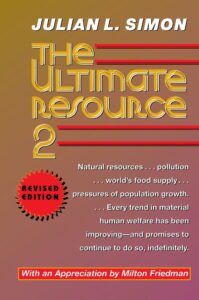
I read Julian Simon’s book The Ultimate Resource 2. I share his belief in the capacity for people to improve the world, both each other’s quality of life and the natural world. I think he misses some important points. I know of his bet with Paul Ehrlich, who may be a talented scientist, but I don’t think a talented or effective leader.
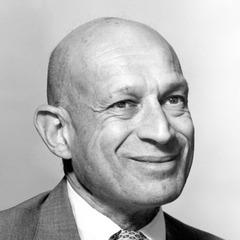
I’ll comment on some quotes of Simon. I think the following is one of his big ones:
“Adding more people causes problems. But people are also the means to solve these problems. The main fuel to speed the world’s progress is our stock of knowledge; the brakes are our lack of imagination and unsound social regulations of these activities. The ultimate resource is people—especially skilled, spirited, and hopeful young people endowed with liberty—who will exert their wills and imaginations for their own benefits, and so inevitably they will benefit the rest of us as well.”
First, I’ll state the obvious, but people confuse talking about population and overpopulation with eugenics, Nazism, racism, coercion, and other things they don’t like. Human communities throughout history and for hundreds of thousands of years spoke about population and acted to avoid overpopulation. Only recently do people confuse the mere mention of it with their preconceptions. I consider the choice to have a kid or not personal and not a matter for government to control. Though I also don’t take for granted that government should provide support. If through democratic means a government chooses to support parents or children, fine, but if you can’t support a child but you have one anyway, I don’t see why the government should compel me by force to support your choice.
Back to Simon’s quote. When he acknowledges that adding people causes problems, the distribution of cost and benefits matters. If I get the benefit of a child or an immigrant working for less pay, and you get the cost of the problems he acknowledges but you didn’t consent to those problems, haven’t I violated the consent of the governed? More precisely, hasn’t a government that allows one person to impose problems on others shirked its responsibility to prevent me from depriving you of life, liberty, and property? Sure, having a kid is nice, but how can we deny that if it imposes costs on others, then it violates the fifth amendment and what the Declaration of Independence states as a condition for a government to be just, as in “to secure these rights, Governments are instituted among Men, deriving their just powers from the consent of the governed.”?
Simon continues that “people are also the means to solve these problems.” The order of causing and solving matters. If you solve the problem first, then create it, I don’t see a problem. Or if only the person causing the problem suffers from it, again no problem. But if someone unrelated to its cause suffers from it, how is that condition not tyranny, or at least coercion?
You might say the problem goes away when solved, but he didn’t say it goes away quickly. Some problems may endure centuries or millennia, as plastic and forever chemicals appear to. Even ones that we solve quickly, the person suffering from them didn’t consent. You can’t say or judge for them that their suffering is worth another person’s benefit, even if you say the suffering is small or short.
Besides, even if the suffering from an individual problem is limited, if the population grows by a percent each year, that’s exponential growth, and the population has been growing faster than exponential for generations. If the population grows exponentially, then it seems the problems created by growth are growing exponentially. So even small problems become collectively big when grown exponentially.
Another quote:
“more people and more wealth has correlated with more (rather than less) resources and a cleaner environment—just the opposite of what Malthusian theory leads one to believe. The task before us is to make sense of these mind-boggling happy trends.
The current gloom-and-doom about a ‘crisis’ of our environment is all wrong on the scientific facts. Even the U. S. Environmental Protection Agency acknowledges that U.S. air and our water have been getting cleaner rather than dirtier in the past few decades. Every agricultural economist knows that the world’s population has been eating ever-better since World War II. Every resource economist knows that all natural resources have been getting more available rather than more scarce, as shown by their falling prices over the decades and centuries. And every demographer knows that the death rate has been falling all over the world—life expectancy almost tripling in the rich countries in the past two centuries, and almost doubling in the poor countries in just the past four decades.”
When he says “cleaner environment” and “U.S. air and our water have been getting cleaner rather than dirtier in the past few decades,” he’s missing that when we change from manufacturing our own cars, furniture, and other things whose manufacture pollutes and depletes to importing them from other places, we don’t pollute and deplete less overall, we just move the pollution and depletion elsewhere.
The US environment can become cleaner while the earth’s overall environment becomes more unhealthy. People suffer from that unhealthiness who didn’t consent to that pollution. It doesn’t stop at national borders and may have happened in countries without democratic governments.
I conclude that Simon is ignoring that the violations of minimum requirements in the US Constitution’s Bill of Rights for liberty, freedom, equality, and democracy. Even if a result is overall positive—that is, if they could be objectively quantified and compared, if my benefit outweighed your cost—I can’t consent for you. That’s tyranny, or at least coercion that leads to tyranny if unchecked.
Another quote:
“This is my long-run forecast in brief: The material conditions of life will continue to get better for most people, in most countries, most of the time, indefinitely. Within a century or two, all nations and most of humanity will be at or above today’s Western living standards. I also speculate, however, that many people will continue to think and say that the conditions of life are getting worse.”
I’m happy to see people’s material conditions improve. People who favor growth without specifying growth of what tend to cite material things. They talk about cell phones and technologies that do things past kings and emperors couldn’t dream of doing. Today even homeless people have smart phones. But if our governments aren’t protecting freedom and those things deprive people of freedom, if our system is tyrannical, then we’re growing tyranny. The manufacture and end-of-life waste pollution and depletion deprive people of life, liberty, and property. For most of human existence, our ancestors didn’t pollute or deplete. Life doesn’t require pollution or depletion, though our current lifestyles might. I support growing liberty, freedom, equality, and democracy. I don’t support growing tyranny. I don’t see Simon making that distinction and therefore ends up supporting some freedom but also plenty of tyranny, however unintentional.
Another quote:
“We now have in our hands—really, in our libraries—the technology to feed, clothe, and supply energy to an ever-growing population for the next seven billion years.”
I looked up the annual population growth at the time he stated this point. I forget the number, but it was at least exponential with some positive exponent. Any nonzero number raised to seven billion is huge. I think it ended up something like 10^billion, that is a one followed by a billion zeros. For comparison, scientists estimate the number of atoms in the universe to be about 10^82.
Ten to the billion means he didn’t think about what he said. If he’s saying the population will grow for billions of years, he’s saying it can’t continue exponentially. If it will stop growing exponentially, how about now? His saying it raises the question how much else he said with confidence but didn’t think about the consequences.
Another quote:
“Because we can expect future generations to be richer than we are, no matter what we do about resources, asking us to refrain from using resources now so that future generations can have them later is like asking the poor to make gifts to the rich.”
Again he focuses on wealth and material things. Of course, he talks about non-material things too, but I often have to clarify that I focus on liberty, freedom, equality, and democracy, which his growth violates if it pollutes or depletes. Growth that doesn’t violate these values, I support, but he doesn’t distinguish and most growth today does.
Another quote:
“Friedrich Hayek, who died on March 23, 1992 at age 92, was arguably the greatest social scientist of the twentieth century. By the time of his death, his fundamental way of thought had supplanted the system of John Maynard Keynes—his chief intellectual rival of the century—in the battle since the 1930s for the minds of economists and the policies of governments.”
Hayek said, and I agree: “If we wish to preserve a free society, it is essential that we recognize that the desirability of a particular object is not sufficient justification for the use of coercion.” and “We shall never prevent the abuse of power if we are not prepared to limit power in a way which occasionally may prevent its use for desirable purposes.“
These quotes and the meaning behind them seem to me to undercut much of Simon’s points. That is, freedom means you can’t just get whatever you want, let alone grow it, let alone grow it exponentially.
Another quote:
“People call me an optimist, but I’m really an appreciator … years ago, I was cured of a badly infected finger with antibiotics when once my doctor could have recommended only a hot water soak or, eventually, surgery…. When I was six years old and had scarlet fever, the first of the miracle drugs, sulfanilamide, saved my life. I’m grateful for computers and photocopiers … I appreciate where we’ve come from.”
I suspect I experience and live as much appreciation and gratitude as he did, but I don’t want benefits that deprive others of the liberty, freedom, equality, and democracy I enjoy. Life does not require that deprivation, though much of the lifestyle he promotes does. Like Hayek, I don’t mind foregoing hypothetical benefits for myself that violate those values in others. I prefer everyone enjoying them even if it means fewer photocopiers.
As for scarlet fever, it appeared in the sixteenth century. I haven’t found how it reached humans, but many contagions came to humans from domesticated animals, so I suspect the disease that innovation solved was caused by innovation centuries earlier.
As for antibiotics, people in remaining indigenous cultures don’t die from infections. Also, humans have used antibiotics for centuries, and farther back if you include plants and fungi with antibiotic properties. Meanwhile, according to Wikipedia, “even before World War II and the introduction of antibiotics, its severity was already declining. This decline is suggested to be due to better living conditions, the introduction of better control measures, or a decline in the virulence of the bacteria. In recent years, there have been signs of antibiotic resistance.”
Simon died at 65, younger than the typical lifetime of our ancestors before agriculture. I admit I was so surprised to read that “the average modal age of adult death for hunter-gatherers is 72 with a range of 68–78 years. This range appears to be the closest functional equivalent of an ‘adaptive’ human life span” that I had to bring the scientist who wrote it onto my podcast. I recommend listening to Michael Gurven’s episode.
He died of heart disease, largely unknown in cultures that live as our ancestors did before all the progress he talks about. He suffered from depression too. Every case is unique and I don’t know any particulars with him, but in general, they experience it less, as I understand owing to their greater social connection and cohesion and more active lifestyles.
Related posts of mine: