
This week I finished:
The Fire Next Time, by James Baldwin: I’ve known about James Baldwin for years but never read his work. I’ve seen him speak on videos, but a book is another story. A book takes time to compose.
Almost always when I finish a book I reread at least the first few paragraphs, sometimes the first few pages. A teacher in college told me that authors can’t help make the opening what the book is about. I went through this whole book twice. Partly because it’s short, but more because it grew on me while listening.
I confess that at the beginning I wasn’t engaged. He doesn’t write like most authors. I became more engaged as the composition revealed itself and the language became more familiar.
I’ll say with him what I’ve said about Coates, Kendi, DiAngelo, and many other writers on race: they misunderstand where it comes from. I know that’s a strong statement to say about bestselling authors. Many will think that a white man can’t experience things that are necessary to understand race. Well, my next book covers these things and I intend to make it public soon, so if you’ll be patient, I predict you’ll appreciate what I’m saying.
For now, I’ll say that I appreciated the dynamics of power and what having it or not does to people who are fundamentally equal. He characterized how people change, what they think of each other, how they treat each other. He doesn’t clarify how white people tend to have power. As best I can tell, he attributes their gaining power to something about being white. He clarifies that Elijah Muhammad’s story was false, though appealing, but I didn’t understand him to get that holding power in certain contexts created racism, but skin color didn’t lead to pursuing or gaining power.
I’m not trying to apologize for white people. I’m pointing out that all people have equal propensity to be corrupted. There are historical and anthropological reasons people arrived at creating race and racism. When he spoke of white people, I substituted on the fly: people with control over necessary resources with no alternative, or, more simply, people with high rank in a dominance hierarchy. For black people I substituted: people with low rank.
With those substitutions, the book retained its full value, but it attributed the problems he spoke of to the causes, not something unrelated.
On another note, I liked how he valued America’s principles and potential to solve these problems, along with the need for deep work on the part of every citizen.
Your Music and People, by podcast guest Derek Sivers: By chance, the last book of Derek’s I got to I liked the most. The book focuses on musicians, but it’s by, for, and about creative people who see marketing as something outside their creative field, especially those who see it as creepy or undesirable.
His message, as I understood it, is that marketing is intrinsic to the process. When you get that message, marketing changes to fundamental to the creative process, fun, and joyful, though always hard work requiring resources, especially time and attention.
Besides that message, the book shares many tips and stories revealing his learning and practicing the work and fun of sharing your creativity with the world so they want to compensate you for it.
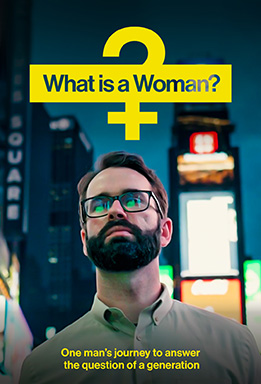
What Is a Woman?: One Man’s Journey to Answer the Question of a Generation, starring Matt Walsh: I’d never heard of Matt Walsh. I don’t know how the movie came to my attention. If nothing else, it fits with my growing habit of learning from people I disagree with.
The movie reminds me of “rolling coal”—when conservatives modify their vehicle, usually a big pickup truck, to spew a big cloud of smog. They press a button and they pollute some target, usually a woke liberal or group of them. I find the idea funny in certain cases in principle, which you’d probably not expect of me, though in practice I see it as criminal as second-hand smoke.
The cases where I find it funny is if it gets a rise out of the target out of proportion to the situation. It’s annoying, insensitive, and even cruel, but not that much.
After watching this movie, I read and watched a bunch of criticism in both directions. Liberals blew it out of proportion. It’s like he played them and they fell for it. Conservatives did too. They didn’t acknowledge how he deceived the people he interviewed to set them up. It wasn’t honest.
Still, I recommend the movie not because I found his message compelling, but because he represents the views of many people. If you agree with them, you’ll enjoy the movie. If you disagree with them, it helps you learn about them, which creates calm.
[EDIT: December 10, 2025: I followed up this movie by watching Walsh’s next one, Am I Racist? Normally I’d post about it in next Sunday’s post, but I didn’t think it merited mention. I’ll mention it here for completeness. In Am I Racist? he prompted some amazing quotes showing how far some of the antiracist industry has gone, for example in hating the US, finding nothing redeeming in it. Also in people outside the industry sounding reasonable, especially blacks they are supposedly helping and hillbillies and conservatives who they imply are racist.
All that material that could be revelatory is overshadowed by Walsh’s antics. I’m not talking about content but quality of film and on-screen presence. I suspected he had deceived Robin DiAngelo and other people he traps. Reviews say he did, which makes me question the context of the conversations edited out, which is sad, because he should have been able to achieve his goals without deception.
To the extent that industry and its effect on society deserves lampooning and revelation, he missed his chance. I had higher hopes.]
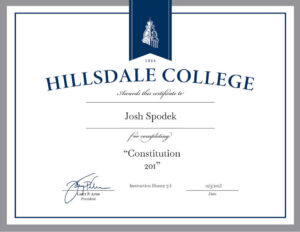
Constitution 201, Hillsdale College course: I think this course is my fourth or fifth. Hillsdale really hates progressive politics. As I wrote about the movie above, learning about views I didn’t know explains their motivations and helps me understand why they do what they do. The effect is calming.
A long time ago I stopped thinking conservatives loved profit more than people who didn’t care that others suffered in the wake of their laissez-faire, winner-take-all drive for monopoly. I’m understanding them more and more.
I expect I’ll write a lot more about conservative values being more valuable for sustainability than anyone suspected from any camp. I apologize that I’ll hold back on writing it here since I expect that after my book comes out I’ll say a lot in that direction.
Briefly, I agree that in this case, big government programs like the Inflation Reduction Act and the Green New Deal exacerbate how we hurt each other when mediated through the environment. I also agree that a constitutional approach will help more than lower level regulation. The problem is not that we aren’t protecting the environment enough. The problem is that people want to do things that pollute and deplete and that pollution and depletion deprive others of life, liberty, and property without due process of law or consent. In other words, the US government at all levels violates the US Constitution and Declaration of Independence.
In the language of conservatives, the problem isn’t socialism or progressivism. It’s that our government, by not enforcing the fifth amendment, is creating not a free market but a coercive market. It wrecks price signals, hides demand, and other things that undermine liberty, freedom, equality, and democracy. Today’s technology is new, but the problems that technology exacerbates isn’t and this nation’s founders created a structure that handles it. The structure only works if all its requirements are all met. Not enforcing the fifth amendment makes it all crumble. It may take longer than, say, not enforcing the first amendment, but the result is as inevitable.
Enforcing the fifth amendment will go a long way toward making the market free, enabling innovators to solve problems people think we have to solve before starting. That’s not how markets work.
Children’s Rights to a Life-Sustaining Climate: The Foundational Rule of Law to Achieve Sustainable Abundance for Humanity, by Julia A. Olson of Our Children’s Trust: Speaking of constitutional approaches, I am speaking of constitutional approaches all the time. I’m seeking to meet and learn from constitutional scholars and other people with relevant experience. I’d heard of Held v. Montana and work on creating amendments to state constitutions to clarify the right to a healthy environment, including by podcast guest Maya Van Rossum.
A friend told me about Our Children’s Trust, which is behind the Held case. Julia Olson founded the group, as I understand, and plays a big role in its vision, mission, and strategies. This paper describes what they’re doing, why, how, and more.
Though while writing Sustainability Simplified, I stumbled on the idea of an amendment protecting the environment, I’ve moved toward the strategy of getting the government to do with the fifth amendment what it should have done before the Civil War: to protect people from depriving other people of life, liberty, and property without due process of law, recognizing that certain types of pollution and depletion do so inherently.
I hope to connect with Julia and some of the other people with experience the paper and related literature mention.