
Col. Everett Spain
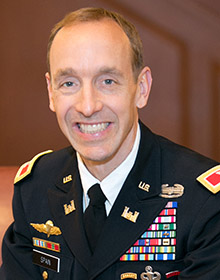
Colonel Everett Spain, U.S. Army, is a Professor, USMA and Head of the Department of Behavioral Sciences and Leadership at West Point.
From 2015-2016, Everett served in the HQ, US Army Special Operations Command at Fort Bragg and in Iraq. Previously, he served at West Point as an Academy Professor and the Director of the Eisenhower Leadership Development Program, a joint-USMA/Columbia University master’s degree program.
From 2009-2011, Everett was the commanding officer of the U.S. Army Garrison-Schweinfurt (Germany), responsible for a community of over 10,000 Americans. Prior to that, he was a White House Fellow during the Bush and Obama Administration’s transition year, where he served as the acting Deputy Chief Operating Officer of the U.S. Treasury’s Office of Financial Stability, “the TARP.” During 2007-2008, Everett was the aide-de-camp for the Commander, Multi-National Force-Iraq, for “the Surge.”
At the start of his career, Everett was a platoon leader and staff officer at Fort Bragg, where he was a member of the winning team of the 82nd Airborne Division’s Best Ranger Competition, and placed 6th in the Army-wide competition. As a captain in Germany, Everett led his company on the initial NATO deployment into Kosovo, after which they were recognized with the Itschner Award, given annually to the outstanding engineer company in the US Army.
Everett received a Doctorate of Business Administration (DBA) in management from Harvard Business School (Dean’s Award), a Master of Business Administration from Duke University’s Fuqua School (Spaulding Award), and a Bachelor of Science in Environmental Engineering from West Point (Association of Graduates Award). He is the author of several articles on leadership and talent management, one of which received the US Army Command and General Staff College’s MacArthur Leadership Writing Award. Everett is also a licensed professional engineer (PE) and a Holocaust Legacy Partner.
Everett is a graduate of U.S. Army Ranger and Sapper Schools, and is a Master Parachutist. He is a recipient of the Soldiers’ Medal, Bronze Star, Purple Heart, Combat Action Badge, Defense Meritorious Service Medal, and Secretary of the Treasury’s Honor Award. Additionally, Everett has received three honorary medallions, the Bronze deFluery Medal (Engineers), the Honorary Order of Saint Barbara (Field Artillery), and the Order of Saint Michael (Aviation).
I can’t help but share a story on Col. Spain I found in a 2014 Harvard Business School press release:
Although he is reluctant to talk about it, of particular note are Everett’s actions in the aftermath of last year’s tragic Boston Marathon bombings.
A Dean’s Award nominator recounts the story: Everett, along with his wife and two Harvard MBA students, had volunteered to serve as a running guide for a blind competitor in the race. When the bombs went off, they were approaching the finish line. Reacting immediately, Everett passed off his blind companion to another race volunteer so that he could be led to safety and then rushed toward the site of the blasts to help treat some of the injured. He administered first aid and using available materials, including his own clothes, created a pressure bandage and a tourniquet for two of the seriously wounded, ran through several buildings with blaring smoke alarms for trapped victims, and then escorted a third victim to a hospital in an ambulance. “I’m sure his actions helped save the lives of several victims,” wrote a nominator.
Media captured the image of Everett, half undressed and covered in blood, but when asked for identification, he would not provide his name, rank, or any other affiliation. He simply said that he was an American soldier. For months after bombings, Everett continued to support and visit victims in the hospital, while shunning publicity. In recognition of his heroic and selfless behavior, however, he recently received the Soldier’s Medal, the U.S. Army’s highest honor awarded in peacetime, in a small ceremony on the HBS campus.
According to a fellow student who nominated him for the Dean’s Award, “Everett’s modesty, compassion, and selfless concern for those in need — be they veterans or victims of terrorism — is immensely inspiring. Many doctoral students are motivated to help others, but his example shows us that we have the capacity to serve in many ways.”
126: Col. Everett Spain, part 2: West Point’s Head of Behavioral Sciences and Leadership
Would you expect the army to change sooner or later than other institutions—say business, traditional education, or non-profits?
Col. Spain committed to using less plastic bottled water for 30 days. He reduced his typical use from 40 bottles to 1. At what cost? It sounds to me like the “cost” was of practicing discipline and selflessness, which sounds positive to me, what leads to long-term change.
I suggest listening for the emotional timbre of his change. Would you say he considers his life better or worse? He practiced personal leadership. He affected his family in a way I think he’d call positive. I heard him sounding satisfied for leaving the world better for his new behavior. I heard him want to continue.
For those looking to learn leadership, you’ll hear me explain, about 15 minutes in, my leadership technique from my book and practicing here my emerging Leadership and the Environment technique to motivate people through intrinsic motivation.
Why not follow the leader of the leadership department of one of the top places for teaching leadership?
Having interviewed him at West Point, I can’t help asking, why are we following other countries on something that improves our lives?
I hope you’ll ask yourself: Why wait for laws or others to start? Why not start yourself?
Read the transcript.
102: Col. Everett Spain, West Point’s Head of Behavioral Sciences and Leadership
Many who serve in the military become leaders in business, politics, entrepreneurship, sports, and many other places.
Why?
What does the military teach so well?
Few people can answer better than Everett, as the head of West Point’s leadership department. To say he and his department have extensive experience and knowledge leading and teaching others to lead is an understatement. You’ll also find few people more calm, gracious, friendly, patient, and helpful.
I consider his voice eminently helpful to environmental causes because I see the lack of effective leadership to the greatest impediment to effective environmental action.
If you want to improve your leadership, this conversation will tell you all you have to do. You may have to listen many times, but you’ll hear what it takes. Implementing will take a long time, but I’m not aware of shortcuts.
We cover how to learn to lead and what West Point does that you can emulate.
Read the transcript.