
Lieutenant General Paul Van Riper USMC
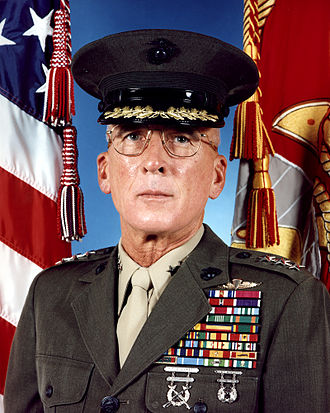
Paul K. Van Riper (born July 5, 1938) is a retired United States Marine Corps officer. When he retired, he was serving as the Commanding General, Marine Corps Combat Development Command, Quantico, Virginia.
He gained notoriety from the Millennium Challenge 2002 wargame. He played the Red Team opposing force commander and sank a carrier battle group with an inferior team in two days, declaring the wargame fixed to falsely validate U.S. Navy doctrine.
Marine Corps career
The Marine Corps University documents his full service career. Here are some salient parts.
Van Riper enlisted in the Marine Corps Reserve, training at the Marine Corps Recruit Depot Parris Island, South Carolina in 1956, joined Officer Candidate Course in June 1963, and commissioned as second lieutenant in 1963.
In 1965, Van Riper served in Vietnam as an Advisor with the Vietnamese Marine Corps, was wounded while attacking a NVA machine gun in a rice paddy outside Saigon, and evacuated in 1966. He later served in Egypt, Israel, Lebanon and Okinawa. He commanded 3rd Battalion, Seventh Marines, First Marine Division (Mike Company) in South Vietnam during 1968, later, stateside, as the Battalion Commander of the 2nd Battalion, 7th Marine Regiment from 1983 to 1985, and later the 4th Marines until 1986.
He served temporarily as a member of the MARCENT/I Marine Expeditionary Force during Operations Desert Shield and Desert Storm in 1991.
In Washington, D.C., he served as Assistant Chief of Staff, Command, Control, Communications, and Computer and as Director of Intelligence from 1993 to 1995. He advanced to Lieutenant General, assumed his last post in July 1995 and retired in 1997 after over 41 years of service.
He was decorated with Navy Distinguished Service Medal at his retirement ceremony.
Since retirement Van Riper has served on several advisory boards and panels. He is the Chairman of the Board of Directors for the Marine Corps Heritage Foundation.
Post-retirement
In the Millenium Challenge, against far superior forces, he and his team adopted an asymmetric strategy. In particular, they used old methods to evade the Blue Team’s sophisticated electronic surveillance network such as motorcycle messengers to send orders to front-line troops, WWII light signals to launch planes without radio communications, and a fleet of small boats to determine the position of the opponent’s fleet.
They preemptively launched a massive salvo of cruise missiles that overwhelmed the Blue forces’ sensors, destroying an aircraft carrier, ten cruisers, and five of six amphibious ships—simulating deaths of over 20,000 personnel. They “sank” another significant portion of the Blue navy with a fleet of small boat attacks, both conventional and suicide, capitalizing on Blue’s inability to detect them.
He is also critical of plans for the occupation of Iraq and their implementation following the Iraq War. In 2006 he joined several other retired generals in calling for then Secretary of Defense and Iraq War architect Donald Rumsfeld’s resignation
Initiative
As podcast host, I’m taking the liberty of sharing Rip’s review of my book, Initiative: A Proven Method to Bring Your Passions to Life (and Work). He wrote:
Whether leading or following, you need to read Initiative. I have long yearned for such a book—the most clear and persuasive on personal development and leadership I’ve found in 60 years of adulthood. Spodek’s focus on initiative and reflection matches what I found important serving in and leading organizations from a few people to over 15,000 Marines and Sailors. He illustrates key ideas with meaningful examples and helpful practical exercises. It’s lucid, succinct, easy to read, and deeply profound. It has earned a prominent place in my library.
398: Lt. General Paul Van Riper USMC, part 2: A Marine Versus Coffee
Rip committed to avoid waste through coffee, which he describes as harder than he thought.
Wait a minute. A three-star Marine Corps general is describing not using coffee cartridges as hard? In the Millennium Challenge we talked about in our first conversation he led a team taking on the best of the entire US war machine and won. How hard can coffee be?
That’s the point of this podcast. Personal change doesn’t depend on calories burned, monetary costs, and so on. It depends on our hearts and minds, which depend on our stories, beliefs, images, and so on. It’s as easy or hard as we believe.
Another main point of this podcast is to empower you to change our beliefs, stories, and images. While a belief may make something as materially simple as changing how you make coffee seem impossibly difficult, recognizing that our belief is the issue puts resolving the
problem under our control. We don’t have to accept that belief. We can change it.
That’s why I value Viktor Frankl and people like him so much. He turned living in Auschwitz into including experiencing love and bliss. What he can do, we can.
Rip shares how he saw the situation before starting, how it ended up harder than expected, then he got to work on himself and his views, and you’ll hear the results, as I heard more positive than he would have predicted.
Systemic change begins with personal transformation. If you think the change will end with a few coffee cartridges, you’re missing how systemic change happens. Among other things, now there’s a Marine Corps three-star General who concerns himself with household waste and sees it as something to enjoy and look forward to. He presents it as decreasing feelings of guilt, taking responsibility, enjoying results. You’ll hear that talking about responsibility and personal growth leads naturally to personal and professional growth at the highest levels of the military, about policy, strategy, campaigns, operations, and tactics.
He shared preparing reading Von Clausewitz’s On War. I almost can’t believe the wisdom and experience I got to hear. This conversation helped prompt me reading the strategy works he described as well as valuing writing about sustainability. Beyond my blog, I’m working on my book and seeing how it reveals the core, as he described. I remember watching a video biography of President John Adams. After he was President a scene showing him fixing shingles on his roof. I thought of how human we all are, whatever our status, whatever importance we give ourselves. As JFK said, in the end we are all mortal. We share the same air, land, and water.
We can view changes as obligations, chores, sacrifice, and burden—hardships for us. Focusing inwardly on ourselves characterizes depression. By contrast, we can view stewardship of nature as connecting us to others. Little improves how we feel more than acting in service of others. That’s leadership. Even if we want to get ahead and think we have to do for ourselves, acting in service of others responsibly is leadership. If I want to get ahead it works. If I want more happiness itworks. If you prefer seeing stewardship as a burden keeping you from your career, that’s your choice.
Rip shared otherwise, as I heard it.
241: Lt. General Paul Van Riper USMC, part 1: Thoughtful strategy before technology
Why a military general? Isn’t the US military one of the greatest polluters on the planet?
My goal is to bring effective leadership to the environment and your life because spreading facts, figures, doom, and gloom isn’t doing it. Leadership is about people. Technology and innovation have historically increased pollution, as I described in other episodes. Nearly everyone promoting technological solutions is unwittingly continuing the drive toward efficiency that created our environmental situation and continues to augment it.
They miss that increasing efficiency doesn’t necessarily lower total waste, which is our problem, as a glance at any plastic-covered beach or Beijing sky will attest. Again: efficiency has overall increased total waste.
I invited Rip after reading about the Millennium Challenge, where the military invited him to come out of retirement to lead the “red team”—a ragtag group to fight the “blue team”, representing the 21st century US military strategy using every advantage they could—technology, data, weaponry, size, intelligence, and so on.
It sounded like a setup—not a test but a cake walk to showcase what they considered an unstoppable, titanic force.
Titanic might be the best term because he mopped up the floor with them. I’ll put links in the text for write-ups on this historic David and Goliath exchange.
You’ll hear in this conversation why they so miscalculated and how he saw things differently that worked. More importantly, I hope to focus you on the value of focusing on people.
Rip shares the inside story you won’t find in those accounts. I was rivited, and he built it up from talking about his beginnings as a lieutenant, learning strategy like Von Clausewitz that remains timeless, US military development since WWII and Vietnam.
If the relevance to the environment isn’t obvious, I’ll clarify. Acting environmentally means facing an apparently unstoppable juggernaut. It’s not CO2, plastic, and mercury but the beliefs and goals driving people to keep doing what they used to—meat, flying, having as many kids as they feel like, buying SUVs, and so on.
Everyone who says that’s human nature is confusing following a system. Systems can change. Growth wasn’t always a goal, nor did people ship their garbage halfway around the world, nor did it take centuries to decompose. Cultures that had to deal with their garbage learned to live sustainably.
So can we. We can learn from Rip’s teamwork, historical knowledge, vision, and all the things that make up leadership to lead ourselves and humanity to overcome our Goliath: the beliefs keeping us doing what got us here.
Rip has made a big impression on me. I don’t know what makes a general. Talking to him, I think it means learning at a cultural level, or learning deeply about people.
I think we who want to influence human effects on the environment can learn from this experience and view. He talked about senior leadership. In my view, we lack senior leadership