
This week I finished: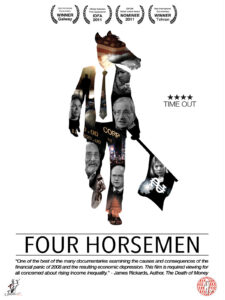
Four Horsemen, directed by Ross Ashcroft: I’m not sure how I hadn’t heard about this documentary since it came out in 2012. Still, it’s another documentary full of information, lacking a vision or plan how to get there. As I understand it, it lays our economic system at the root of our society’s problems. It says we should be informed, but actual changes are things like changing the federal reserve system and global equivalents. What exactly should I do?
I was pleased to see two people I’ve met and one whose book I’m in the middle of. I know Joseph Stiglitz because he teaches at Columbia Business School. I didn’t take a course with him but attended at least one talk he gave. I asked him a question. I don’t remember it but I think he remarked that he thought it was a good and answered it. I could that exchange as a conversation with a Nobel Prize winner, though the economics one is different than an actual Nobel.
I recorded my second podcast conversation with John Perkins just before watching the documentary and seeing him there. I’m in the middle of Michael Hudson’s book …and forgive them their debts: Lending, Foreclosure and Redemption From Bronze Age Finance to the Jubilee Year (Tyranny of Debt). I’ve watched and listened to five or ten interviews and talks of his.
Anyway, the video is on YouTube:
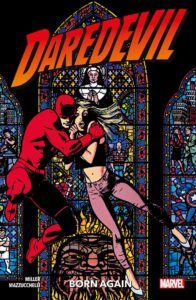
Daredevil: Born Again, written by Frank Miller and drawn by David Mazzucchelli: I came across fans describing this series from around 1985 as the best Daredevil series. I consider Frank Miller’s Dark Knight Returns series literature, not just great comic books, but serious literature.
Wikipedia described the Born Again series as, “Widely regarded as one of the greatest Daredevil and Kingpin stories ever told, ‘Born Again’ is considered a landmark of the Modern Age of Comic Books for its deconstruction of the superhero archetype through an attack on the hero’s civilian identity rather than his physical abilities.”
It turns out the New York Public Library had a trade paperback version of it so I borrowed it. I found the story and art engaging. I’m not sure the state of the art of comic books then, so can’t tell how much it innovated. I didn’t find it as deep or meaningful as Dark Knight Returns, which came out the next year.
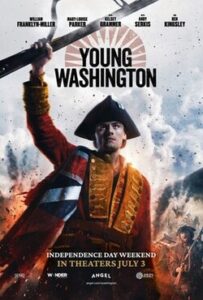 Young Washington, directed, produced, and co-written by Jon Erwin: I got a free ticket to see this movie. Just after getting the ticket emailed, I got an email from the production company, which seems mostly to make religious movies. Hmm… was I going to be stuck on an email list or was my address going to be shared in that community?
I didn’t have high expectations. I wish I had because I liked a lot of the movie. I think its major goal was to show what made arguably the most famous American the leader he came to be, as well as to show the situation he was born into: rigid hierarchy, burgeoning multilateral war between the British, French, and many Native American groups, and a stunningly beautiful Virginia.
Young Washington starts off stifled but ambitious. You see how he starts learning to lead through books and life challenges. Then he doesn’t take no for an answer and sneaks around the system to connect with people who can help him rise.
His big lessons come from battles, first that he stumbles into while surveying, than as a soldier. A couple failures enable him to learn and grow into becoming an effective diplomat and military leader.
The movie goes overboard with the action shots, whose volume nearly made me regret seeing the movie in a theater, and his overcoming dysentery seeming through force of will, though I don’t know enough details of his life to say. Also, I didn’t like the melodrama of characters being archetypes prone to speeches lacking subtlety, like his mother’s overly inspirational pep talk, the British dismissing him, or the woman succumbing to his charms.
After reading so many books and watching so many documentaries on Franklin, Jefferson, John Adams, Madison Lincoln, Douglass, Tubman, King, and other important Americans, it’s time I learned more about Washington. He factors into every story. Nearly everyone considers him the most important figure in the founding.
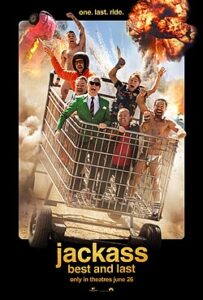 Jackass: Best and Last, directed by Jeff Tremaine and produced by Tremaine, Spike Jonze, Johnny Knoxville, and Shanna Zablow Newton: Decades ago, a friend used to find when the timings for movies she wanted to watch lined up at certain theaters nearby where once you paid to enter the whole multiplex, you could watch another without paying again. It turned out that Young Washington played at one of those theaters and I could watch this latest and claimed to be last Jackass movie for free.
It was what you’d expect: funny and bizarre. For once, it benefited from two or three groups of younger viewers who laughed and talked through the whole movie. Their reactions added to the movie.
The characters are weird, fearless, and shameless, but I have to admit, they’re also genuine, which make these properties reveal I could take bigger risks and protect my vulnerabilities less.