
This week I finished:
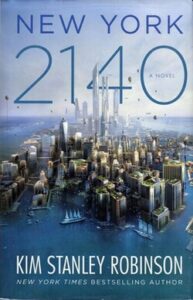
New York 2140, by Kim Stanley Robinson: I met him at a talk at a place in Brooklyn called Pioneerworks, invited him to be a guest on the podcast, and he agreed. I finished Ministry of the Future a couple years ago so am preparing by reading another of his books.
He suggested this one both because we were in New York City and because I asked him about the water in that time. I anticipate that many landfills will flood, leading nearly all the waste we thought we were keeping from polluting the rest of the world to empty into the oceans. He said the water in the book was filthy. It was, though not as much as I would expect.
The book covers many topics. I haven’t heard him say it in the many talks I’ve listened to of him, but I suspect he considers himself an author first. If a book isn’t engaging to read, nothing else matters. Besides elements of writing like developing characters and the world, he treats finance, politics, arts and culture, labor, and a few other things. Finance and politics seemed the big one. I read the story first a commentary on the 2008 bailout and banks controlling government. Second was politics.
Oh yeah, also New York City, especially Manhattan, especially lower Manhattan, and science. Science wasn’t part of the story but was part his writing. He seems to like to put in lots and lots of detail of what happened in the past of the book but our future. He seems to like to dare the reader to disbelieve what he says happened in their past and our future.
Documentaries on George Washington: I felt my discovery of how much I missed by not studying George Washington merited its own post, so I posted about watching these documentaries yesterday. I’ll take the liberty of copying from that post here.
Last week I watched a movie about George Washington. It prompted me to watch a few documentaries on him. Five so far.
I can’t believe I haven’t learned more about him. I’m downright embarrassed. No one else is called the father of this country. He is. I study leadership. I’m studying the founding of this nation. He’s widely considered the greatest President of the nation. His picture is on coins and bills. His name is on states, cities, buildings, and more. I could go on.
How have I not read one biography of him? How did I not watch one documentary?
Just from these documentaries I’ve seen his humanity, his struggles, his challenges, his failures, successes, and more. I see parts of leadership I’ve neglected: boots on the ground, leading from the front, risking your life, inspiring love and loyalty from men, I could go on.
I’ve read biographies and watched documentaries about American people, events, and documents including
- Abraham Lincoln
- Thomas Jefferson
- John Adams
- Harriet Tubman
- The Civil War
- The Revolutionary War
- James Madison
- Martin Luther King
- Frederick Douglass
- The Constitution
- The Declaration of Independence
- Malcolm X
- Abolitionism
- Benjamin Franklin
- Ulysses Grant
- Henry Thoreau
I could go on, but I hope I’ve conveyed that I’ve studied plenty. How have I skipped GEORGE WASHINGTON?
My new book and my vision and mission are about changing culture. I’m looking for role models. How about the most important figure in creating the first constitutional democracy?
I started Ron Chernow’s Washington: A Life. According to Wikipedia:
a “one-volume, cradle-to-grave narrative” that attempts to provide a fresh portrait of Washington as “real, credible, and charismatic in the same way he was perceived by his contemporaries”… The book was released to wide acclaim from critics, several of whom called it the best biography of Washington ever written. In 2011, the book won the Pulitzer Prize for Biography or Autobiography, as well as the New-York Historical Society’s American History Book Prize.
Here are the documentaries: