
I met a professor at Pace University who told me that its law school ranked number one in environmental law. It turns out it does:

My upcoming book approaches problems we face today, including environmental degradation as one of many, as resulting from not understanding how the Constitution applies. More precisely, they result from not enforcing the Constitution. I was interested in talking to lawyers with constitutional backgrounds.
I should note that I’ve learned that constitutional lawyers don’t tend to be trained in leadership. When I proposed the APPLE PIE amendment in Sustainability Simplified, I learned that the creation of new amendments doesn’t have to come from lawyers. As far as I can tell, they seem to train to look back at existing ones, precedent, and how to interpret and debate existing ones than to look forward to potential new ones or how to make them happen. They’re also skilled at saying how hard it is to pass new ones.
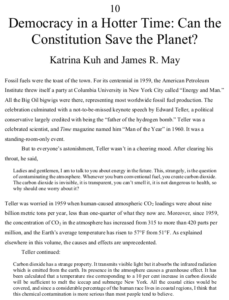
Anyway, the professor I met put me in touch with some people there, which led me to read some of their work. In this post I’m commenting on Can the Constitution Save the Planet?, by Katrina Kuh and James R. May, chapter 10 in the book Democracy in a Hotter Time.
I’m not writing a review. I’m writing notes for myself for future referecence so I’m not sure how helpful it will be to others, but it will show how different my approach is.
Here is Katrina Kuh’s bio from Pace’s Law School page:
Katrina Fischer Kuh joined the Elisabeth Haub School of Law faculty as the Haub Distinguished Professor of Environmental Law in 2017. She was previously on the faculty at the Maurice A. Deane School of Law at Hofstra University, where she was a Professor of Law and served as an Associate Dean of Intellectual Life. Professor Kuh’s scholarship focuses on climate change and sustainability, and she has taught Environmental Law, International Environmental Law, Global Climate Change and U.S. Law, Administrative Law, and Torts. She is the co-editor of The Law of Adaptation to Climate Change: United States and International Aspects and Climate Change Law: An Introduction. Previously, she served as the Faculty Director of the Environmental Law Program at Pace Haub Law.
Before entering academia, Professor Kuh worked in the environmental and litigation practice groups in the New York office of Arnold & Porter LLP and served as an advisor on natural resource policy in the U.S. Senate. She received her undergraduate and law degrees from Yale and served as a law clerk to Judge Charles S. Haight of the U.S. District Court for the Southern District of New York and Judge Diana Gribbon Motz of the U.S. Court of Appeals for the Fourth Circuit.
Can the Constitution Save the Planet?
They mostly answer No, the Constitution can’t save the planet. I don’t think they’re asking a relevant question. The problem isn’t the planet or environmental degradation. They are the results of the problem. Nearer to the problem is human behavior. At the root is a culture that rewards behavior that causes the problems. As long as those rewards exist—that is, until we change our culture—we will keep reproducing the results.
If we “saved the planet” but didn’t change culture, we’d redo what caused the planet to need saving and have to save it. We’d keep having to do so until we changed our culture.
This paper doesn’t look at culture, despite the Constitution being a major factor in setting our culture. It starts pessimistic:
Even a healthy US democracy would struggle mightily to respond effectively to the “wicked” problem of climate change… And our democracy is decidedly not healthy.
It continues, to preview the rest. It bemoans that the Constitution doesn’t treat the environment.
The first two sections detail how and why the Constitution is hostile to climate policy. The third section explains why courts are reluctant to engage climate change. The fourth section explores what it means for our brand of democracy…
The US Constitution’s 7,369 words all but ignore environmental concerns. It was crafted to address separation of powers, federalism, and civil liberties.
The paper bemoans
absence of clear and broad authority to protect the environment
But it sees the problem as that the environment requires protection.
The Constitution presumes the existence of an environment capable of supporting a flourishing society but does not explicitly recognize or protect the environment. Indeed, it was historically uncertain whether the Constitution empowered the federal government to act to protect the environment at all.
It wants language to protect the environment. Unable to find any, it ventures into speculating how to get the results it wants, leading to wanting judges to stretch to interpret it how it wants. This strategy seems open to prompting others to stretch to interpret it the other direction. It also seems contrary to separation of powers.
The absence of clear and broad constitutional authority to protect the environment—explicit in the text of the constitution or understood by courts to reside within other enumerated powers—limits the scope of federal environmental law. One aspect of this limit is foundational. It required judicial willingness and a stretching of doctrine to find constitutional authority on which to adopt our core federal environmental laws.
I repeat, I see the solution not in protecting environment or regulating our effect on it, but about how people effect each other, which is a main point of government and Constitution.
I see goals to coerce others to do what you want as distracting from seeing that the problem isn’t a lack of protection for the environment but allowing violations of Constitutional rights, even rewards for them.
The textual constitutional omission of the environment could be overcome by judicial interpretation. For example, during the Progressive Era, scientists, attorneys, and politicians succeeded in persuading courts to interpret the Commerce Clause to give the federal government significant constitutional environmental authority. And there are many powerful arguments that, despite the lack of explicit text and a historical doctrinal focus on the Commerce Clause, the Constitution can and should be understood to afford broader environmental powers to and impose environmental limits and duties on the government. To date, however, courts have largely abdicated their institutional role in the development of climate policy.
Seems to be trying to work around how the Constitution structures government. Are the courts supposed to develop climate policy? Article 1, section 1 implies otherwise: “All legislative Powers herein granted shall be vested in a Congress of the United States, which shall consist of a Senate and House of Representatives.” By “implies” I mean: states without chance of misinterpretation.
Still, as long as the paper sees the problem as coercing people to follow the solution scientists propose, or something like that path, it sees getting judges to stretch their powers as the only route.
Advocates, alarmed at the closing window for mitigation to avoid catastrophic warming, have repeatedly beseeched the courts to use their constitutional authority to compel or prompt more meaningful mitigation policy. Courts decline, insisting that our constitutional structure (the separation of powers among the legislative, executive, and judicial branches of government) renders climate change policy exclusively a matter for the elected branches. In doing so, the courts hold up the need to respect democracy, positing that climate change policy is so complex and central to the polity that decisions about it should not and cannot be made by unelected judges. But this view abdicates the essential role of courts in our constitutional democracy to protect rights, correct for pathologies that subvert the political process, and engage in conversation with the other branches.
This strategy looks desperate. In my experience, desperation never leads to effective action or leadership.
The conclusion closes with an appeal to find approaches from new directions.
We could also encourage new understandings of existing constitutional text that cognize the fundamental value of and right to a healthful environment, more effectively support healthy democratic processes, and go further to advance social justice. Any approach will require an open-eyed reckoning with how and why the constitutional status quo is failing to meet the climate moment.
My upcoming book presents such a new understanding of existing constitutional text, though with a slightly different goal, one that will achieve more.
You can’t lead others to live by values you violate yourself
Every message from environmentalists on polluting and depleting less implies that doing so makes an individual’s life worse, makes society worse, and other discouragement. They haven’t tried, so don’t know that it improves lives and society, especially those affected most.
I mention this view because it leads environmentalists to avoid polluting and depleting less in any meaningful way. Not having experienced that improvement, they speak without hands-on practical experience and, however unintentionally, motivate people away from trying. Since you can’t lead others to live by values you violate yourself, they cripple their ability to lead others. My point is not a purity test. Would you take a yoga class from an instructor who has never struck a yoga pose?
So nothing personal to Kuh since the following could be said by nearly all environmentalists, but in an interview with Pace, she said, “When I travel with my family, I prioritize taking them to special places that will be significantly altered in their lifetimes. We’ve been to the Everglades, Venice, Glacier National Park, glacier skiing in Europe, and to the Galapagos. Over Christmas, I wanted to take my kids to Grande Isle in my birth state – Louisiana.” It reads to me like this person’s flying habits, in kind if not in quantity.