
This week I finished:
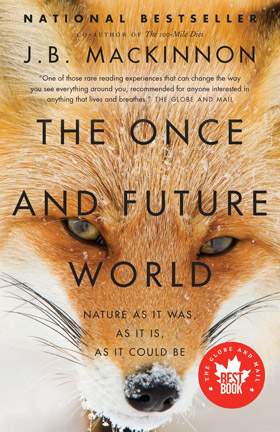 The Once and Future World: Nature As It Was, As It Is, As It Could Be, by podcast guest J. B. MacKinnon: I read this book years ago, before recording the episodes with J. B. I reread it for the book club of the alumni of my workshop. It made a big impression on me then. I like it even more today.
It was coincidental how timely it was as a counter to Julian Simon’s work. This book illustrated the depletion and homogenization humanity has unleashed on the world. J. B. uses the term “ten percent world” to describe the amount of wildlife left. He portrays how earth used to be. It has never been static, but there was a lot more life before.
Its tone isn’t nostalgic though is somewhat forlorn, mixed with wonder at what life is capable of when not polluted and paved.
I can’t recommend this book enough. The language is engaging, but the content a gut punch, a gut punch you’d rather take than imagine today’s world was anywhere near its potential nor our effect remotely close to benign.
Parents, Keep Out!, podcast guest Peter Gray on the Hidden Brain podcast: Despite listening to many wonderful podcasts and podcast episodes, I rarely post single episodes here. Yet this episode resonated. Peter describes the value of kids playing especially but spending time together in general independent of adults. He lays out clearly how much we deprive them of what they need to mature and become independent, responsible humans.
Listening to questions from parents at the end of the episode, it’s tragic how far we’ve come from how kids used to just grow up. We coddle them like putting a cast on a body part. It protects it from being injured but causes atrophy from disuse.
I followed up by reading the Guardian article The real Lord of the Flies: what happened when six boys were shipwrecked for 15 months about the story they referred to. I downloaded a peer-reviewed article by Gray that I plan to read: Play as a Foundation for Hunter-Gatherer Social Existence, American Journal of Play, 2009.
I read the The Lives of Alumni page about podcast guest Nikole Beckwith and Hal Sadofsky, whose getting a PhD in math at MIT despite no high school math changed my view of education.
 The Case for a Debt Jubilee, by Richard Vague: A friend told me about a book called And Forgive Them Their Debts by an economist Michael Hudson about the concept of jubilees and how much it was practiced in Mesopotamia and other ancient cultures. I watched a few conversations with him online, which prompted me to put the book on my list.
It hasn’t reached the top yet, but as usual in my picking up litter daily, I found a copy someone was throwing away of this book with the word jubilee in the title.
This book is short, though parts steeped in enough economics lingo that I think I missed the meaning of some important parts. If I didn’t have a PhD in physics, I might have felt unintelligent, so I think it could have explained some economics in plainer language.
Still, it referred to Hudson a couple times and cited his book in ways that suggest Vague and Hudson know each other and agree. I’ll still read Hudson’s book, which sounds more accessible. I also downloaded some videos on Vague, who has written other books on debt and economics.
The first main point of this book is that debt, both public and private, and their growth relative to GDP—that is, how much we owe versus how much we earn—are inherent parts of the economy. They can’t go away, nor can we even decrease them. As they grow, they hurt the economy and citizens’ lives in various ways.
The next main point is that there are almost no ways to decrease debt relative to GDP. Though our culture disdains letting people off their obligations to others, societies have practiced debt forgiveness for thousands of years, generally to widespread benefit. I wouldn’t have believed it, but this book and the Hudson videos make it plausible. I think the Hudson book will explain in more detail.
This book suggests that forgiving certain kinds of debt in certain ways, protecting against certain moral hazards and other objections would work and that benefit everyone relative to an economy without such forgiveness. He’s not trying to equalize outcomes and wants to avoid creating dependencies. He knows the objections and treats them.
 The Thread of Liberty: Keeping Our Republic and American Leviathan, both directed by Ned Ryun: The first of these two videos show conservative views of America’s founding and values, which means it is positive and laudatory. It doesn’t shirk on some major problems, like slavery, but focuses enough on the positives to make me wonder why it leaves out what it does. I copy below some self-promotional text from the team so you can see its focus. I suspect they wanted to make something to counter Ken Burns’ recent documentary on the nation’s founding as well as the 1619 Project and Howard Zinn’s People’s History of the United States.
Leviathan was more direct, taking progressivism to task. Neither work looks critically at its own views, not that documentaries from progressives do either.
These two videos were informative though less scholarly or comprehensive in favor of garnering support for their side, close to propaganda. Still, they show a view that hundreds of millions of Americans agree with or at least appreciate. Not to watch some documentaries like it would put an American out of touch with his or her communities.
Here’s the text from the sites to give you a feel:
About Ryun: “Ryun is the founder and CEO of American Majority and a former writer for President George W. Bush. … previously founded Generation Joshua, a civics education program for middle and high school students. He served on President Trump’s 1776 Commission”
The Thread of Liberty reframes the American founding not as a revolt for new ideas but as the culmination of millennia of Western political thought — codified into law by serious men with a realistic view of human nature. Hosted by Ned Ryun and built on interviews with eleven leading historians and constitutional scholars, the 85-minute documentary uses Alexis de Tocqueville’s 1830s journey as its lens, tracing the republic across five chapters: the intellectual origins of American liberty, the founding crucible of 1763–1789, Tocqueville’s America through Reconstruction, the progressive-era erosion of constitutional limits and the rise of the Administrative State, and the fight to restore the Constitutional Republic today.
It is not a partisan argument but an honest one — clear-eyed about the nation’s flaws and confident in the constitutional framework’s enduring power. The film connects abstract principle to concrete modern strain — unaffordable housing, economic stagnation, the loss of meaning — and the steady expansion of federal power that pulled government away from the people it was built to serve. Beneath it runs Benjamin Franklin’s challenge: “A republic, if you can keep it.” Every generation has faced that test, and now the challenge is ours.
And for the book American Leviathan: The Birth of the Administrative State and Progressive Authoritarianism:
“…Ned Ryun reveals the History of the Deep State, which has seized unConstitutional control over our Nation, and unleashed Death and Destruction on the World. This is not what our Founders’ intended.”
—Donald Trump, president of the United States
“…a much needed and timely eleventh-hour clarion call for citizens to wake up and rebirth the republic as the Founders intended.”
—Victor Davis Hanson, The Hoover Institution, Stanford University
American Leviathan is the story of the rise of Progressive Statism and their massive, bureaucratic Administrative State at the turn of the 20th century and how we got to where we are today in the 21st century with governmental abuse by a class of so-called experts.
Because of Progressives’ quiet regime change over the last century and their replacing the Constitutional Republic with that Administrative State, our government today has very little to do with what the Founders’ envisioned. So the question for us today is will we restore the American Republic and actually have a government of, by and for the people?
American Leviathan details how an empowered Executive in the White House can actually devolve and break apart the Administrative State that is the leviathan crushing the freedoms of the American people.