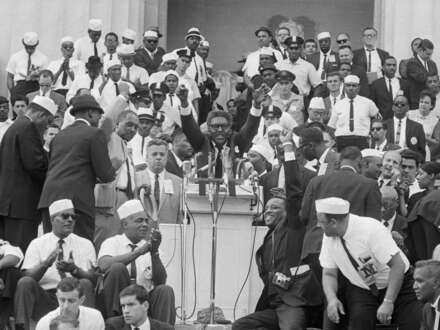
This week I finished:
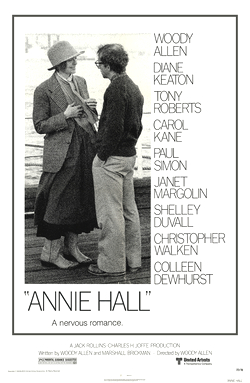 Annie Hall, produced by, directed by, and starring Woody Allen, also starring Diane Keaton: I loved this movie the first time I saw it, in high school in the late 1980s, when I was first experiencing love and relationships. I thought of love as magical and read the movie as a love story, dismayed that their relationship didn’t work out.
Many years later, when I saw it the second time, probably in college, I could tell their relationship wouldn’t work from the start, not just because in the opening monologue he said so. They didn’t match. I didn’t see their breakup as tragic. I don’t think I was jaded, but the movie was different.
I’m sure I saw it at least once since then before this time. I remember it being very meaningful, one of the most important movies I’d seen.
This time I was looking forward to an American movie of the quality of the movies I’d seen since Yi Yi. For most of the movie this time I appreciated the advances in movies Allen showed, but didn’t find it compelling. I didn’t realize how many of his lines were jokes. I didn’t find his character believable. I wish he’d either made it a comedy and more farcical or satirical, or more serious.
So I wasn’t bored, but it felt anticlimactic, or I felt crestfallen.
Until the very last scene. Despite having seen it before and knowing it was coming, it redeemed the whole movie. It nailed something so much a part of the human condition, of love faded yet somehow no less powerful. Showing his lingering, looking after she’d walked away. You could say he drove her away with his self-focus and nebbishness, but his culpability doesn’t change or diminish his loss. Literature and movies typically treat men as less susceptible to powerful emotions that aren’t anger, rage, or the few that male characters show.
Allen’s character missed her. She was a big part of his life, he invested in her, he tried opening up to her, he wanted her.
She moved on, apparently happy enough to see him and showing gratitude for what he brought to her that she values, but he didn’t mean that much to her.
I don’t know where I’ve seen that aspect of men’s vulnerability treated elsewhere. I presume most other men, maybe nearly all, have felt it. I guess it’s an inevitable side effect of falling in love. Man, it hurts.
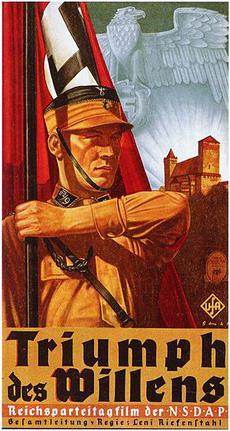 Triumph of the Will, by Leni Riefenstahl: Watching this movie just after Annie Hall, which referred to The Sound and the Fury many times, was coincidental. I saw it listed among top movies, plus I’m learning about tyranny and fascism.
I also watched a half-dozen or so reviews, each of which tried to disentangle the propaganda and fascism from the art, and determine if Riefenstahl was an artist, collaborator, opportunist, or what. It seems to me that most Nazis were opportunists. I doubt many foresaw, let alone planned, what they would do except after the opportunity arose.
It was probably designed to show German unity and strength. I didn’t realize how big those Nuremberg rallies were. Even if they were staged for the movie, they were huge.
It revealed to me how much the Germans felt good at their pride being restored after World War I and the humiliation that followed. They seemed at last proud and enthusiastic. The movie was made in 1935, a decade after Mein Kampf, so everyone knew about Hitler’s antisemitism and pattern to blame everyone he could, but before Kristalnacht.
The documentaries about the movie asked if Germans could have known, especially Riefenstahl. Anyone who wanted to know could have. Anyone could make themselves willfully ignorant by not asking. The movie’s relevance to today couldn’t be greater, when we celebrate our technical and market achievements while trying to keep ourselves willfully ignorant or believing that what we do doesn’t matter and all the other excuses everyone tells themselves as they violate their values.
Again, the biggest difference between then and now is that our system is causing vastly more suffering and death. Perhaps the biggest similarity is that most people contributing to that death and suffering aren’t doing the actual killing, so we can’t say we aren’t the ones operating the trains, death camps, and showers. We’re all participating in a market and culture causing the suffering and death. Like nearly all of them, nearly all of us can share our excuses to the support of most people around us. Yet we all know what we’re doing.
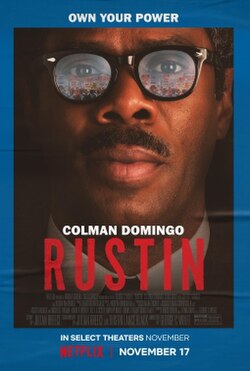 Rustin, starring Colman Domingo: A Quaker friend mentioned the name of Bayard Rustin, which I hadn’t heard before. Apparently he spent time at a meeting house near where I live.
I watched the recent bio-pic followed by reading a ton as well as listening to and watching more. I included a bunch online below. I’ll put one of the ones I found most valuable here, since it doesn’t embed. You have to click it and watch there: Eyes on the Prize; America, They Loved You Madly; Interview with Bayard Rustin.
I didn’t know how much he contributed to the organization of the March on Washington in 1963. It seems Rustin played a major role in bringing nonviolence to Martin Luther King.
Most of all, he seemed to understand political strategy better than most. It seems like he paired well with King.
I recommend learning about him. He’s a role model.