
I’ve been reading Aristotle’s Nicomachean Ethics as part of the online course at Hillsdale College. I should say rereading, since I read it in college as part of Columbia’s Core Curriculum, but that was the late 1980s. As long ago as the 80s were, it was recent compared to when Aristotle wrote them. I should also say reading selections from it, not the whole book.
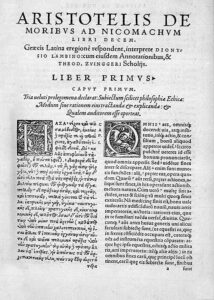
A section on what he calls a good person versus a corrupt one resonated with how I’m choosing to live. Avoiding polluting and depleting seem beautiful to me. It takes work. It doesn’t make money or honors. I do it for others, not just myself.
I was pleasantly surprised at how accurately this over-two-thousand year old book resonated with the challenge and rewards of living by our shared values of liberty, freedom, equality, and democracy even when my culture rewards the opposite.
Everything below quotes the book (except the section headers).
Beauty Versus Corruption (Book 9 Chapter 8)
Therefore, a good person ought to be a lover of self, since he will both profit himself and benefit the others by performing beautiful actions, and a corrupt person ought not, since he will harm himself and those around him by following base passions.
So in a corrupt person, what he ought to do and what he does are out of harmony, but a decent person does what he ought, since every intellect chooses what is best for itself, and the decent person obeys his intellect.
But it is also true of a person of serious worth that he does many things for the sake of his friends and his country, and if necessary, dies for them, since he will give up money and honors, and all the goods people fight over, to gain what is beautiful; for he would choose to have an intense pleasure for a short time rather than a mild one for a long time, and to live in a beautiful way for a year rather than in a random way for many years, and to perform one great and beautiful action rather than many small ones. And this no doubt is what happens with those who die for others; they choose something great and beautiful for themselves.
Such a person would also give up money in a case in which his friends would get more money, since there would be money for the friend, but a beautiful act for himself, so that he distributes the greater good to himself. And it is the same way with honors and offices, for he will give up all these things to a friend, since this is a beautiful thing for him, and something to be praised. And he seems appropriately to be someone of serious stature, since he prefers the beautiful above all things. And it is possible that he would even give up actions to a friend, and it would be a more beautiful thing to become responsible for the friend’s performing them than to perform them himself.
So in everything that is praised, a person of serious worth obviously distributes to himself the greater share of the beautiful. In this way, then, one ought to be a lover of self, as was said, but one should not be so in the way most people are.
Happiness (Book 10 Chapter 6)
The happy life seems to be in accord with virtue, and this involves seriousness and does not consist in play. And we speak of serious things as better than those that bring laughter and involve play, and say that the activity of the better part or of the better person is always the more serious, and the activity of what is better is more powerful and more conducive to happiness from the start. And any random person, or a slave, might enjoy bodily pleasures no less than the best person, but no one would grant a share of happiness to a slave, if he does not even have a share in his life. For happiness does not consist in such pastimes, but in activities in accord with virtue.
[EDIT]
Other Translations
Book 9, Chapter 8
The good man, therefore, ought to be self-loving; for by doing what is noble he will at once benefit himself and assist others: but the bad man ought not; for he will injure both himself and his neighbours by following passions that are not good.
Thus, with the bad man there is a discrepancy between what he ought to do and what he does: but with the good man what he ought to do is what he does; for reason always chooses that which is best for itself; and the good man obeys the voice of reason.
Again, it is quite true to say of the good man that he does many things for the sake of his friends and of his country, and will, if need be, even die for them. He will throw away money and honour, and, in a word, all the good things for which men compete, claiming for himself that which is noble; for he will prefer a brief period of intense pleasure to a long period of mild pleasure, one year of noble life to many years of ordinary life, one great and noble action to many little ones. This, we may perhaps say, is what he gets who gives his life for others: and so he chooses for himself something that is noble on a grand scale.
Such a man will surrender wealth to enrich his friend: for while his friend gets the money, he gets what is noble; so he takes the greater good for himself.
His conduct will be the same with regard to honours and offices: he will give up all to his friend; for this he deems noble and praiseworthy.
Such a man, then, is not unreasonably considered good, as he chooses what is noble in preference to everything else.
But, again, it is possible to give up to your friend an opportunity for action, and it may be nobler to cause your friend to do a deed than to do it yourself.
It is plain, then, that in all cases in which he is praised the good man takes for himself a larger share of what is noble. And in this sense, as we have said, a man ought to be self-loving, but not in the sense in which the generality of men are self-loving.
The good man, therefore, ought to be self-loving; for by doing what is noble he will at once benefit himself and assist others: but the bad man ought not; for he will injure both himself and his
neighbours by following passions that are not good. Thus, with the bad man there is a discrepancy between what he ought to do and what he does: but with the good man what he ought to do is what he does; for reason always chooses that which is best for itself; and the good man obeys the voice of reason. Again, it is quite true to say of the good man that he does many things for the sake of his friends and of his country, and will, if need be, even die for them. He will throw away money and honour, and, in a word, all the good things for which men compete, claiming for himself that which is noble; for he will prefer a brief period of intense pleasure to a long period of mild pleasure, one year of noble life to many years of ordinary life, one great and noble action to many little ones. This, we may perhaps say, is what he gets who gives his life for others: and so he chooses for himself something that is noble on a grand scale.Such a man will surrender wealth to enrich his friend: for while his friend gets the money, he gets what is noble; so he takes the greater good for himself. His conduct will be the same with regard to honours and offices: he will give up all to his friend; for this he deems noble and praiseworthy.
Such a man, then, is not unreasonably considered good, as he chooses what is noble in preference to everything else. But, again, it is possible to give up to your friend an opportunity for action, and it may be nobler to cause your friend to do a deed than to do it yourself. It is plain, then, that in all cases in which he is praised the good man takes for himself a larger share of what is noble. And in this sense, as we have said, a man ought to be self-loving, but not in the sense in which the generality of men are self-loving.
Therefore the good man should be a lover of self (for he will both himself profit by doing noble acts, and will benefit his fellows), but the wicked man should not; for he will hurt both himself and his neighbours, following as he does evil passions. For the wicked man, what he does clashes with what he ought to do, but what the good man ought to do he does; for reason in each of its possessors chooses what is best for itself, and the good man obeys his reason. It is true of the good man too that he does many acts for the sake of his friends and his country, and if necessary dies for them; for he will throw away both wealth and honours and in general the goods that are objects of competition, gaining for himself nobility; since he would prefer a short period of intense pleasure to a long one of mild enjoyment, a twelvemonth of noble life to many years of humdrum existence, and one great and noble action to many trivial ones. Now those who die for others doubtless attain this result; it is therefore a great prize that they choose for themselves. They will throw away wealth too on condition that their friends will gain more; for while a man’s friend gains wealth he himself achieves nobility; he is therefore assigning the greater good to himself. The same too is true of honour and office; all these things he will sacrifice to his friend; for this is noble and laudable for himself. Rightly then is he thought to be good, since he chooses nobility before all else. But he may even give up actions to his friend; it may be nobler to become the cause of his friend’s acting than to act himself. In all the actions, therefore, that men are praised for, the good man is seen to assign to himself the greater share in what is noble. In this sense, then, as has been said, a man should be a lover of self; but in the sense in which most men are so, he ought not.
And so the good man ought to be Self-loving: because by doing what is noble he will have advantage himself and will do good to others: but the bad man ought not to be, because he will harm himself and his neighbours by following low and evil passions. In the case of the bad man, what he ought to do and what he does are at variance, but the good man does what he ought to do, because all Intellect chooses what is best for itself and the good man puts himself under the direction of Intellect.
Of the good man it is true likewise that he does many things for the sake of his friends and his country, even to the extent of dying for them, if need be: for money and honours, and, in short, all the good things which others fight for, he will throw away while eager to secure to himself the καλὸν: he will prefer a brief and great joy to a tame and enduring one, and to live nobly for one year rather than ordinarily for many, and one great and noble action to many trifling ones. And this is perhaps that which befals men who die for their country and friends; they choose great glory for themselves: and they will lavish their own money that their friends may receive more, for hereby the friend gets the money but the man himself the καλὸν; so, in fact he gives to himself the greater good. It is the same with honours and offices; all these things he will give up to his friend, because this reflects honour and praise on himself: and so with good reason is he esteemed a fine character since he chooses the honourable before all things else. It is possible also to give up the opportunities of action to a friend; and to have caused a friend’s doing a thing may be more noble than having done it one’s self.
In short, in all praiseworthy things the good man does plainly give to himself a larger share of the honourable. In this sense it is right to be Self-loving, in the vulgar acceptation of the term it is not.
Book 10, Chapter 6
the happy life is thought to be that which exhibits virtue; and such a life must be serious and cannot consist in amusement.
Again, it is held that things of serious importance251 are better than laughable and amusing things, and that the better the organ or the man, the more important is the function; but we have already said that the function or exercise of that which is better is higher and more conducive to happiness.
Again, the enjoyment of bodily pleasures is within the reach of anybody, of a slave no less than the best of men; but no one supposes that a slave can participate in happiness, seeing that he cannot participate in the proper life of man. For indeed happiness does not consist in pastimes of this sort, but in the exercise of virtue
Again, the happy life is thought to be that which exhibits virtue; and such a life must be serious and cannot consist in amusement.
Again, it is held that things of serious importance are better than laughable and amusing things, and that the better the organ or the man, the more important is the function; but we have already said that the function or exercise of that which is better is higher and
more conducive to happiness.Again, the enjoyment of bodily pleasures is within the reach of anybody, of a slave no less than the best of men; but no one supposes that a slave can participate in happiness, seeing that he cannot participate in the proper life of man. For indeed happiness does not consist in pastimes of this sort, but in the exercise of virtue.
The happy life is thought to be virtuous; now a virtuous life requires exertion, and does not consist in amusement. And we say that serious things are better than laughable things and those connected with amusement, and that the activity of the better of any two things-whether it be two elements of our being or two men-is the more serious; but the activity of the better is ipso facto superior and more of the nature of happiness. And any chance person-even a slave-can enjoy the bodily pleasures no less than the best man; but no one assigns to a slave a share in happiness-unless he assigns to him also a share in human life. For happiness does not lie in such occupations, but, as we have said before, in virtuous activities.
This Post Has 0 Comments