
James Rebanks
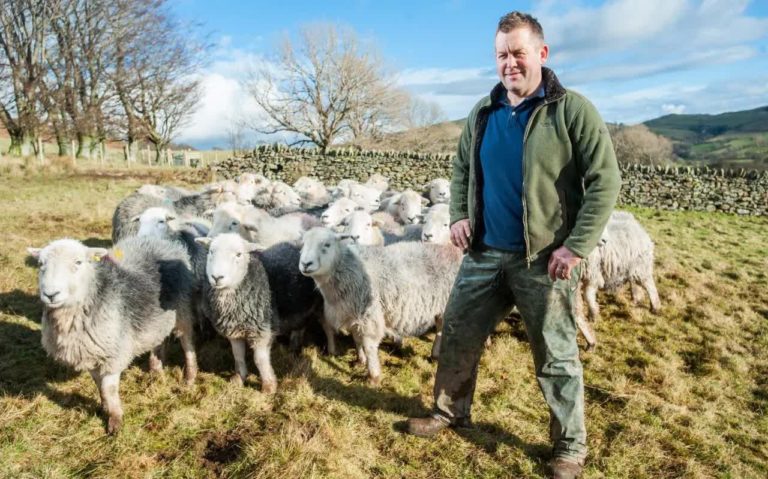
From this NPR profile:
James Rebanks is a farmer who shepherds sheep into pastures and words into books. He has a gift for capturing both the allure of his beautiful surroundings and his difficult work, and for articulating the complex, worrisome issues facing farmers today.
Pastoral Song, like his first bestselling memoir, The Shepherd’s Life, enchants with lush descriptions of England’s Lake District and Cumbrian hills, where Rebanks’ family has worked the land for 600 years. But it is more than a paean to fells (hills), becks (streams), and flocks. Inspired by Rachel Carson’s Silent Spring, Rebanks’ new book urgently conveys how the drive for cheap, mass-produced food has impoverished both small farmers and the soil, threatening humanity’s future.
Rebanks hopes to help reverse this dangerous trajectory, not just by the environmental measures he has taken on his small family farm, but by using the bully pulpit of his books and popular Twitter account @Herdyshepherd1 to advocate for change. “How can we farm in ways that will endure and do the least harm?” he asks in this important — and frequently stirring — book.
Born in 1974, Rebanks is old enough to recall the old-fashioned, mixed rotational farming his grandfather taught him as a boy. He was lucky to grow up at a time when curlews and gulls soared overhead in abundance and “the hawthorn dikes around the barley fields frothed white with blossom and hummed with bees.” Such cherished childhood memories — like seeing a mare in labor, with the foal’s limb “pushing up jagged beneath the taut skin as if she had swallowed a stepladder” — have sustained him in difficult times.
524: James Rebanks, part 1: Pastoral Song
James Rebanks’ first massively bestselling book, The Shepherd’s Life, and the images of that life he posts online, at first make you think he hails from another time. It describes a life both almost unimaginable to most city dwellers like myself and more than half the Earth and traditional, going back centuries or even millennia. He illustrates his relationships with his father and grandfather, the land, the sheep, and history.
But he also shows that he is from now, not another time. I sensed myself out of touch with humanity and nature with plastic and not knowing what trees and birds live near me. In his second book, Pastoral Song, also a massive bestsellr, he describes more his conflict and struggle with the invasion of modernity into his life, his foray into acceptance, and ultimate his joyful rejection of it.
Many of us dream of rejecting the parts of modernity that stultify us but decline to act out of fear. James rejected it, not easy. You’ll love his openness and experiences likely different from anyone you know. When British people talk about the Lake District, they get wistful. I’ve never been there. James is of that territory.
James’s views contrast and complement previous guest James Suzman‘s, who wrote about the San bushmen in the Kalahari Desert. Both speak of living in harmony and balance with nature, struggling at the first world expanding into their territory.
In our conversation, James Rebanks shares his views and experience on nature, family, and his life. I mostly bring people from organizations—businesses, political office, sports teams, etc. James comes from family, farms, and England’s Lake District. He shares a life unlike anyone I met but probably like thousands of my ancestors.