
Last week I wrote a post that referred to the satellite I worked on for my PhD. Writing it led looking up the satellite on Wikipedia. I do so every now and then.
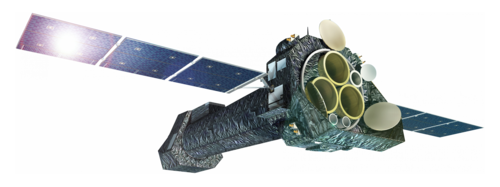
It’s called XMM-Newton. XMM stands for X-ray Multimirror Misson. It was launched in December 1999, designed for a ten-year life. It’s still going, so it outperformed its mission.
For some reason, this time looking on the Wikipedia page I noticed footnote 44, which linked to a paper “The Reflection Grating Spectrometer on board XMM-Newton”. The reflection grating spectrometer is the component I worked on. The authors listed in the footnote include my advisor. If you click the link, you’ll see my name on the author list. The paper shows calibration results. A couple of the numbers resulted from my work as a graduate student.
The paper doesn’t report any scientific results from observation, just information about the instruments. It wasn’t glamorous work, but someone had to do it. If I’m generous to myself, all future results depended on my work, but I didn’t analyze astronomical data from the satellite I worked on. I did analyze astronomical data for my PhD to complement my lab work, but since I was already starting my company (our first funding came in November 1999), I used data from a satellite from a previous generation. Usually a reward for working on a satellite is first access to its data. Somebody else got to use the data my work earned.
I didn’t know if I should wish the satellite would make groundbreaking discoveries or secretly wish it wouldn’t, so I wouldn’t regret leaving. It turns out it didn’t make any groundbreaking discoveries, as far as I know. When scientists create a tool that observes what nothing could before, you never know what you’ll find.
EDIT: What do you know, after writing the above, I noticed I show up in the paper referred to in footnote 45, The Reflection Grating Spectrometer on board XMM.
Here’s an article from The Register in 2020 on the satellite’s performance: How ESA’s keeping XMM-Newton alive after 20 years and beyond.