
For Independence Day, I thought I’d share some notes from my upcoming book on the huge historical significance of what happened around 1776 in the colonies that became the United States.
For context, for most of the 250,000 years of human existence until the last Ice Age, when the current geological period began, called the Holocene, as far as we know, our ancestors lived in egalitarian groups. After the Holocene, agriculture began, which led to surpluses of food, animals, and other resources, which led to the formation of dominance hierarchies—also known as tyranny. People also began to deplete resources, which led to imperialism.
From 12,000 years ago until 1492, the development of human society from those first necessary resources that could be controlled, when agriculture became inevitable in those few river valleys, has been like water flowing downhill.
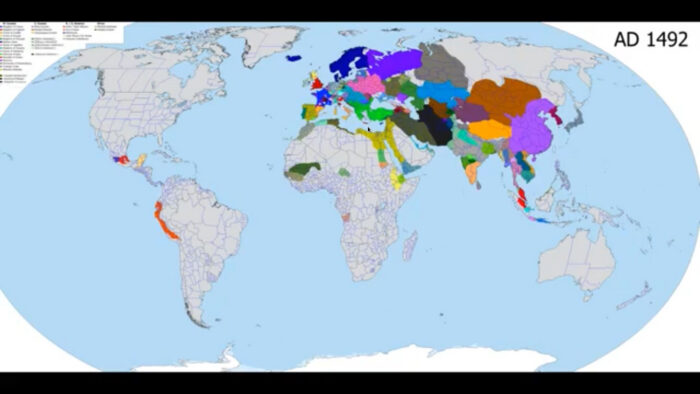
The result of that development was that in 1492, from Portugal to Japan, with rare exception everyone humans lived on arable land became governed by dominance hierarchy—that is, tyranny—competing with neighbors imperialistically.
These societies evolved into states, civilizations, and empires. The rare exception to tyranny and empire occurred when conditions allowed direct democracy. Those conditions were limited population size, homogeneous population, easily defensible territory (such as island), or territory lacking strategic value (like Switzerland).
In the map below, the colored regions are states and empires. Look at how much of Europe, Asia, and North Africa they cover. You might notice that where they don’t cover, not many people live.
Then, from 1492 to 1776, five conditions in North America enable residents to conceive of a plan for a democracy that could work.
- From what we call the Old World came a complex political structure, resulting in simple-minded people but able to destroy others but also protect selves
- In the New World was a non-tyrannical semi-democratic government. It wasn’t different because the because people were different or special but because there were no necessary resources that could be controlled as in the river valleys in the Old World, so no dominance hierarchy or imperialism. Simpler government but more complex individuals, less atrophied minds.
- The colonists saw what they considered effectively infinite resources, so there was huge demand to colonize. No systemic change, but led to huge acceleration. (I had grown up seeing only the harm caused by the colonists).
- Those effectively infinite resources meant that resources enabling European tyrants to dominate over everyone were no longer controllable, at least until people saw the apparently unlimited resources as limited. They came to see the tyrant lording over them as a person.
- The parent empire, Britain, had been moving toward democracy for a few centuries. Democracy could develop there because as an island, it was more easily defensible as technology allowed rule to expand to whole island.
The result: in these colonies emerged a conception of government of the people, by the people, and for the people with enough chance of success to declare independence.
Without those conditions, a democratic hierarchy that could span a continent as opposed to a limited territory may never have had the conditions to form. Had the colonists not acted in time, those conditions may have changed.
Had they not declared and won independence, then written an effective Constitution in time, it’s possible that humanity never would have found a counter to tyranny and empire. Democracy barely gained a foothold in time. Flawed as it was, it endures.
Happy Independence Day.