
Hosting a top-ranked podcast with the word “sustainable” in the title means being sent pre-releases of books, documentaries, and other media. Most don’t match with my focus, but some do. Often a book or author looks interesting and I research them.
Lately I was sent a pre-release of Bad Energy: The AI Hucksters, Rogue Lithium Extractors, and Wind Industrialists Who Are Selling Off Our Future, by Joshua Frank. I didn’t know the author so I looked him up and found his book Atomic Days: The Untold Story of the Most Toxic Place in America, about the Hanford nuclear site in Washington State.
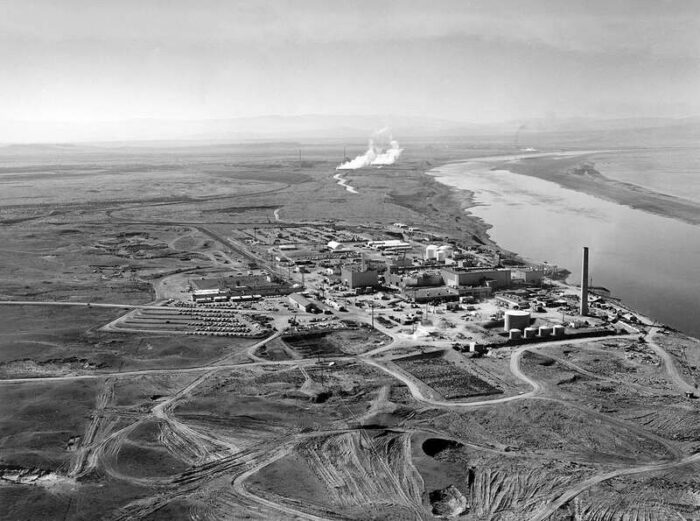
Have you heard of Hanford? I hadn’t, so I looked it up. I’ll quote what seems a source without a strong bias on this issue, Business Insider, whose headline said in 2024: The Hanford Site is America’s most contaminated nuclear location. Here’s the Wikipedia page. It seemed worth learning about.
That article began:
Sitting on 586 square miles of desert in Washington, the Hanford Site has the most radioactive and chemical contamination in America.
Buried in storage tanks beneath the ground are 56 million gallons of radioactive waste. Many of them are leaking.
In the late 1990s, Washington’s then-governor, Gary Locke, called Hanford “an underground Chernobyl waiting to happen,” the Associated Press reported.
As part of the Manhattan Project, Hanford produced the plutonium to build Fat Man, the atomic weapon that was detonated above Nagasaki at the end of World War II, and for the United States’ nuclear arsenal during the Cold War.
In 1989, after years of dismissing concerns about contamination, the site’s management finally said the site needed to be cleaned up. But cleaning up nuclear waste is difficult. It can’t be burned or buried. Soon, a waste management plant will turn the waste into glass, which can be stored away for thousands of years. It’s a slow, costly process.
Yet time is of the essence. The longer the contaminated materials are left untreated, the worse they become. Plus, natural disasters could spread the site’s contamination.
Sounds serious. The book’s description agreed:
Once home to the United States’s largest plutonium production site, the Hanford Nuclear Reservation in Washington state is laced with 56 million gallons of radioactive waste. The threat of an explosive accident at Hanford is all too real—an event that could be more catastrophic than Chernobyl.
The EPA designated Hanford the most toxic place in America; it is also the most expensive environmental clean-up job the world has ever seen, with a $677 billion price tag that keeps growing. Huge underground tanks, well past their life expectancy and full of boiling radioactive gunk, are leaking, infecting groundwater supplies and threatening the Columbia River.
I didn’t receive a copy of Atomic Days, only Bad Energy, so I didn’t start reading the book, but followed up with a few articles and videos. Hanford seems like something everyone should know about.
This piece in Aeon A people’s truth: The Hanford nuclear site was meant to be safe for its neighbours. Now they are fighting the experts to tell their story recounts what looks like serious problems exacerbated by contractors funded by government shielding them from accountability. It describes the effects on people who live there, especially so-called “downwinders” and one of them, Tom Bailie, who questioned the story of safety that the government and contractors were telling them:
Pat rolled up in a wheelchair. She told me she had multiple sclerosis, as did her sister. She said she used to pick peaches down in Ringold, across the river from the plant. She attributed her illness to Hanford. Linda chimed in that her mother had troubles with her thyroid. Her father, always slim and active, had heart problems very young. Crystal (thyroid and lung cancer, never smoked) said she never bothered with that downwinder business on account of her own health problems, but when her daughter got cancer and was diagnosed infertile, that made her angry. Gwen (thyroid disease) didn’t look well. Her husband had to heave her from her walker to a chair. The classmates all grew up on land opened in the early 1950s for irrigation, farms just downwind from Hanford. They talked about the green books the scientists gave them in the 1960s to record every bushel of wheat and pound of potatoes. All that crazy detail, they laughed.
Bailie joined us and turned to Gwen. ‘Remember how your mother used to say she didn’t feel well because of the water? And your father used to say: “You’re crazy, woman! That is a 1,200 foot artesian well.” Remember that?’ Bailie asked. ‘No one knew then that we shared an aquifer with Hanford’s leaking waste tanks. We all drank from that aquifer.’ Becoming agitated, he pulled out a dinner napkin and drew a line marking a country road. He made an X over the Holmes’ farm. ‘She got bone cancer. The girls both had thyroid problems.’ His pen turned a 45-degree angle. ‘She drowned her deformed baby in the bathtub and then committed suicide.’ Bailie marked out two more farms: ‘She had leukemia, and up there the baby was born with no head.’ Bailie stopped at Gwen’s farm. Gwen’s mother died of leukemia in her 40s. Her father also died of cancer. Gwen had a lifetime thyroid condition (and died a few years after the reunion). ‘That’s what we used to call the death mile,’ he said.
“Death mile” sounds like “cancer alley,” another place in the US that suggests violations of consent of the governed, that no person shall be deprived of life, liberty, or property without due process of law, and property rights as understood by the Constitution’s writers, ratifiers, and public.
This article about Bailie’s death, Tom Bailie, nuclear ‘downwinder’ who led rallying cry against ‘industrial recklessness’ at Hanford, dies at 76, recounted their first learning about deliberate experiments violating safety limits (the videos below describe more):
The federal government, responding to newspaper and activist groups filing Freedom of Information Act requests, released 19,000 pages of formerly classified Hanford reports in February 1986. More would follow.
They revealed chronic off-site contamination during Hanford’s first 20 years – with the heaviest releases eventually traced to Bailie’s community. Significant Iodine 131 releases continued until 1956.
The public was especially shocked by the revelation in The Spokesman-Review of a deliberate military experiment called the Green Run. In December 1949, it spread “green” (uncooled) uranium fuel in a 200-mile plume from Spokane to The Dalles, violating Iodine 131 safety limits by 11,000 times at Hanford and by hundreds of times in some Hanford-area towns.
Videos
I watched this video first. It seems informative:
A couple more videos described activism, though no one seems to know how to fix the radiation and toxicity. Current attempts seem to move the radioactive material around, slightly concentrating it in more stable glass form, but not making it go away.
Here’s another featuring Frank:
This video looked like artificial intelligence, but it’s nine years old. It also covers other nuclear disasters or near disasters. Note the bombs that fell from a US plane within the US.
Propaganda?
I didn’t research who made these videos beyond the name The Hanford Site, which has a Department of Energy logo. They are 14 years old and I didn’t cross check in detail, but I think several of the projects it announced with optimism were reported in the videos above as having failed.
There were more videos in the series, but I figured the ones below give enough idea.
Father in law worked at the plant until about 12 years ago. Got breast cancer that didn’t get caught until Stage 3 at about 54. Beat it somehow after a few years of treatment. He was clear for few years, then it came back with a vengeance throughout his body and took him out in about 3 months last year.
I’m sorry to hear about the loss but appreciate your sharing. I don’t know the details and correlation doesn’t mean causation, but what I learn about Death Mile and more about Hanford sounds condemning to me.