
This week I finished:
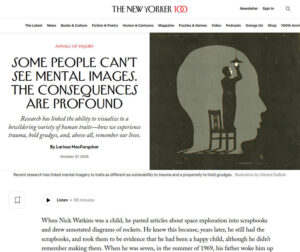
“Some People Can’t See Mental Images. The Consequences Are Profound,” by Larissa MacFarquhar in the New Yorker: A few years ago I learned that most people, when they imagine something visual, actually visual something, as if they were seeing it. By contrast, when I imagine seeing something, I don’t see anything. I just imagine it.
Apparently nobody knew of this distinction until recent decades and only recently has it become well known, studied, or verified through methods like brain scans. It also acquired a name: aphantasia. For my part, it’s relieving to know I’m not alone. It explains a few things that didn’t make sense, like how counting sheep wasn’t a complicated exercise. When people told me to visualize things like counting sheep or to relax by imagining myself in clouds, my brain did the opposite of relax. I couldn’t understand what people meant. My mind felt like when I give my computer a hard task and the fan starts whirring.
By contrast, some things to me seem easy. Apparently aphantasics are overrepresented in science. This article features an aphantasic PhD in physics, which I am and there aren’t many of us. When I compare deaths from air pollution (9 million per year) with total number of slaves (9 million over centuries), it’s obvious air pollution is far far far bigger and more deadly a problem. But I think most other people have seen gruesome images and movies of slavery, but compared to no such images of people dying from pollution, I think they can’t compare apples to apples.
Some quotes and reflections from the article:
“Clare had realized that she was the opposite—hyperphantasic. Her imagery was extraordinarily vivid. There was always so much going on inside her head, her mind skittering and careening about, that it was difficult to focus on what or who was actually in front of her.”
“In 2012, two Harvard psychologists published a study about visual imagery and moral judgment. They found that people with weak imagery tended to think more abstractly about moral questions.”
Reflections I wrote while reading the piece (sorry just notes, not edited for the reader): no wonder why sketching is so hard, or music. I can’t see a hand when I’m not looking at one. I don’t hear music when I’m not hearing it. The harm of polluting and depleting are as harmful as those from slavery, even if I haven’t been shown the pain and suffering of people dying from lung disease or learning their babies were born with birth defects. I wonder if people who have seen movies of overseers whipping slaves consider buying cotton in 1850 more wrong than buying airplane tickets in 2025, even though today’s system causes orders of magnitude more suffering and death, though they haven’t seen it visually represented. What does dying of lung disease feel like? I imagine it’s torture, all the more for the family. I don’t think they suffer less because the person buying the airplane ticket thinks it’s important to show their kids museums around the world or that no one physically held a whip.
Is this equality of empathy and compassion lost on people, who instead distribute it based on the accessibility of specific visual memories or imaginations? If something looks more painful do they treat it as more painful?
Another quote from the piece, about the opposite condition, hyperphantasia: “They might become so absorbed while on a walk that they would wander, not noticing their surroundings, and get lost. It was difficult for them to control their imaginations: once they pictured something, it was hard to get rid of it. It was so easy for hyperphantasics to imagine scenes as lifelike as reality that they could later become unsure what had actually happened and what had not. … One hyperphantasic told a researcher that he had more than once walked into a wall because he had pictured a doorway.”
More notes, from the latter part of the article, which treated an aspect (not creating memories) that doesn’t apply to me: Loss of memory didn’t make sense. I don’t lose memory. These sentences couldn’t be further from my experience: “When aphantasics recovered from bereavement, or breakups, or trauma, more quickly than others, they worried that they were overly detached or emotionally deficient. When they didn’t see people regularly, even family, they tended not to think about them.” That section of the article felt foreign. I’ve had hard times breaking up. I feel like I’ve taken longer than the women I’ve loved to get over them.
These sentences are the opposite of my experience too: “It was not just the distant past that she had lost—she was continuously aware of the present slipping away as soon as it happened. She had already forgotten what her two sons had been like when they were little, the feeling of holding them.” Memory doesn’t seem to connect to internal visualization for me, so not having the latter doesn’t mean not having the former.
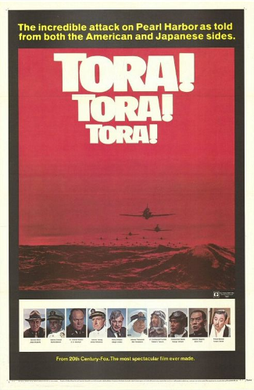
Tora! Tora! Tora!, directed by directed by Richard Fleischer, Toshio Masuda and Kinji Fukasaku: I think someone suggested this movie after I mentioned how much I loved Tokyo Story, which was recommended to me after Yi Yi and A Brighter Summer Day.
I might have liked Tora! Tora! Tora! more if not for the comparison I couldn’t help make with the three other movies. The three other movies were sublime in their artistry, especially the acting and directing. By comparison, this movie’s acting was mostly indicating. The direction was just plodding along. I could tell that characters had backgrounds that led them to say and do things that didn’t make apparent sense but resulted from something in their pasts, but the movie didn’t show it.
I understand from reading about the movie after watching it that it was accurate historically, not counting the specific types of planes or boats. It showed the parallel actions of Japanese and Americans, the rivalries between each nation’s military bureaucracies, and the number and scope of American miscommunications that prevented its preparation.
A few characters on each side showed meaningful awareness and vision beyond just what the movie showed, such as that some Japanese foresaw that they couldn’t defeat the US: however great their victory at Pearl Harbor, they would lose. Mostly, characters just revealed what people said, without drama.
The scenes of attack and ships at sea, I had to imagine seeing through movie technology at the time, before I was born, long before Jaws or Star Wars. I guess they were great since the movie won an Oscar for its effects, so maybe it was a blockbuster and somewhat a documentary on how the Americans bungled their intelligence and Japanese were carried by inertia into winning a battle that would lose them the war, but as a work of art or personal expression, it pales in comparison to the other three. They may all use film, but they’re simply a different medium than this movie. And a different class of expression.

At the Heart of the White Rose: Letters and Diaries of Hans and Sophie Scholl, edited by Inge Jens: I only read the first 27 pages, from the free online part of this book, so I haven’t read I expect are the critical parts: Hans and Sophie choosing to risk their lives acting to oppose Hitler in Munich, Germany.
I mention this book, or just the few letters they wrote, because they reveal how ordinary these two people were. They were nobody special. They started with no special connections or perspective to give insight or vision that anyone else couldn’t have had. They had no reason to be more courageous than anyone else.
Anyone could have done what they did. Today, anyone can oppose our system and culture leading to greater death and destruction.