
You’ve probably heard the advice not to compare things to the Holocaust or slavery. I have. It says that however bad you think your thing is, it’s not as bad and you just end up looking ignorant.
[EDIT November 16: Immediately after posting this post, I started updating and editing the graphs, explanations, and more. The changes were too big to just update this post. I’ll keep it here for reference and post new versions, but consider it a rough draft.
Here is a later version, in two parts:
- The Scale and Pollution and Depletion’s Effects on People: Here, now, not future projections
- The Timeline for Pollution and Depletion’s Effects on People
]
I’ve written before about the difference in levels of suffering and death from today’s environmental problems and the Holocaust and slavery before, in Magnitude of suffering and death then and now and Plastic: “between 400,000 and 1 million people die each year in low- and middle-income countries because of diseases related to mismanaged waste”.
Two relevant numbers:
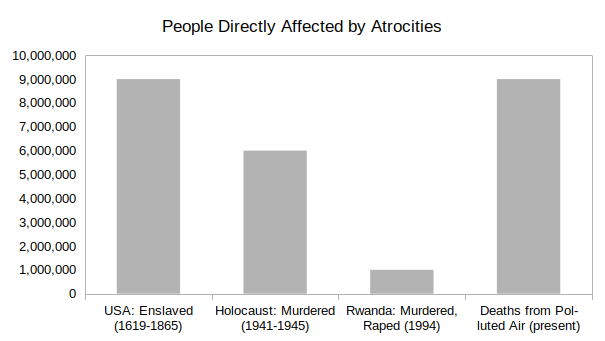
- The Lancet, one of the most respected medical journals, reports that nine million people have died per year from breathing polluted air since 2015. More recent reports show that that level hasn’t dropped.
- The cumulative number of slaves in the United States was slightly more than 9 million, based on a peer-reviewed paper From ‘20 and odd’ to 10 million: The growth of the slave population in the United States, by J. David Hacker in the journal Slavery & Abolition.
- I’ll also include roughly half a million Rwandans killed and another half million raped in the 1994 Rwandan Genocide.
I’m going to graph these numbers. It’s tempting looking at numbers to forget that they represent human lives and suffering. It might be easy for some to look at them and lose the respect and honor—these aren’t the right words, but I don’t know if any words can describe the emotion due them—the people involved deserve. Please don’t let that happen. My goal is to prevent future atrocities and to decrease present ones.
Before looking at the graph, a few things to keep in mind.
First, I’m not presenting them as rigorous or evidence. Make of them what you want. I’m not trying to publish them in a peer-reviewed journal. Still, I think they convey meaning.
Second, some of my earliest physics training included always to keep the units for numbers and never mix units. In the graphs below I convolve deaths, rapes, and enslavement, which are different results.
Third, I’m only using a few available numbers. The first column is the number of people enslaved in the US (and the colonies before 1776). The next is the number of Jews murdered in the Holocaust. The next is the number of people murdered and raped in the Rwandan Genocide. The fourth is the number of annual deaths from breathing polluted air.
These numbers aren’t directly comparable since you can’t compare enslavement, death, and rape, though they’re all horrific. Also, the US and Rwandan numbers refer to just one country. The pollution deaths are global. Should I count global enslavement? I may make more graphs if people point out other relevant numbers.
It’s tempting to point out that people deliberately enslaved, murdered, and raped people in the first three cases. People today aren’t trying to kill the people who breathe the polluted air, but this purported difference misses who drove the first three atrocities. In 1850, very few people held whips, but people around the world bought sugar, cotton, tobacco, and other goods that funded slavery. Tens of millions of Germans paid taxes that funded the Holocaust and participated in making the state work. The Rwandan situation was driven by colonialist forces funded by global trade.
Just because someone chooses to live flying distance from the rest of their family and then claims they have no choice but to fly doesn’t change that they are funding a system as much as someone buying tobacco from a plantation.
We’ve all seen images of slaves suffering in movies and photographs. We’ve seen Holocaust victims. Their pain and suffering seem beyond imagination. We haven’t seen images of people suffering and dying from lung diseases and other problems from pollution. It’s tempting to conclude they don’t suffer as much but lack of imagery doesn’t mean anything. The suffering may be more acute and painful. Maybe it takes longer.
In all cases, the people suffering and dying have family. Who knows how the suffering affects them.
Today’s deaths from breathing polluted air is but one measure of how people are suffering and dying from polluting and depleting. It leaves out refugees and other ways people suffer, especially those that don’t kill. There are many people enslaved today to extract fossil fuels. Maybe in a future post I’ll include more of them.
Perhaps biggest: deaths from environmental problems are projected soon to dwarf the number of people already dying from just the one cause of breathing polluted air.
Despite all these caveats and considerations, I believe this graph communicates meaning:
Per Year
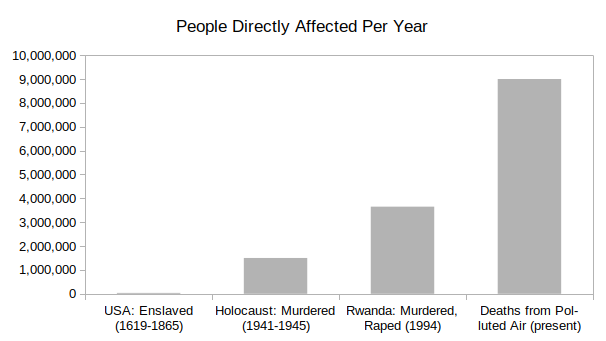
The number of slaves happened over centuries. The Holocaust was much shorter and the Rwandan Genocide shorter still. Here’s the graph of people affected per year.
You could point out that most of the slave numbers happened near the thirteenth amendment that (mostly) made slavery illegal. In 1865, there were four million slaves in the US, so maybe I should divide by a smaller number than the years between 1619 and 1865, but it would still have to be at least ten years.
The Rwandan Genocide happened over about 100 days, so I divided by 100/365, which raised the number.
But only one is ongoing
The first three atrocities are in the past. Everyone in the world is still breathing polluted air.
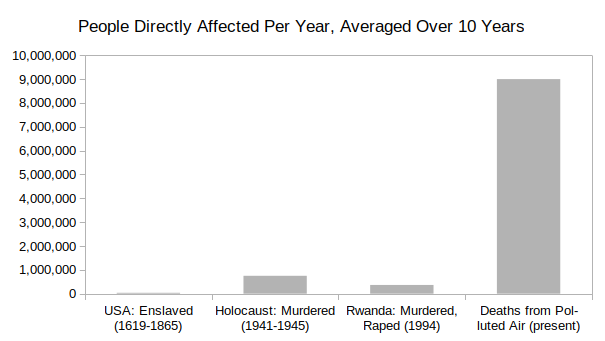
In the next plot, I averaged over ten years. Since the Rwandan Genocide and Holocaust didn’t last ten years, they went down.
If you want to know why I consider sustainability so important, this graph, even including all the considerations above, shows a big part.
If I lived in 1860, in the wake of the Dred Scott decision, I’d like to think that whatever I had been doing before, I would work on abolitionism, likely making it my top priority.
If I lived in 1941, after learning of Hitler’s antisemitic plans, I’d like to think that whatever I had been doing before, I would work on defeating the Nazis, likely making it my top priority.
Those times were nearly unique in world history. They called for action like no other times. Most people didn’t act. If we learn anything from history, one of the top lessons must be to oppose such outcomes with all our abilities. The mechanism may appear different, but that difference shouldn’t blind us to the suffering and death we can stop.
I’m not sure what I could have done during the Rwandan Genocide since it stopped so soon after it started, but we all know plenty of things we can do to stop today’s vastly greater death and suffering. My book Sustainability Simplified answers many things. My workshops train you in effective joyful ways to act.
I just don’t see how anyone can look at numbers like these and say, “When it affects me I’ll act” or imagine that today’s situation is not on the scale of past atrocities. It dwarfs them. It’s not future. It’s here and now and has been for decades.
How can anyone not make ending pollution and depletion through sustainability leadership a top priority, here and now?
How can anyone not make ending pollution and depletion a top priority?
How can anyone buy a plane ticket, an SUV, or takeout?
I’m not trying to sell it, but at least sign up for my workshop.
Not only do the workshops enable you to act effectively, they bring joy to your life, replacing internal conflict and denial. They enable you to bring that joy to others, enabling them to act effectively and lead others, who will return gratitude.
This Post Has 0 Comments