
I gave a keynote and led a leadership workshop near Harrisburg, PA—a place halfway between where I grew up in Philadelphia and where my dad grew up, in Pittsburgh, so we passed through there many times growing up.
I learned that the city hosts a Civil War Museum, so arranged to spend half a day there. I recommend it.
A few items affected me beyond what I would have expected. Scroll down and you’ll see the leg irons, collar with spikes, and whip with spiky metal spurs (the card implied that it wasn’t known if this particular whip was actually used, but even if not, just that someone made it says a lot). First a few words.
I’m not sure the pictures will hit you as seeing them in person hit me, since I’d seen such things in pictures before. It felt different in person. I couldn’t touch them, but was close enough to had there been no glass.
Seeing them gave a more visceral sense to what I’d always known, that people made these devices to put on other people, and they thought that they were doing something good, right, and natural. The main difference between them and any of us, including you and me, was that they were born into a culture that induced them to act this way. If you believe they were fundamentally different, say genetically, well, the scientific evidence I know of shows no scientific basis for race, so I don’t accept that millions of people born in the South were all different in the same way.
It’s tempting to say the people who made them are inhuman and must be different than we are. We would never make or use such things. But then how are they different? Philip Zimbardo’s book The Lucifer Effect compiles overwhelming research that shows that with rare exception, nearly all of us would have complied. Much of that research was inspired by a need to understand how tens of millions of otherwise regular people could became Nazis.
The Challenge of Empathy and Compassion
It’s very difficult to see the commonalities between yourself and people who commit atrocities, yet great historical figures like MLK, Gandhi, and Jesus promoted that empathy and compassion. When you see slave leg irons like the ones below, or Inquisition thumb screws or other tools of oppression, if you don’t see that you, as a human like them, could do it, you don’t understand humanity or yourself.
I’m not saying you’re bad or judging. I’m saying we’re human and if we want to influence people to act by their values, it helps to understand them. We can’t understand them if we can’t identify parts of them that we share, or at least not empathizing makes it harder.
I have never found a case where low self-awareness helps. It’s difficult or impossible to influence people you have no authority over without empathizing with them when they tell themselves every day that what they are doing isn’t bad, even if they think it is deeper down.
The challenge of empathy and compassion goes the other way. Consider the people we may want to empathize with, those who suffered. Our greatest enemies were as human as they were. When you see people suffering, it’s tempting to think that you connect more to them than your worst enemies, but they are just as human.
A third way: if you think people in wheelchairs need help and people with autism are neurodivergent but psychopaths or narcissists are bad, you’re missing that they’re all human.
If you think Columbus was one of history’s bad guys and therefore different than you, but you pollute and deplete, you’re denying a basic part of being human.
The Pictures
The leg irons. Sorry the image is hard to see but the museum was dimly lit and this display was mostly in shadow. It occurred to me that you could see clearer images online so seeing my images will probably connect you less than images online, but maybe knowing that someone you know took the picture may help, perhaps helped by my reflection.
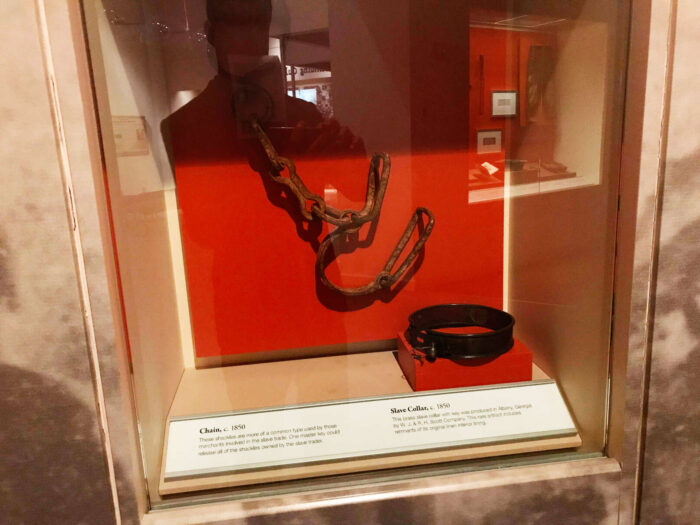
The note for this collar with spikes to make escape harder pointed out that they made running in the woods impossible.

As I noted above, the text implied that it wasn’t known if this whip with its spiky metal spurs was actually used, but that it was made shows that people at least conceived of such things. The photograph shows someone wearing a collar like the one above.

This Post Has 0 Comments