
This week I finished:
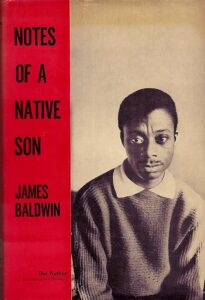
Notes of a Native Son, by James Baldwin: After last week’s Fire Next Time, and August’s debate between Baldwin and Buckley, I want to learn more about Baldwin. I like his analysis.
It’s hard to gauge how much of his analysis was new. I read that Henry Louis Gates Jr. said that Baldwin “articulated for the first time to white America what it meant to be American and a black American at the same time.” Reading his work seventy years later, I’ve heard that articulation before, but suspect a lot of it originated in Baldwin.
I’ll be candid. I don’t understand a lot of his language. I kept saying to myself, “I’m glad I have a PhD in physics so I know I’m not dumb, because I kept thinking he’s probably communicating more than I’m understanding.” I think I got the gist of the parts that are most relevant to me: what it was like to live as a black man in those times in those places, clarified in ways no one had before. I suspect many people read it and felt something like, “Yes, that’s what it feels like! I’ve felt it, but had never been able to articulate it” or “Oooh, so that’s what it’s like to be on the other side.”
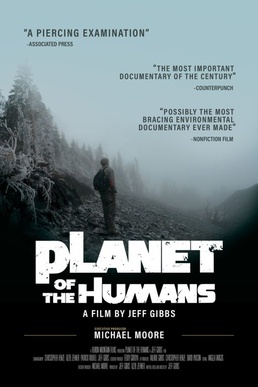
Planet of the Humans, directed by Jeff Gibbs: I watched this documentary when they released it during the pandemic. I remember thinking it seemed too critical for me to handle. I felt: sure, there may be problems with solar, wind, and other energy sources, but they must not all be deal breakers. Some must be surmountable.
Watching it now, and reading reviews and follow-up research, combined with having learned more, I conclude that while it got some details wrong, the overall message—that so-called renewables are not the panacea people think they are and that the movements supporting them have corrupted themselves from denial of their problems in the vain hope of something to transition to—is mostly accurate. I also see more of the sliminess of environmentalists that people look the other way about because they feel they have no alternative and want something, anything, to grasp.
One big difference: I see ways forward that the movie doesn’t consider, which is what Sustainability Simplified covered and my new book covers more. I am confident in an effective route to sustainability. It’s simple though not easy. So I see the movie as reasonably accurate in criticizing the movement, but missing what’s most important about sustainability: the route forward.
White Privilege and Male Privilege: A Personal Account of Coming to See Correspondences Through Work in Women’s Studies and Unpacking the Invisible Knapsack: by Peggy McIntosh: This piece came out in my first year in college. It’s short and easy to read. Though I only read it this week for the first time, I feel I’ve been living in its wake.
I found it by looking up resources describing white privilege. Finding it felt like finally getting to scratch an itch that’s been affecting me for decades: where do all the talk and underlying beliefs on white privilege come from, seeing how coordinated it seems? The sources that pointed to it say it is the first source.
Of course it doesn’t exist in a vacuum so some sources preceded it, but it seems like it played a significant role.
As with most of my comments on works on race, racism, and antiracism, it doesn’t understand where the concept of race comes from. Since she misidentifies what it is and how it started, she ascribes motivation where it wasn’t and distracts from what could work to decrease or end racism.
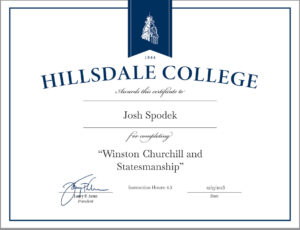
Winston Churchill and Statesmanship, by Larry Arnn: My next course from the ultra-conservative school, about a conservative government leader.
I found two threads very relevant. One is Churchill’s view on science and technology and how much they risk destroying everything. Churchill was worried most about weapons, having seen early machine guns ripping through people like a conveyor belt, then playing a role in developing the atomic bomb, then learning about the hydrogen bomb. He was also worried about changing humans through manipulating DNA.
His worries apply to science and technology polluting and depleting. I’m interested in talking to Arnn about that application.
Two, Churchill values constitutions and sticking with them, at least when they’ve been tested, like those of the US and UK. Since my work, especially the new book, focuses on the US enforcing our Constitution, I see people who valued Churchill’s views and actions supporting my approach. They won’t at first, based on it being contrary to how we live our lives, but believe they will when they see that how we are living violates our values, especially some written in plain English in our Constitution and Declaration of Independence.