
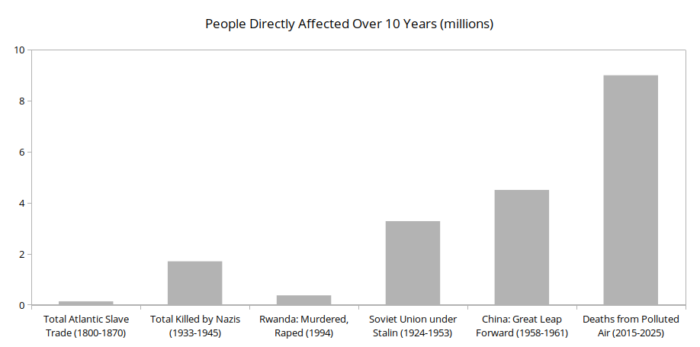
Recalling the plot from my post The Scale and Pollution and Depletion’s Effects on People: Here, now, not future projections (read the post for context) that shows how many more deaths our system today is causing than past atrocities, in particular, the Atlantic Slave Trade:
I pose the questions in this post’s title:
First, if slaves didn’t have a choice in being enslaved, did owners? It seems clear to me that slaves didn’t have any choice in being enslaved. People used weapons and other means to deprive them of agency and coerce them into being enslaved.
What about the owners? They lived within a system that to some degree coerced them too. It told them that slavery wasn’t bad. In fact, it delivered many messages that slavery was good. Maybe some were indebted or trapped into patterns they couldn’t get out of except to pay off their debts or were unable to conceive of other ways forward.
They may not have had guns to their heads with people saying, “practice slavery or we’ll kill you,” but coercion can be effective without being that extreme. Maybe they saw no way to feed their children otherwise. Operating a slave ship even as captain or crew carried a high chance of death, implying that they felt they had little choice.
How about the people buying slave-produced goods? Did they have a choice? Could they have avoided those goods? Could they have avoided helping fund a system dependent on slavery?
If you’re like me, you believe that they did have a choice and could have done differently. Some may have had extenuating circumstances that at least partly explained their actions, but even then, I expect many more could have tried harder.
Nelson Mandela, for example, saw those practicing Apartheid as caught in the same system those suffering under it did. That’s why he learned Afrikaans in prison, as he explained for people who wondered why he was learning the language of his oppressors.
Second, do we have choice to do what we do that harms others? If the system we participate in kills far more people than slavery did, and we buy goods and services that advance that system, do we have a choice in our funding our system?
It’s tempting to say we aren’t holding whips or harming people directly, but no one person caused slavery either. Very few people held whips. Most people paid their wages to, indirectly, just as we fund pollution, depletion, and other results that cause today’s death and suffering.
It seems to me that if we believe people who enslaved and people who funded slavery could have chosen differently, then so can we. To suggest otherwise says that people who enslaved were innocent.
Does what I wrote above to explain the behavior of people who enslaved apply to us?
We live within a system that to some degree coerces us. It tells us that the results of pollution and depletion aren’t bad. It delivers many messages that behavior that pollutes and depletes is good. Some of us are indebted or trapped into patterns we can’t get out of except to pay off our debts or we are unable to conceive of other ways forward.
We may not have guns to our heads with people saying, “do things that pollute or deplete or we’ll kill you,” but coercion can be effective without being that extreme. Maybe we see no way to feed our children otherwise. Doing things that pollute and deplete carry a high chance of death to ourselves and our loved ones, implying that we feel we have little choice.
It’s tempting to accept such things. At least the evidence of many people saying such things to me about themselves suggests so.
I think otherwise. I believe that we can act and will prefer life when we do. I don’t want to join a community of people explaining their behavior using arguments people did to enslave. I hope you don’t either. I prefer to extend the legacy of people who went against the tide of mainstream culture to oppose the institution.
Nelson Mandela didn’t accept Apartheid just because his oppressors were trapped in the system too. He opposed the system and used empathy and learning about his oppressors to inspire them to work to end it too. Hence he shared the Nobel prize with de Klerk. He also got his job. Talk about a role model. I’d much rather extend Mandela’s legacy that keep explaining my behavior the way people who practiced slavery did, while contributing to far more deaths.