
I talk about the USSR gulag system, abolitionism, slavery, the Holocaust, and similar atrocities in the context of pollution and depletion. Most Americans know the horrors of slavery and the Holocaust. We know viscerally the images of slaves’ welts and concentration camp survivors looking like skeletons. By comparison, images of pollution and depletion look like piles of garbage and graphs of CO2 concentration. Similarly, few images of the gulag exist because few were taken and few Americans register how many more suffered and died, nor how gruesome the conditions.
Am I stupid, ignorant, or crazy to talk about these atrocities in the context of pollution and depletion?
Context and Frame of Mind
Before reading this post, it helps to clarify how you feel about some of the greatest causes of suffering and death and what you would have done had you seen them coming. Keep your answers to the following questions in mind for the rest of this post, especially if you think the questions are not relevant to today owing to the difference in scale of suffering.
- If you lived in the time of slavery, the Holocaust, or the USSR gulag, would you have acted?
- Would you have tried to help reduce the suffering of people who didn’t consent?
- If your actions, the taxes you paid, or the products you bought ended up funding the atrocity, even if you didn’t want them to, would you have tried to help?
- What if you knew you couldn’t change the system but knew that if you continued behaving unchanged, your actions would hurt people?
The Scale of Today’s Suffering and Death
Before the Civil War, slavery was brutal for slaves, but the amount of death per year was small compared to the Civil War. So far the US and other nuclear powers have seen only modest political instability. The amount of death we see from pollution and depletion will be small compared to what follows if we keep not enforcing the 3RMRs. Still, the number and rate of deaths so far from pollution and depletion indicate the gravity of our situation and how much greater the political instability will unleash.
This book will help you understand and act on this solution with resolve and purpose. First we have to understand the problem. One manifestation: Last year I stumbled on an article in a peer-reviewed medical journal that said that nine million people died in the year 2015 from breathing polluted air. It didn’t count only people working in factories. It was just people breathing, what we all need to do.
The journal is a regular medical journal, not part of what some call the Climate Industrial Complex. Other research found similar results. Harvard’s School of Public Health reported in 2021 that, “Worldwide, air pollution from burning fossil fuels is responsible for about 1 in 5 deaths… In the United States 350,000 premature deaths are attributed to fossil fuel pollution.” The Lancet, one of the most respected medical journals, reports that nine million people have died per year from breathing polluted air since 2015. More recent reports show that that level hasn’t dropped.
These nine million annual deaths weren’t the biggest threat projected for humans to face. It wasn’t projecting into the future at all. It was documenting what had happened ten years ago. It wasn’t documenting about “the planet” or “the environment” in general. It was reporting on how humans are affecting other humans. It turns out the death toll from that cause has remained about the same in the decade since.
I found the article because I work on sustainability leadership. As I wrote in my last book, Sustainability Simplified, I’ve learned that proposed solutions based in technology, market incentives, and legislation are tools. Like fire and sharp knives, tools augment the values of the people and society wielding them. Whatever we want them to achieve, they will accelerate the results we’re seeing already.
If we want to change their results, we have to change our culture, to restore lost values from when humans lived without polluting or depleting. Since changing global culture would not necessarily be possible and I didn’t want to waste my time, I researched if humans had changed global culture in the time we have. We have, at least twice: abolitionism and the move to representative democracy.
Researching abolitionism, I had found a paper on how many people were enslaved in the United States and the colonies that become the US: also about 9 million. The cumulative number of slaves in the United States was slightly more than 9 million, based on a peer-reviewed paper From ‘20 and odd’ to 10 million: The growth of the slave population in the United States, by J. David Hacker in the journal Slavery & Abolition.
I first thought to avoid comparing the numbers. I had learned not to compare things with slavery or the Holocaust: My thing would never be as serious and I would look ignorant for the suggestion.
But the numbers were nearly identical. Speaking of the Holocaust, its 6 million Jews killed seemed close too. I looked up Rwanda’s genocide of 1994 and learned it involved about a half a million murders and half a million rapes.
In physics I learned always to keep track of the units a number indicated. These numbers’ units—murder, enslavement, and rape—weren’t identical. One occurred in Europe, another Africa, another US, another global.
Still, scientists do back-of-the-envelope calculations that sometimes yield insight and inspire more serious research. Also, I thought of the book Freakonomics, whose cover I loved. It shows an apple mixed with an orange, declaring from the start: we’re going to do what everyone says not to, we’re going to mix apples and oranges.
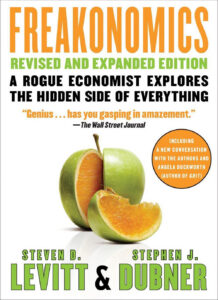 From another perspective, they’re both fruit, so can be compared. I found the book valuable for expanding my perspectives. Many others must have too. It became a New York Times bestseller and spawned another book, a podcast, and more.
Another big difference: US slavery was legal from 1619 to 1865. Our economy is killing as many people per year that the US enslaved over centuries. Every year we’ll kill that many again, a number projected to increase, and small compared to other projected casualties from human impact on other humans. Even the Holocaust took years, from roughly 1939 to 1945.
I was as full of objections as you probably are, and not just on units, but I wasn’t trying to publish for peer review. I was looking to understand scale and see what I could learn from some Freakonomics-style analysis. Regarding environmental problems, most of my life I felt like many did: I’ll act when it affects me. Things haven’t much affected me yet. Hurricanes, beaches covered with plastic, and other things in the headlines look serious, but nothing remotely like US slavery or the Holocaust. Since headlines focus most on the climate and visible things like losing coral reefs, I figured other issues would be modest.
It’s tempting to think, “The Nazis and slaveholders chose to harm their victims. They were deliberately cruel. I’m not trying to be cruel. I’m just living my life and can’t help those unintended consequences.” (TYMCALM) Most people didn’t whip slaves or work in concentration camps. In the 1800s, they just bought sugar and cotton or in the 1930s paid their taxes and enjoyed that Germany was regaining employment and stature after World War I. In other words, markets of regular people funded a small number of people who performed acts that were cruel and as essential to the system.
Was I wrong to compare suffering? Would comparing numbers dehumanize victims or dishonor their suffering? People in public health compare numbers of deaths to save lives, as do people in the military, to defend their nations. My goal was not to blindly compare numbers or think about “the planet” in the abstract, but to save human lives too. If you’re angry, outraged, or questioning about my comparing pollution to the Holocaust or slavery, hold that thought. We’ll come back to it.
We’ve seen movies and images of enslaved people whipped, lynched, and more. We’ve seen the horror of people in concentration camps. Smokestacks, cargo ships, and oil refineries seem benign in comparison so it’s also tempting to suppose that the suffering they caused wasn’t as bad, but the availability of imagery or its horror is not a measure of people’s experience. Dying from lung cancer may involve years of physical and emotional pain. Most victims have family. Do they feel better for the people funding their pain being distant, in their minds just buying big SUVs, plane tickets, or products for convenience or leisure whose factories that produced them are killing them?
Keeping all these concerns in mind, the numbers seemed to me worth comparing. The raw numbers are the least comparable, but most accessible:
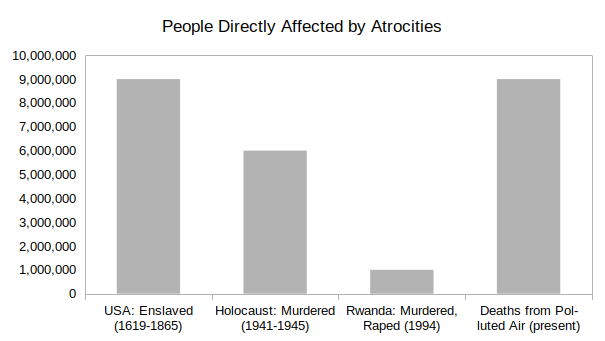
Here are those numbers per year:
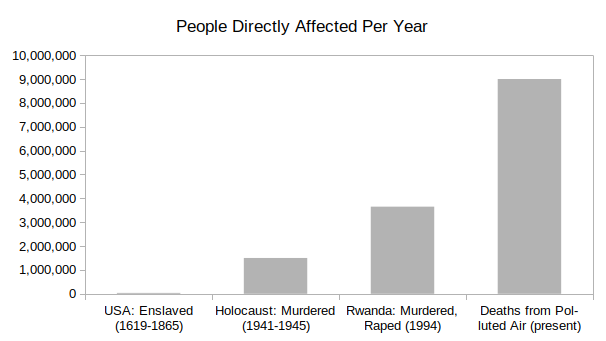
This chart represents a big part of how I considered how we humans are impacting each other when that impact is mediated through the environment. I grew up learning about slavery and the Holocaust. I don’t mean to minimize them. On the contrary, I believe a major reason to learn about them is to apply what we learn to prevent future atrocities.
If we don’t stop polluting and depleting, in another ten years, the Holocaust and Rwanda bars will become relatively smaller.
It’s hard to look at this chart and say, “I’ll act when it affects me,” especially if you believe people should have acted before US slavery grew into the tens or hundreds of thousands or the Nazis seized power. On the contrary, the chart makes me think of the poem by the German Lutheran pastor Martin Niemöller as quoted at the US Holocaust Memorial Museum:
First they came for the socialists, and I did not speak out, because I was not a socialist.
Then they came for the trade unionists, and I did not speak out, because I was not a trade unionist.
Then they came for the Jews, and I did not speak out, because I was not a Jew.
Then they came for me, and there was no one left to speak for me.
Is it wrong to recall that somber message for something other than the Holocaust? I believe that part of its point was to prepare future generations to prevent such outcomes. I don’t think we should expect future outcomes to look just like past ones—for example, with a person like Hitler or Stalin driving it.
Other differences merited another graph. First, while racism and antisemitism persist, and I believe we must work to end them, US slavery and the Holocaust ended. Today’s pollution and depletion continue. To show that significance, I averaged over a ten-year interval. The bar for today’s pollution remained unchanged since we’ve killed 9 million per year for ten years. Likewise for US slavery, which lasted far longer. The bars for Rwanda and the Holocaust dropped because they didn’t last ten years.
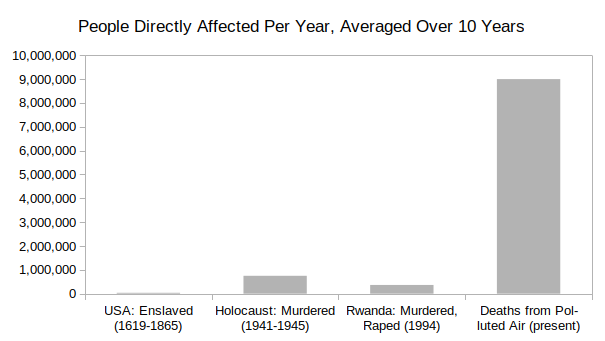
Next, the Atlantic slave trade involved more than the British colonies so I included the total number of slaves taken from Africa bound for the Americas. Also, the Nazis killed more than Jews so I included all their victims. I also included the Muslim slave trade, deaths in the Soviet Union under Stalin, and deaths in China under Mao.
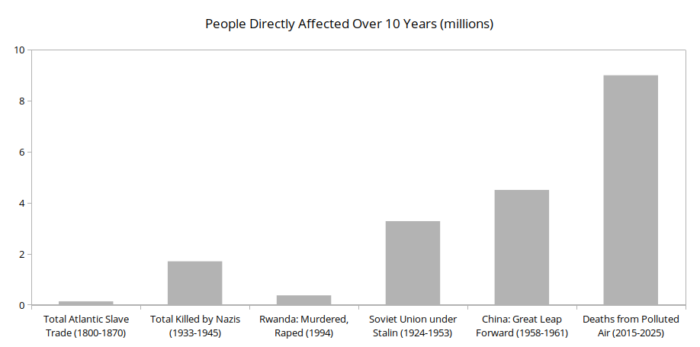
Again, if we don’t stop, in time, the first five bars in this chart will become smaller relative to today’s deaths from pollution since their atrocities all ended, whereas ours is increasing. If you believe in other ways humans are depriving others of life, liberty, and property when mediated through the environment, as I do, then you likely believe projections of billions of people so deprived that dwarf today’s deaths from polluted air. I’ll hold back from graphing projections and stick with historical data, but note for scale, just one such projection. Researchers at Cornell found, “By 2060, about 1.4 billion people could be climate change refugees,” a number 155 times greater than today’s deaths from polluted air.
I didn’t adjust the chart for population growth since the other events were regional, not global, but when I do, only Stalin’s reign surpasses deaths from polluted air. Otherwise, deaths from polluted air remains the tallest bar, though if combined with deaths from other pollution and depletion and extended another few years, it again surpasses Stalin, and will continue to grow.
By the end of my upcoming book, you’ll see that all these effects resulted from one cause, including slavery (US and otherwise), the Holocaust (including fascism, antisemitism, genocide, and racism in general), tyranny (including fascism, Stalinism, and Maoism), colonialism, imperialism, wars over resources, and our environmental problems.
If I lived in the years leading to the Holocaust or Civil War, I like to believe that I would have acted. No one could have known with certainty they would have happened, but today we can learn from them.
When people learn of my having disconnected my apartment in Manhattan from the electric grid or that I take years to fill a trash bag with household garbage, they call me extreme. Today, I tend to think to myself, “Was Lincoln extreme for promoting zero slavery? Since some people owned hundreds of slavery, would allowing a few for people who wanted to balance other people’s freedom with their wanting to relax sometimes?” As Lincoln understood and communicated when he said that a house divided against itself could not stand, a nation could allow slavery or could have liberty, freedom, equality, and democracy, but not both. He didn’t just feel that way. The nation tried for generations with compromise after compromise, market incentives, legislation, and technology to balance slavery and freedom. They failed and delayed the inevitable.