
This post follows The Scale and Pollution and Depletion’s Effects on People: Here, now, not future projections. I suggest reading it first.
The timeline is important. Before the atrocities above, things could seem like they might work out, then explode. I could treat any of them, but will pick US slavery since its timeline is long, so easiest to discern.
Here is the increase in number of slaves in the US from 1610 (zero) to 1860 (4 million):
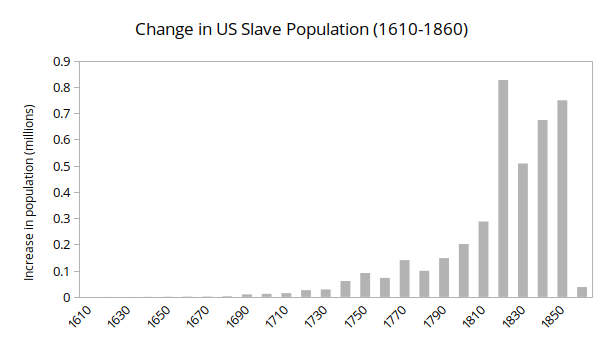 US slavery in the years approaching 1860 involved a national culture of trade, torture, and killing. While any instance of slavery is cruel, that national culture didn’t exist in 1619. Oxford-educated Trinidadian historian Eric Williams wrote, “A racial twist has thereby been given to what is basically an economic phenomenon. Slavery was not born of racism: rather, racism was the consequence of slavery.” [my emphasis] That is, the colonists in the seventeenth century were practicing not what we know of from just before the Civil War but what had been practiced globally since before written history. Colonists practiced indentured servitude with other Europeans and enslaved indigenous North Americans to some degree, but they could escape, which was much harder for Africans. Enslavers had long before learned that slavery was easier when the enslaved couldn’t escape, so they brought them from far away. The difference in skin color made the practice that much easier.
Let’s consider some relevant milestones intended to increase liberty, freedom, equality, democracy, and national security.
1775 (0.5 million enslaved): After several decades of community developing, the first abolition society formed in Philadelphia. Slaves had worked for freedom for themselves as individuals and communities since before Spartacus, but this date marked the first organization designed to end the institution. Only a handful of individuals participated or noted, but they were notably from the top of the dominance hierarchy. Coincidentally, it happened a short walk from where I grew up in Philadelphia. Soon after, several colonies becoming states began abolishing slavery in their state constitutions.
1776: The Declaration of Independence states that governments are instituted “deriving their just powers from the consent of the governed.”
1791 (0.7 million enslaved): The fifth amendment in the Bill of Rights to the US Constitution states that “No person shall … be deprived of life, liberty, or property, without due process of law.”
You’d hope forming an abolitionist society would help decrease the number of slaves. Likewise, since nobody consents to being kidnapped or born into slavery and since enslaving someone deprives them of life, liberty, and property, you’d hope that these fundamental, founding properties of the US government would contribute to ending slavery, or at least decreasing it.
As we know, these three milestones didn’t end slavery. On the contrary, placing them on the timeline shows they were followed by tremendous increases in slavery.
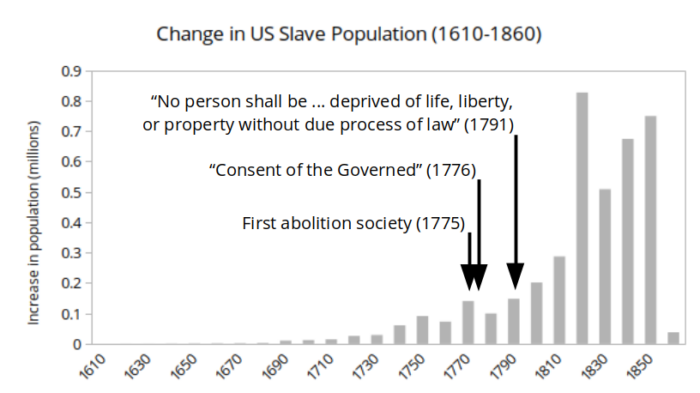 However ineffective the individual action of forming the abolitionist society, the idea to abolish slavery was revolutionary in world history that unleashed all future abolitionist action.
Still, that these milestones intended to promote liberty, freedom, equality, democracy, and national security were followed by growth in slavery shows that without action and enforcement, ideas and even constitutional amendments are ineffective, even distracting. Even people including Benjamin Franklin, George Washington, Thomas Jefferson, and James Madison, who risked their lives for those values for themselves and their peers, didn’t extend them to their slaves.
People acting against their values keep telling themselves what they’re doing is good. This process is what Eric Williams described in creating racism. Being induced to act against your values is corruption. The more it happens, the more people try to convince themselves, leading to racism growing and taking deeper root in culture. People also conceive of ever more cockamamie schemes to undo their actions, such as colonizing Liberia and sending freed slaves there or so-called “diffusion theory,” that said that expanding slavery over more territory would cause it to diffuse away.
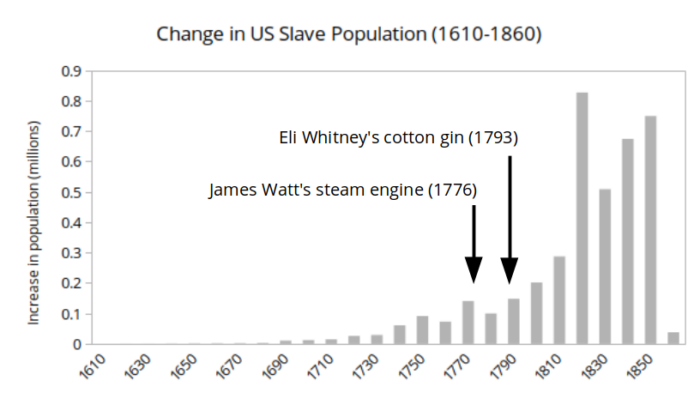
These cultural factors enabled slavery, but didn’t contribute to its tremendous growth that followed. Technology did, in particular, technologies designed for efficiency and to decrease labor.
Technology tends to accelerate culture, not change its direction
1776: James Watt’s steam engine was used commercially for the first time. It was vastly more efficient than the steam engine before it. People predicted that its efficiency would lead to using less coal. On the contrary, while the amount of coal per use decreased, more people found more uses for more steam engines.
1793: Eli Whitney patented the cotton gin. You may have heard that many founders believed that slavery was dying out. They were just wishfully thinking. Before the cotton gin, planters could only grow one type of cotton commercially and it grew in a small coastal region. The slave labor to process that amount of cotton was met with the numbers of slaves before 1793. The cotton gin made another type of cotton that happened to grow throughout the south commercially viable. That is, it made much more land arable, requiring the amount of labor seen following its invention. Meanwhile, steam engines following Watt’s design powered looms and textile factories to process the cotton, as well as steam ships and locomotives to transport it.
Why did technology designed for efficiency and to decrease labor increase it? Technology is a tool. It isn’t inherently good or bad, nor does it serve only the purposes its creators intend. Like fire or sharp knives, technologies advance the people and culture wielding them. The people who bought cotton gins and steam engines weren’t interested in less labor. They were interested in more cotton and profits. They weren’t telling themselves they were acting against their values. They told themselves what everyone tells themselves when they act against their values: how they were actually good, they couldn’t help it, they are serving a market, individual action wouldn’t matter, and so on.
Technology generally accelerates culture. If different parts of a society have different levels of access, it will help those with greater access more, which generally means people with more resources. That is, overall, technology tends to lead culture to create more of what it did before, not different, favoring those with access. It will steepen and reinforce dominance hierarchies such as slavery.
Technology dwarfs the effect of words that aren’t enforced, even beautiful revolutionary words like “consent of the governed” and protecting life, liberty, and property. The result is more of the opposite of liberty, freedom, equality, democracy, and national security than ever.
When the roots of a culture become forgotten
Then followed decades of strategies and tactics to try to make slavery coexist with liberty, freedom, equality, democracy, and national security like ours today to accommodate pollution and depletion: market incentives, technology, legislation, and compromise. These tools ended up accelerating the existing culture as practiced, not as written, as long as the nation did not enforce the Minimum Requirements. Slaveholders used those tools as effectively as abolitionists, and more so in their home territories.
People acting yet more against their values led to them augmenting their corruption and racism. The Richmond Enquirer wrote in 1856:
In this country alone does perfect equality of civil and social privilege exist among the white population, and it exists solely because we have black slaves . . . Freedom is not possible without slavery . . . The abolition of negro slavery in the South would inevitably end in the ruin of the political constitution of the country.
It bears repeating: the paper wrote, “Freedom is not possible without slavery.” Vice President John Calhoun stated on the senate floor in 1837: “The relation now existing in the slaveholding States between the two [races], is, instead of an evil, a good—a positive good.” Calhoun considered himself the heir to Jefferson’s legacy. That he advanced Jefferson’s slavery practices more than his words indicates the importance of individual action, not just words, no matter how eloquent or heartfelt. In other words, Jefferson’s corruption—and Franklin’s, Washington’s, Madison’s, and their peers’—contributed to the corruption of other individuals and American culture. It manifested internally as racism and externally as slavery.
There’s no mystery what works: enforce the Constitution. While the fifth amendment’s “No person shall … be deprived of life, liberty, or property, without due process of law” should have sufficed to end slavery, the founders’ corruption, especially of those profiting from slavery, kept them from seeing a person with different skin color as a “person” being deprived of life, liberty, and property. The thirteenth amendment outlawed slavery and was enforced (partly). The results in the change in number of slaves couldn’t be more clear when I add a few more years to the last plot.
The most hopeful plot I know of
I see the next plot as creating the most hope of any I know of. It shows a change this nation actually did. Shortly before the Constitution made slavery illegal (mostly), few believed it possible. If we did it once in an area violating the Declaration and Constitution, we can do it again in another area violating them too: pollution and depletion.
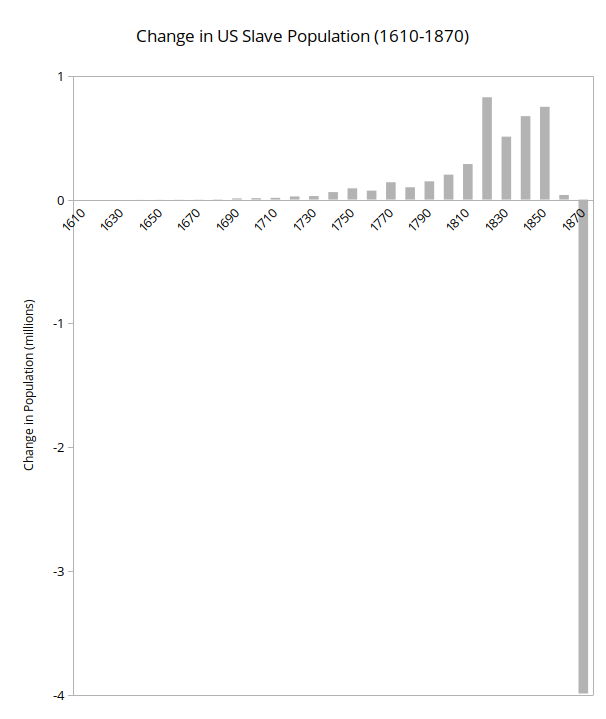
Though, again, we have to recall that while the thirteenth amendment made slavery illegal (mostly), racism didn’t stop with Calhoun or the Civil War. Making slavery illegal didn’t stop the causes that it resulted from, which continued and grew. My book describes those causes and how to end them. That solution looks like implementing what the founders didn’t. I write “looks like” because the hard part of undoing their corruption is unseen. We first have to do internally what they didn’t.