
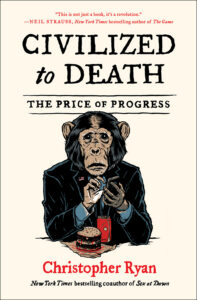
This podcast appearance started with my reading Chris’s book Civilized to Death, which I recommend to anyone thinking that not pushing for progress means returning to the Stone Age, dying earlier, etc. I’ve read and watched too many primary articles, books, and documentaries to count, and of them all I find Civilized to Death summarizes them best.
The next step was Chris appearing on my podcast, which I posted last week:
Christopher Ryan’s podcast and substack
At the end of mine, Chris invited me to his, which he posted today:
Some comments from Chris’s listeners:
What an interesting conversation. Fascinating guy.
and
I gotta say. I was a little skeptical at first but he turned out to be a cool guy. We all have our complexities.
Christopher Ryan on Jordan Harbinger’s podcast
While we’re at it, since Chris and I talked about Jordan Harbinger, with whom I toured North Korea twice, check out Chris on Jordan’s podcast:
Jordan’s podcast contains great episode notes:
What We Discuss with Chris Ryan:
- Civilization loves writing its own Yelp reviews — the story that it saved us from lives that were nasty, brutish, and short is propaganda. We never doubled the human lifespan either; a wave of child deaths dragged the average down, while hunter-gatherer adults routinely reached their seventies.
- Many of the problems civilization brags about solving, it created. Contaminated water, crushed teeth, and the plagues bred by crowding and livestock all arrived with us. It’s like lighting your house on fire, then showing up with a bucket and expecting thanks.
- Pick the yardstick and you win the argument — so we count GDP, tennis rackets, and mango slicers instead of loneliness, chronic pain, and despair. By honest measures, record anxiety and suicide among the young point to a culture built for commercial interests, not human ones.
- Agriculture wasn’t a triumphant invention — it was an emergency irrigation fix during drought that ratcheted into a trap. Surplus grain needed storing, storing needed guarding, guards needed bosses, and the cascade rolled on to taxation, hierarchy, patriarchy, and slavery.
- The good thing is that none of this is destiny, and, for the first time in human history, we can choose how we live. This week, shrink your world to human scale: learn your neighbors’ names, get into nature, share the caregiving, and find work that feels more like play. Helping others is the oldest cure.
- And much more…
and
Most of us grew up believing a tidy story: before civilization, human life was solitary, poor, nasty, brutish, and short, and then progress rescued us and never looked back. But what if that story is the most successful marketing campaign in history? Look closely and a strange pattern emerges. Many of the ailments civilization congratulates itself for curing, from contaminated water to rotting teeth to the crowd-borne plagues that leapt from our own livestock, barely existed before we built the conditions that produced them. We keep score with GDP and shelves full of mango slicers, then quietly step around the loneliness, chronic disease, and record anxiety stacking up underneath. Which raises an uncomfortable question: what if your private struggles aren’t a personal failing, but a healthy animal’s response to a world in which it was never designed to live?
On this episode, we’re joined by Christopher Ryan, the author behind Civilized to Death: The Price of Progress and the earlier (with Cacilda Jethá) Sex at Dawn, and a working podcaster for over a decade, who has spent years assembling civilization’s most honest balance sheet. Chris walks us through the foundational lie he calls the neo-Hobbesian narrative, beginning with the myth that we doubled the human lifespan; in reality, a heartbreaking rate of child mortality dragged the average down while hunter-gatherer adults routinely reached their seventies. From there he traces how agriculture began not as a triumphant invention but as an emergency irrigation fix during drought, one that ratcheted into surplus, storage, armed guards, bosses, taxation, patriarchy, and eventually slavery.
Chris explains why people so often turn kinder during catastrophes, drawing on the discipline of disaster sociology and Rebecca Solnit’s A Paradise Built in Hell, and why convenience can quietly become another word for isolation. He reframes the modern epidemic of childhood distress, suggesting a restless five-year-old might be a perfectly healthy young primate reacting to an insane environment, and argues that asking two exhausted parents to shoulder the work of an entire village was never going to end well. The point isn’t to torch our antibiotics and crawl into a cave. It’s that none of these arrangements are destiny — a society gets more of whatever it rewards, and for the first time in history we can choose to reward something better. For burned-out parents, anxious young people, and anyone who has ever felt like a failure inside a “successful” society, Chris offers a strangely liberating diagnosis and a refreshingly simple prescription: know your neighbors, get into nature, and share the work of caring for the people around you. Listen, learn, and enjoy!