
Following up what I learned about The Hanford Nuclear Site a couple months ago, I learned of the Church Rock uranium mill spill. I think the biggest point to remember about the following is that several sources say that it was one of multiple incidents that received minimal coverage. It may be the biggest, but may only be the biggest reported or known.
According to Wikipedia [my emphasis]:
The Church Rock uranium mill spill occurred in … New Mexico on July 16, 1979, when United Nuclear Corporation’s tailings disposal pond at its uranium mill in Church Rock breached its dam. The spill remains the largest release of radioactive material in U.S. history, having released more radioactivity than the Three Mile Island accident four months earlier.
This article looks peer-reviewed: Once Upon a Mine: The Legacy of Uranium on the Navajo Nation, from a journal called Environmental Health Perspectives. It wrote:
A dam broke at the United Nuclear Corporation mill, where workers processed ore from the nearby Northeast Church Rock uranium mine. The spill dumped 94 million gallons of mill process effluent and 1,100 tons of tailings—an acidic, radioactive sludge—into a large arroyo that emptied into the Puerco River.
The Church Rock spill occurred less than four months after the partial meltdown of the Three Mile Island nuclear reactor, and it released three times as much radiation, making it the biggest nuclear spill in U.S. history, yet it received only a tiny fraction of the news coverage. Declared a Superfund site in 1983, the heaps of waste around the mill still cause radiation survey instruments to squeal from the invisible uranium atoms that remain active 30 years later.
From Business Insider’s piece Inside the Navajo Church Rock Nuclear Disaster, the largest radioactive disaster in US history that’s somehow often forgotten [their emphasis]:
- The 1979 Church Rock Nuclear Disaster is the largest radioactive accident in US history.
- 94 million gallons of radioactive water and 1,100 tons of uranium waste flooded out of a breached dam into the Rio Puerco.
- The spill happened just four months after the Three Mile Island nuclear incident and released more than three times as much radiation.
In 1979, a dam holding millions of gallons of nuclear waste in Church Rock, New Mexico, collapsed.
In a matter of hours, 94 million gallons of radioactive water and 1,100 tons of uranium waste flooded into a nearby river.
The spill killed crops and cattle, and contaminated the surrounding land and the people who lived off it for decades to come.
It happened just four months after the Three Mile Island nuclear accident. It was the largest accidental release of radioactivity in US history and third worst accident in history, after the Chernobyl catastrophe in 1986 and Fukushima in 2011.
Despite this, perhaps because it happened in a rural, low-income area, or perhaps because it was primarily people from the Navajo Nation who were impacted, it was largely ignored.
Here’s what happened.
The article then describes the history.
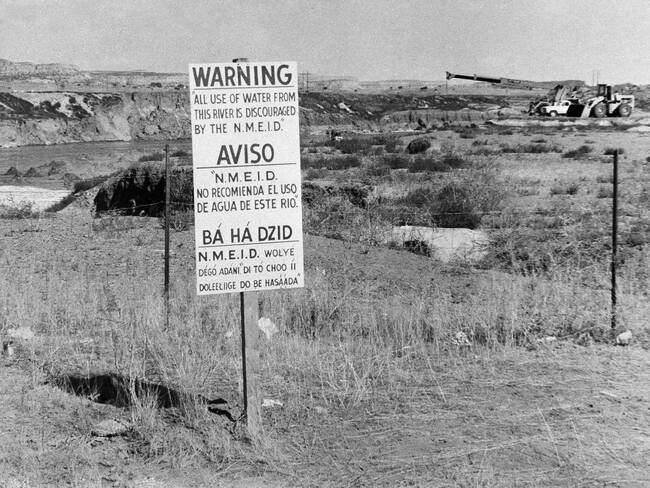 Context
Here’s a Wikipedia article on a larger trend: Uranium mining and the Navajo people. Here’s a picture of a river after a mine spill from that post. Is water supposed to be that color?
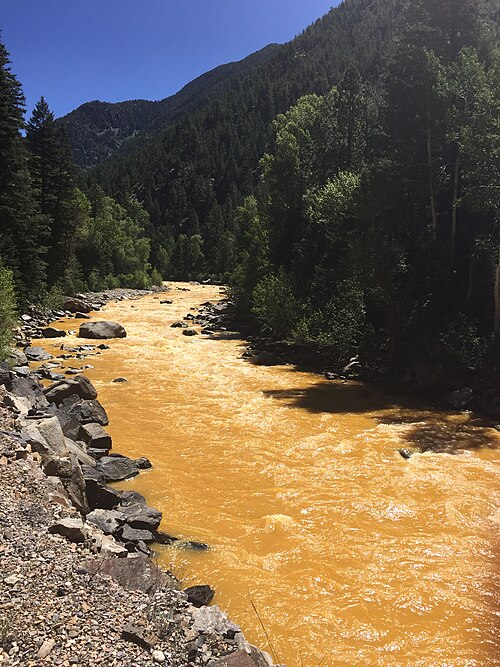
Here’s some text from that article:
living near a uranium mill mining area has been linked to birth defects among babies with mothers who live close to the mill, lung cancer, leukemia, cell damage, renal cancer, and stomach cancer . A study was conducted to compare residents who are close to the mining areas and those who are distant. The results show that the residents living near the mining areas suffered from:
- 1500% increase in testicular and ovarian cancer in children;
- 500% increase in bone cancer in children;
- 250% increase in leukemia;
- 200% increase in miscarriage, infant death, congenital defects, and learning disorders.
Dr. Joseph Wagoner, a health expert collected data regarding the health effects of uranium since 1960 for the US Public Health Service, would report that from 1960 to 1974 there were 144 cancer deaths among 3,500 miners, 700 to 800 of whom were Navajo. Statistically, approximately 30 deaths would have been expected instead of the 144 which were discovered.
Church Rock
I started learning by watching these this video:
Business Insider seems fairly politically neutral. Its piece links to many sources, including the New York Times, several government reports, and more. A few quotes from that piece:
- The government was happy to hire Navajo people to work in the mines, but it failed to warn them about the effects of radiation.
- Cattle drank from contaminated runoff, people built their homes out of lumber taken from uranium mines and children played in contaminated streams.
- The spill caused crops to wither, contaminated sheep had to be killed and wells had to be closed off permanently. The water’s radioactivity level near the dam reached 7,000 times the safe radiation limit for drinking water.
- It was the third worst accidental release of nuclear radioactivity in the world, after the Chernobyl catastrophe in 1986 and the Fukushima in 2011.
- After the spill no one was compensated, and the UNC only removed about 3,500 tons of sediment from the river—about 1% of the solid waste released in the spill.
- In 1990, the government officially apologized to the Navajo people. Two years later, UNC was ordered to invest $16 million to do a better clean up job, but instead the money was paid to its parent company.
- From the 2000s on, the EPA slowly started cleaning up the area, including other mines and waste sites. By 2015, about $100 million was spent on the clean up—and about 200,000 tons of contamination were removed— but the pollution was far worse than the agencies first thought.
Here’s a video by Vox:
Here’s a documentary free online that the hosting site doesn’t allow embedding: The River that Harms. (That site also hosts one of the most influential documentaries for me, The Great Dance, on a different topic by the team that made the Oscar winning Octopus Teacher).
I haven’t watched the documentary The Return of Navajo Boy, but several of the sources above refer to it.
Vice wrote a piece, Church Rock, America’s Forgotten Nuclear Disaster, Is Still Poisoning Navajo Lands 40 Years Later.
Here’s another video by a YouTuber:
Wow, I never heard of this, and I used to work in nuclear power (for the Navy).
It’s sobering to think how many other similar events may have happened but not recorded.