Podcast


640: Mark Mills, part 2: Low cost, high availability energy creates wealth

Mark and I share more highly researched, thoughtful conversation on human welfare and the environment. We see things differently, but I consider our conversations the type we should have more of. This session we cover The book Limits to Growth as well as the concepts underlying limits to growthEarth's carrying capacityHow much wealth is consumed by food and fuel, now and historically, and how much it's droppedHow the low cost and high availability of energy has allowed us to devote more money for other things, inventions, and life improvementsWhat is pollution? and plenty more.

0 Comments

639: Bruce Robertson and Milad Mousavian: Carbon Capture and Storage Is Not a Climate Solution

I learned of Bruce and Milad's Institute for Energy Economics and Financial Analysis (IEEFA) report, The Carbon Capture Crux – Lessons Learned, with fascination since I held out for carbon capture to be one of the major potential solutions to climate change. Though climate is only one of the many environmental problems risking civilization, it's one of the big ones. I contacted them to learn what could work or not. Many projections take for granted that today's unproven technologies will work in time to help, but our wanting them to work doesn't mean they will. In our conversation, we talked about their findings and what they meant. Sadly, the results aren't pretty. As they said “as a solution to tackling catastrophic rising emissions in its…

0 Comments

638: Mat Johnson: Exploring and Expressing Identity

Longtime listeners know I spent some formative years in some rough neighborhoods in Philadelphia. In researching them for my upcoming book, I discovered the many-award-winning book Loving Day by Mat Johnson took place largely a block from where I lived. His Wikipedia page showed he went to grade school with my stepbrother and stepsister. I read and loved Loving Day, which not only described my neighborhood, it explored it through race, which I was looking to understand, and it was raw and vulnerable, which I struggle to create in my writing. It opens: "In the ghetto there is a mansion, and it is my father's house." That house was a block from my home. Loving Day led me to read his books Pym, Incognegro, and…

0 Comments

637: Holly Whitaker: Overcoming Addiction, Embracing Freedom

I read Holly's book because I see us as a society and individuals addicted to what pollution brings. What can we learn from someone who overcame a different addiction? Holly's book is the opposite of a downer. It's spirited, researched, personal, and engaging. She reveals with infectious anger how society profited at wrecking her life, telling her poison was normal and good. Most of all, she shares how before stopping her addiction she thought sobriety looked impossible to achieve and boring if she did, but after sobriety, she loved life beyond what she could have imagined and beyond what an addiction-based society conditioned her to expect. We live in a society built on addiction. We created it. Almost every sentence in her book applies directly…

0 Comments

636: Mark P. Mills, part 1: “Renewables” aren’t renewable

Mark is a physicist who went into business around the environment. There aren't many of us, so I think you'll hear a rapport we enjoyed that I think you'll enjoy too. We indulge in physicist talk. I contacted him because I found his reports on what solar and wind---what I don't see how we can call renewable, green, or clean energy sources---require in their manufacture, transportation, installation, decommissioning, and more. Many fans of such technologies gloss over their problems, which seems to me irresponsible. If we are not honest about them we will make mistakes. Partisanship is a problem when there are testable answers to how much a particular solar installation or strategy to lower emissions works. Mark looks at possible futures but also returns…

0 Comments

Stood up in the rain by a homeless guy with AIDS

Last week, while I picked up litter in Washington Square Park, a guy approached me and asked, "Why do you do it?" Before I could answer, he continued, "Really, I've seen you do it and wonder why you do it." He told me his name was Dave. Before I could answer again, he continued and talked about values, where this country is going, integrity, and things like that. We got to talking about doing what one thinks is right, our childhoods, litter, and more. He told me he's homeless and has AIDS. I told him my motivations for doing it, including how this nation has abandoned Do Unto Others As You Would Have Them Do Unto You (the Golden Rule), Leave It Better Than You…

0 Comments

634: Donald Robertson, part 1: Thinking in Systems (a third listener episode)

Don regularly reads my blog. We've emailed for years so after inviting to record episodes with other listeners, I invited him. We both find a systems perspective the most effective way to understand and act on our environmental problems. I enjoyed talking to him about systems. Many people see them as technical, to the extent they get the view at all, but you don't have to work with them that long to see they are how to understand the environment and how we can act on it effectively. The alternative is to keep proposing solutions that sound nice but exacerbate our problems, things like trying to reduce carbon emissions alone, carbon offsets, recycling, chasing efficiency, and plans that accelerate the system and its polluting results.…

0 Comments

635: John Biewen, part 2: Turning off screens at 8pm

Do you keep your screens by your bed? Do you find yourself running in circles like: Twitter to email to latest news to Facebook to Instagram to Twitter and repeating the cycle forever? John shares his results committing to turning off his screens no matter what at 8pm a couple nights a week. Do you imagine it would affects his relationship with his wife, with whom he watched shows and movies? Would he get more anxious or less? Read more or sleep earlier? What do you think you would do? He shared what worked, what challenged things he needed to do for work, feelings of addiction. Toward the end he generalized to patriarchy, hierarchy, race, and leadership. Before recording we planned to keep the conversation…

0 Comments

633: Alan Ereira, part 1: Meeting the Kogi of Colombia’s Sierra Nevada mountains

I learned of Alan soon after learning of the Kogi (see below). He lived with and made films of them, among many other documentaries and films. He also works to help preserve their culture and spread their message to help us stop wrecking our environment and selves through the Tairona Heritage Trust, which you can support. His films about them---From the Heart of the World - The Elder Brother's Warning (1990) and Aluna - An Ecological Warning by the Kogi People (2012)---tell stories and show a culture I consider tremendously valuable. As I live more sustainably, I learn more about cultures that live without polluting and are happy and healthy, contrary to what our culture predicts. They look at us and see we could use…

0 Comments

632: Mitzi Perdue, part 1: Sex Trafficking in Ukraine

Mitzi just returned from the Ukraine War, invited by General Andriy Nebytov from the Kyiv Regional Police. He invited her after reading her piece Human Trafficking on Ukraine’s Border to see this trafficking in person. She saw abductions happening, powerless to act, as traffickers controlled the region. She describes what she saw. This episode isn't graphic, but sober. We'd prefer to live in a world without what she described, but I believe if it exists, better to know about it than not. She also shares what we can do to help and how, in particular helping the charity she created. Mitzi's home pageMitzi's Ukraine charity, ULET Group

0 Comments

631: Stephen M. R. Covey, part 1.5: To Arrive Where We Started and to Know the Place for the First Time

Continuing a long trend of guests sharing partially doing their commitments but not stopping, Stephen comes back for an episode 1.5, not yet his episode 2. Stephen committed to sharing his childhood family experiences hiking on a path near a family cabin (my description doesn't do justice to his description, so listen to his first episode, 622, to hear his description drawing on his life experiences). As happens sometimes when a commitment depends on other people, their being unavailable meant he couldn't complete the whole things. Genuine, authentic leaders know one's measure of personal success depends not on things outside of your control. You succeed if you perform to your potential. He did his part, as he describes in this episode, and he could have…

0 Comments

The text from episode 630: Simplifying Meditation Words and Meaning

The notes I read episode 630: Simplifying Meditation Words and Meaning from were long, so instead of including them in the podcast notes, I'm posting them separately here. Longtime listeners know I meditate regularly, now 25 minutes every other day. I started in 2007 with a ten-day vipassana retreat and have done a few ten-days, plus some 5-days and 3-days. Mostly I pay attention to my breath or do body scans. I don’t usually do guided meditations, but listen to the Sam Harris podcast so joined his Waking Up app. By now, I’ve listened to nearly all the recordings in it, including the guided meditations, his conversations with guests on theory and practice, and most guests’ recordings. I love many parts and find them useful,…

0 Comments

630: Simplifying Meditation Words and Meaning

The notes I read for this episode were long, so instead of including them in the podcast notes, I posted them as a separate blog post. My book: Leadership Step by StepThe Science article I mentioned: Limits to economic growthThe article showing humans lived to a modal age of 72: Longevity Among Hunter- Gatherers: A Cross-Cultural ExaminationViktor Frankl's Man's Search for Meaning Wikipedia pageThe Calvin and Hobbes page showing defenestrationThe Not Just Bikes video channelLow Tech Magazine

0 Comments

629: Michelle Nijhuis, part 2: Stopping doom scrolling

We started talking about Michelle's commitment to avoid scrolling on vacation. She did. It sounds like it was both no big deal and something worth building on. We had intended to keep the recording to under thirty minutes for scheduling reasons, but the conversation kept staying too interesting to stop. We talked about addiction, how big a difference small differences can make, the difference between Portland and Vancouver in culture, how to change culture, living off the grid, and what stays with you when transitioning back. Coincidentally, a story of hers appeared in this week's New Yorker: When Summer Becomes the Season of Danger and DreadMichelle's book: Beloved Beasts

0 Comments

628: Jay Walker, part 2: Kayaking together on the Hudson

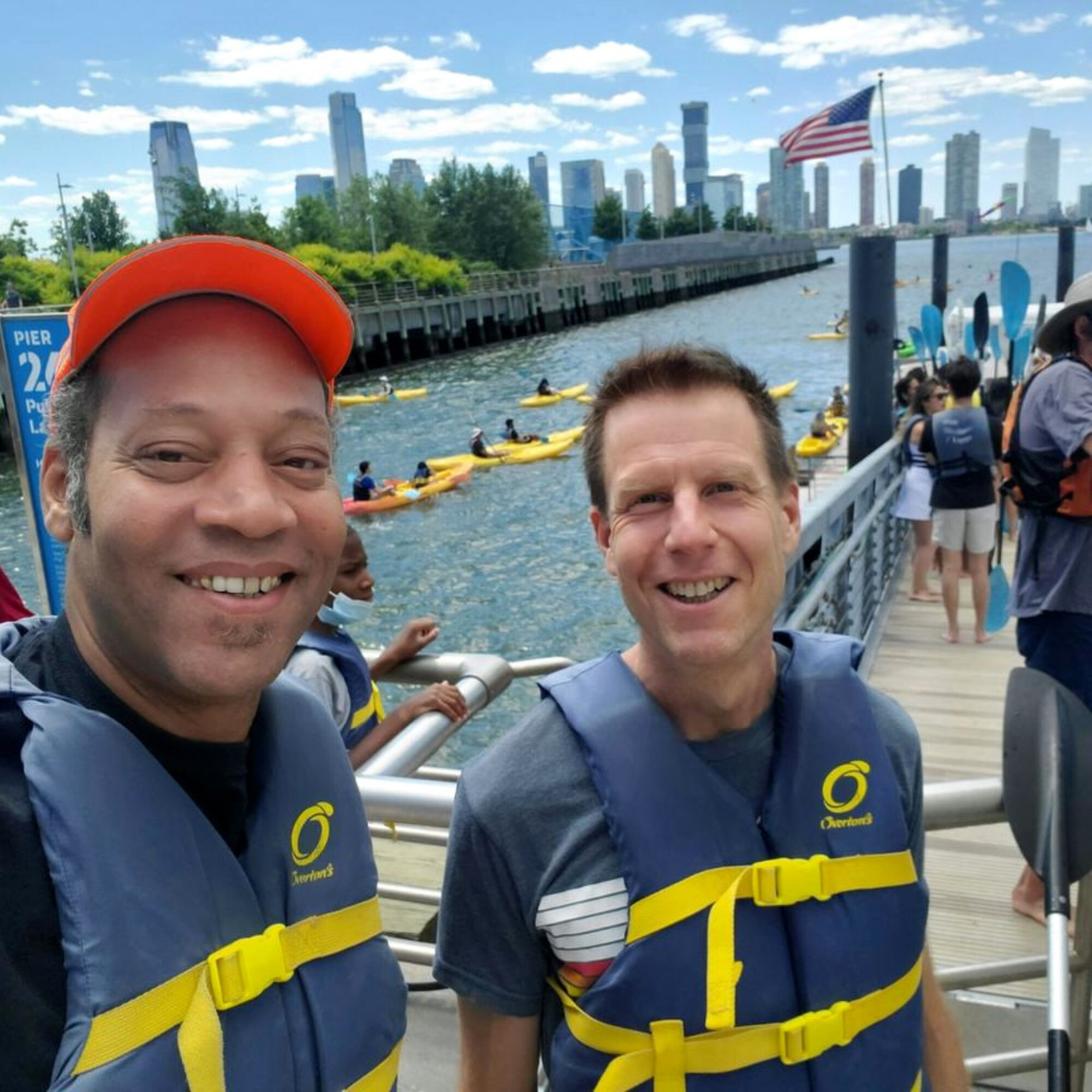
I think Jay's commitment may be the first where I participated and we had a blast! You may remember he committed to kayaking on the Hudson. He invited me to join. As you can see from the picture, I did, and we kayaked together. We shared about the experience. Note the change in our conversation and relationship from last conversation to this one. By last conversation we had spoken several times to set up the call, then you could hear our recorded conversation. Then hear how things changed just spending time in nature, in a way suggested by his values. That the Hudson by Manhattan isn't wild like, say, the mouth of the Amazon doesn't change that acting on our environmental values opens us up…

0 Comments

627: Nadeem Akhtar, part 1: A Long-Time Listener from Norway

Nadeem contacted me as a listener to suggest Abdal Hakim Murad as a guest, as I hadn't hosted any Muslims on the podcast by then. I learned a lot and enjoyed meeting Abdal, plus Nadeem and I stayed in touch. When Janet Allaker's first episode with a listener went well, I invited Nadeem to be a guest. He loved the opportunity. I think we both enjoyed the conversation. If you're a regular listener, you'll get to hear another voice from your position. You'll get to hear another listener's views on sustainability and this podcast. Nadeem cares enough to act, though not as much as me. He listens to This Sustainable to ground him and inspire more sustainability work. We talk about what motivates him, religion, family,…

0 Comments

626: Jay Walker, part 1: Organizing New York City’s Queer Liberation March

Regular readers and listeners know my passion for cleaning my local park, Washington Square Park, and how my heart breaks at how we abuse this sliver of a vestige of nature, especially the mornings after the Queer Liberation Marches of the past two years. As an organizer, Jay didn't have to respond to my request, but he did. By the end of this recording, you'll hear us talk about reducing waste next year. We begin by talking about the evolution of the pride marches from when he started attending in the 1980s. He describes them becoming more corporate, less participatory, but most of all, controlled by the cops, not necessarily helping the march. The cops often seem like they're just dominating parades; all New York…

0 Comments

625: Listener Questions, volume 01

I answer my first listener questions. If you have questions on topics I write about, like leadership, sustainability, sustainability leadership, sidchas, habits, academia, physics, podcasting, and so on, contact me. This episode's questions: Hi, Joshua, in the winter months of this year, in New York, in your flat, will you use heating or blankets?Can you describe a time when you struggled with a decision about a polluting act? To give an example of what I mean from my own life, as you know I'm trying to reduce my car use. To go to my modern jive night requires car use (no suitable public transport and too far to walk in dark). So I've wrestled with giving it up but decided I didn't want to because…

0 Comments

624: John Biewen, part 1: Seeing Whiteness and Other Systems

I came across John from listening to one of his podcast's season, Seeing White, about the development of whiteness as a race. I listened to the whole series, which I found fascinating and provocative. Then I discovered another season, Men, covering another topic important to me. I invited him to be on the podcast, then I learned from him the most recent season, The Repair, is on the environment. We start this conversation talking about systems and approaching the topics above through a systems perspective. With such topics, with which everyone connects intimately, meaningful communication about them becomes personal. John shared his evolution beyond his expectations, challenging his identity even to himself. I comment how openly he shared about himself, which must have taken a lot…

0 Comments

623: AJ Jacobs, part 1: Be Curious and Act

AJ is in some ways a kindred soul, actually doing things many people hear about or even talk about, but rarely do. Regular listeners might remember our mutual friend Mike Michalowicz suggesting we talk. We start by talking about things AJ has done and written about. He read the encyclopedia cover to cover. He lived a year following biblical instructions as literally as possible. He practiced radical honesty. He shares behind the stories too, the fun and learning that came from it. I believe I heard some resonance and more meaningful respect for my trying to live more sustainably. Underneath it all from AJ, you'll hear a curiosity, thirst for life, and enthusiasm to experience life to its fullest, the opposite of watching it happen…

0 Comments

622: Stephen M. R. Covey, part 1: Trust & Inspire

Stephen's book, Trust & Inspire, recounts today's effective way to lead, by creating trust and inspiring. He laments people still relying on the old techniques of commanding and controlling, which may have worked in more industrial times, but not today. They provoke resistance, the opposite of trust and inspire. Those familiar with my work have heard me lament what people do in sustainability: CCCSC, my shorthand for convince, cajole, coerce, and seek compliance. They rely on extrinsic rather than intrinsic motivation, which provoke resistance. From the start of our conversation, I tell him how valuable his book's message is for sustainability. We explore each other's approach and share how much we like them. His descriptions of what the environment mean to him and his commitment…

0 Comments

621: Whitney Tilson, part 3: Talking sustainability with a Harvard-Trained Investment Advisor Who Flies Monthly

In our third conversation, Whitney and I get more friendly and conversational, fun conversation. He's been picking up more garbage, which I hope is part of a journey of continual improvement. Since long before we met, he rides his bike to get around the city. Otherwise, he's focused on other things in life than sustainability. He's examined a lot of parts of his life, but not his impact on other people mediated through the environment. I'm not trying to change people who don't show they want to change, so we just talk. You'll hear a very thoughtful, active leader speak with me about his views and environmental values. Not Just Bikes YouTube channel

0 Comments

620: Nature delivers what psychedelics do, but we don’t know what we’re missing (feat. Sam Harris and Roland Griffiths)

Listening to an episode of Sam Harris's podcast featuring Roland Griffiths, Johns Hopkins neuroscientist researcher, on psychedelics revealed that much of their benefit sounds a lot like my guests talking about their experiences of nature. I think we don't know how much we're missing by paving over and cutting off as much as we do from nature. I'd guess people before we cut ourselves off from raw, wild nature so much would never have guessed we could deprive ourselves from forests, beaches, and birdsong so effectively. As I'm typing these words, cars are driving by with noise engines blasting music you could hear from blocks away. How can we experience the sublime or transcendent under these conditions? I suggest we can't. By contrast, our ancestors…

0 Comments

619: Dr. Michael Gurven, part 2: The Forager Population Paradox and what do we do

Most second conversations on this podcast come weeks or months later, after the guest does his or her Spodek Method commitment. In Michael's case, our first conversation was so engaging, we kept talking almost two hours, so I split the conversation into two parts. The first mostly covered Michael and his research. This part covered applying his research and my leadership to sustainability. What can we learn from cultures that lived thousands of years or longer? What can we learn from cultures that thrive without polluting? What benefits do we enjoy that they lack and vice versa? How can we apply answers to those questions? Can we change our culture? We also discussed Michael's research on the forager population paradox. Quoting from a UCSB article…

0 Comments

618: Dr. Michael Gurven, part 1: Our ancestors evolved to live to 72 years*, and did (not 30).

* "The average modal age of adult death for hunter-gatherers is 72 with a range of 68–78 years. This range appears to be the closest functional equivalent of an 'adaptive' human life span." Would you be surprised that humans evolved to live to 72 years old? Wait, isn't one of the greatest results of our technology and progress to advance human lifespan from 30 years old? How long do humans live naturally? Of course, the question and its answers is complicated, but I found Michael through a paper he co-wrote with Hillard Kaplan: Longevity Among Hunter-Gatherers: A Cross-Cultural Examination, that researched the question through populations all over the world. Read the paper for their full research, but the quote at the top suggesting 72 years…

0 Comments

End of content

No more pages to load