The New Yorker reported this week: Could Switzerland Become the First Country to Cap Its Population?: The Swiss will soon go to the polls for a novel initiative that could upend the nation’s economy and rupture ties with the European Union.
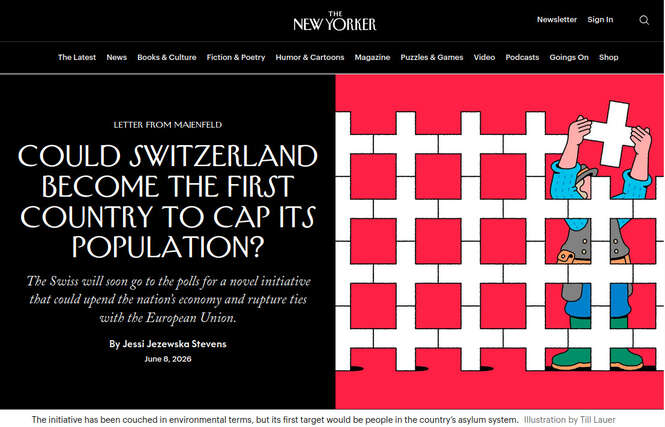
An early paragraph describes the article’s main issue. I’ll share it plus a couple other paragraphs, then my comments after.
On June 14th, Switzerland will vote on whether to become the only country in the world to officially cap its population, with a limit of ten million people until 2050. (The current population is 9.1 million.) The initiative, which was put forward by the Swiss People’s Party (S.V.P.) and in recent polls has been supported by as many as fifty-two per cent of respondents, would require the government to curb growth through two main measures. The first, triggered as soon as Switzerland exceeds 9.5 million inhabitants, would lead to restrictions in the areas of asylum and family reunification. If the population surpasses ten million for two consecutive years, the second measure would kick in, requiring the termination of the Free Movement of Persons agreement, which allows citizens of the European Union to work, study, and live in Switzerland (and vice versa). This move would rupture Switzerland’s relations with the E.U., its closest partner in trade and security. “The whole package of bilateral agreements would be at stake,” Michael Siegenthaler, a labor economist at the public university E.T.H. Zurich, said. “It’s quite likely that the European Union would cancel all of them.” A population ceiling is more or less unprecedented; the closest comparison might be conservation laws that limit human settlement in ecologically fragile places like the Galápagos Islands.
The article paints the party promoting it as right wing, connected to Nazism. Maybe it is, I don’t know. It also suggests the environmental part is insincere, which also might be, I don’t know:
The initiative, whose other official name is the Nachhaltigkeitsinitiative (Sustainability Initiative), is couched in the language of environmentalism. The S.V.P. proposes it as a solution to the consequences of unchecked growth: housing shortages and rising rents in cities, overcrowded trains, clogged roads and highways, and the loss of green space to new construction. In towns such as Maienfeld, the influx of mass tourism gives the impression that even remote valleys have become overrun. “Every major problem in our country,” Matter said from the stage, “is directly or indirectly linked to the incredible explosion of the population.”
The right wing part:
The S.V.P. has maintained some distance from other right-wing parties in Europe, such as Germany’s Alternative für Deutschland and France’s National Rally. It does not trade in Holocaust denial, and it retains a reputation for coöperating with other parties and institutions at the cantonal level. Nevertheless, in national politics, the Party acts as a clearing house for Switzerland’s most extreme expressions of nativism. “There is no party to the right of the S.V.P.,” Jakob Tanner, a professor emeritus of modern history at the University of Zurich, told me; the S.V.P. “soaked up” more extreme movements in the nineties. And its use of initiatives to restrict immigration has served as an inspiration to right-wing movements in Europe. “They always say, ‘We have to do something like Switzerland,’ ” Tanner said.
Reflections
Back to the Galapagos Islands comparison, and this quote:
The government’s highest estimates for population growth put Switzerland on track to reach ten million people by 2033. The cap would then impose an effective net-zero immigration flow—one person out (or deceased), one person in. “Imagine a society in which a Swiss citizen is permitted to live with their foreign partner in Switzerland only when another person leaves the country,”
I’d compare it with Hawaii for centuries after people there stopped trading with Polynesia and before Europeans arrived. They saw how much land they had. They had more than enough time to grow, if Malthusian collapse was inevitable, to overpopulate, but they didn’t. I could be wrong, but I conclude that they must have learned to implement something like one person out, one person in, that couples couldn’t just decide for themselves to have as many kids as they wanted. A couple might have to wait for an old person to die.
If they implemented something like that policy, I don’t know if they did so by consensus, tyranny, consent of the governed, collectively voluntarily, or something else. I presume they all realized that their necessary resources couldn’t grow just because their population did. Whatever the mechanism, if any, I grew up hearing it described as a heaven on earth.
Now its population is higher, dependent on polluting and depleting inputs, and I hear of wildfires, pervasive concrete and asphalt, gasoline seeping into its groundwater, and inability to protect what nature remains undisturbed as its culture approaches that of Disneyland.
I don’t compare with Hawaii because I think it was unique or special. It’s just easy to visualize because of its isolation. I understand that many cultures for millennia were similarly isolated and constrained not by ocean but by other geography or by other populations that defended their territory.
What’s normal?
Maybe the people promoting this Swiss policy are Nazis, I don’t know, but the policy of managing population levels isn’t rare in human history, nor necessarily right wing, left wing, nor cruel, inhuman, or promoting racism. I’m happy to be shown otherwise, but it seems to have been normal for most of our ancestors.
How else can you explain the flat part of this population curve?

Before you answer, note that that curve doesn’t go back far. Nor does this one, despite going back ten times farther in time, but humans go back beyond 12,000 years ago. Homo sapiens go back 300,000 years. Homo in general goes back 3 million years.
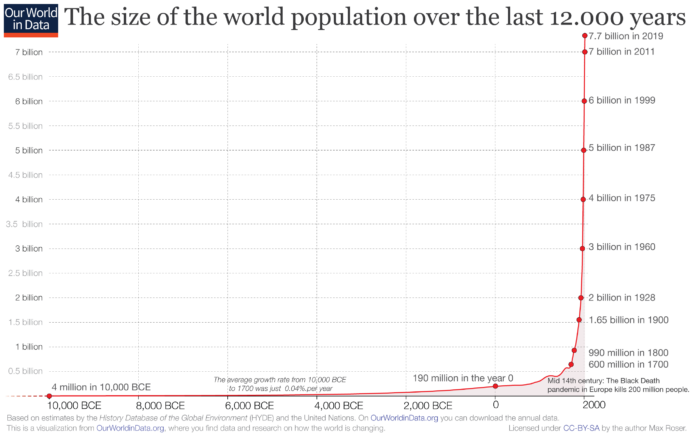
According to the plot above, humans stayed below 4 million people for hundreds of thousands of years. We gain that many in five months today. We act as if we’re teetering on the brink of extinction if population lowers, but much smaller numbers endured for a thousand times longer than the United States has existed or we started using coal for steam engines. They didn’t require technology and they lived healthier, safer, more secure lives than we do. I used to think they died young, but “the average modal age of adult death for hunter-gatherers is 72 with a range of 68–78 years. This range appears to be the closest functional equivalent of an ‘adaptive’ human life span.” I had to bring the scientist who wrote it onto my podcast. I recommend listening to Michael Gurven’s episode.
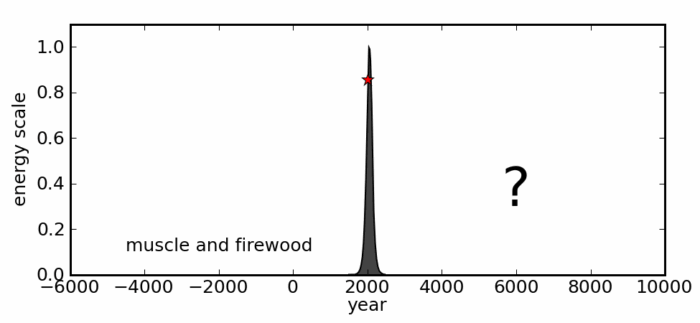
Speaking of podcast guests, I recall the plot Tom Murphy considers the most important. Note the y-axis is energy use, not population, but I recommend reading the relevant parts of his blog or book, which I consider The Science Book of the Decade: Energy and Human Ambitions on a Finite Planet.