
A friend and workshop graduate sent me a news article that described and linked to primary research published last month in a journal called Communications Sustainability within the family of Nature journals.
- The journal article: The undervalued quality-of-life benefits of demand-side energy and climate strategies.
- The news article in plain language: Cutting energy use may improve quality of life more than cleaner technology.
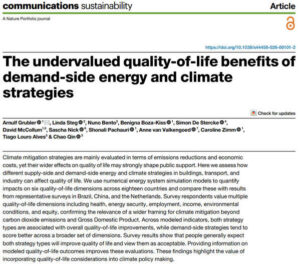 The news article described the main result of the journal article. It compared how people felt about acting on different strategies to reduce polluting and depleting. Some strategies reduced behaviors that polluted and depleted or otherwise used less (demand-side strategies). Others relied on new technologies, like heat pumps and electric vehicles (supply side strategies). When different strategies achieved similar environmental results, how did the changes make people feel?
The answer:
Every strategy improved quality of life–not one made things worse.
The using-less options pulled ahead, scoring better across a wider spread of the six measures.
Summary
Read the original paper for the raw data, but in my words, people who try it enough to make a difference prefer polluting and depleting less like the change. Nearly everyone I talk to expects the opposite, but they base their expectation on speculation, not observation or experience.
Extrapolation
What would happen if those promoting the reduction of pollution and depletion took into account this life improvement? According to the news article:
For years, climate talks have stalled on a familiar split. Wealthy nations and developing ones each suspect the other is getting the better deal, and that cutting energy and emissions will cost them more.
The numbers tell a different story. Quality of life rose in every country the team modeled, rich and poor alike. Some of the largest gains appeared in both major industrial economies and fast-growing developing nations…
That shared upside is exactly what global agreements have struggled to find.
Furthermore:
A stubborn belief hangs over demand-side policy. People assume the public hates being told to use less – that asking households to insulate, take the bus, or nudge the thermostat down will spark resistance.
So the team ran proper national surveys in three countries with very different economies and politics–the Netherlands, Brazil, and China. More than 3,500 people answered questions about how each strategy would touch their own lives.
The backlash never showed. Across all three countries, people expected both kinds of strategy to improve their lives and said they would accept them–even the demand-side options that ask for real changes in habit.
My Take
My take: no s#!t, Sherlock!
I’ll believe the results of hands-on practical experience over self-serving speculation that reinforces laziness and complacency. People haven’t tried and don’t know what they’re missing. That group included me until I tried. Now I know what I didn’t before I tried. I remain a small minority.