
I’ve written plenty about a person who has become one of my great role models, whose actions are poignant today. He freed the most number of slaves of any American before the Civil War.
He didn’t ask to be born into a culture in which slavery was legal and financially rewarded. Yet he acted.
We didn’t ask to be born into a culture in which polluting and depleting, which cause death and suffering orders of magnitude greater than US slavery did. Most of us don’t act. It’s tempting to say we aren’t holding whips, a red herring. Few people held whips then. They bought cotton, tobacco, and other slave-produced products and services. They paid for others to whip and enslave, just as we pay people to extract, pollute, and so on.
235 years ago today
235 years ago today, he submitted what he called his Deed of Gift, the legal document he created to free all his slaves, giving many of them land. He didn’t sell them. He freed them, dramatically lowering his net worth. We talk about polluting and depleting less. How many of us stop ourselves from hurting people without their consent?
All of us could. Anyone can, for example, choose never to fly again. The change to our lives would be tiny compared to Carter’s. As with him, it would purely improve our lives, though our perceived dependence on it leads us to think otherwise.
Would you prefer to continue the legacy of someone who freed slaves or talked about it but didn’t? Sorry to break it to you, but it doesn’t matter your ancestry or skin color today. If you pollute and deplete, you are in today’s version of people who in buying slave-produced goods and services, funded slavery. On the plus side, you can change history more than Carter did. Yes you can.
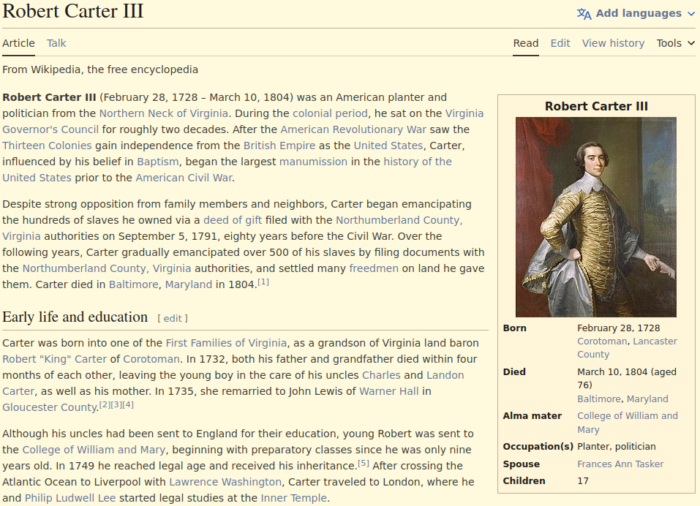
For background, Carter figured in my book Sustainability Simplified a lot, and will in my upcoming book, as someone who could have remained corrupted by slavery but freed his slaves, in contrast to nearly everyone around him in Virginia after the American Revolution. George Washington, Thomas Jefferson, and James Madison didn’t, despite their brilliant words and actions on freedom.
Here’s Andrew Levy on Robert Carter III, excerpted from his piece The Forgotten First Emancipator:
Robert Carter, then, stands as the personification of the inconvenient truth that emancipation, even on a large scale, was entirely feasible in the United States, at least at the turn of the nineteenth century. In this way, his life serves as an indictment of the civic gods of America—Thomas Jefferson, George Washington, James Madison, Patrick Henry, Richard Henry Lee—who did not free their slaves during their lifetimes. The inevitable conclusion is these revered slaveowning Founders, all of whom spoke out against slavery, were at least one of the following: (1) disingenuous, voicing antislavery sentiments simply to conform to Enlightened public opinion; (2) avaricious, privately rejecting the idea of surrendering the wealth represented by their slaves; (3) cowardly, wanting to do the right thing but too fearful of white backlash; (4) conflicted, lying to themselves about the practicality of emancipation as a way to soothe their consciences.
Here’s a page with more Resources on Robert Carter III.