
I read a piece in The Onion recently that pointed me to an apparent controversy that hides a problem everyone seems to be missing, playing into the hands of some people profiting at the cost of people’s health, or at least appear so to me.
I’ll share the Onion piece first, then the distracting false controversy of people being played by PR and marketing people, then the actual tragedy. Since the piece and controversy cover breasts and men’s attraction to them, the impatient among you or those prone to stereotype may jump to conclude I’m being prurient or fall into a preconception. I hope you’ll overcome such tendencies and read to the end.
The Onion headline is ‘Now My Breasts Are Over Here,’ Announces Sydney Sweeney Peeking Out From Oak Tree. To save a click, here’s a screen shot followed by the text:
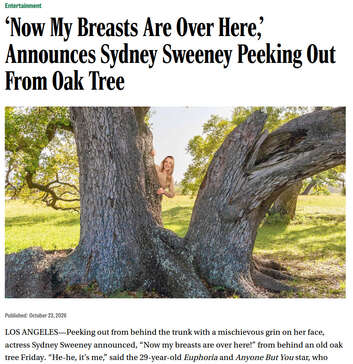
Published: October 23, 2026
LOS ANGELES—Peeking out from behind the trunk with a mischievous grin on her face, actress Sydney Sweeney announced, “Now my breasts are over here!” from behind an old oak tree Friday. “He-he, it’s me,” said the 29-year-old Euphoria and Anyone But You star, who giggled as she ducked behind the tree and reemerged a moment later from behind a telephone pole across the street, followed by an oleander bush, a playground slide, and a mail carrier’s bag. “Um, excuse me? Were you looking for my breasts? Because they’re right here! Or are they here? He-he, where will they appear next? Will it be this gopher hole? Your refrigerator, perhaps? There are so many drawers in your office filing cabinet—I wonder if one of them has my boobs in it? Don’t forget to look at the moon tonight!” At press time, reports confirmed a terrified child had run to his parents’ room crying that he’d found Sydney Sweeney’s breasts under his bed.
I’d never heard of Sydney Sweeney so didn’t get the joke. Friends have told me she’s popular, but for others who don’t know here, quoting from her Wikipedia page.
Sweeney called the obsession with her appearance “this weird relationship that people have with me that I have no control over”
She seems to have a reputation for showing lots of skin. That’s her prerogative. A Vogue article, Why Is the Discourse Around Sydney Sweeney’s Breasts So Unhinged? wrote about media attention on her, diminishing men: “Let’s call all of this what it is: really ]f-ing] strange. And it’s not the first time Sweeney’s cleavage has left members of the middle-aged bloke community and their allies behaving like they’ve never seen a breast before.” I point out the dismissal of men because of what the Onion pieces is about and whom it hurts.
In particular, some people find an ad for a sports betting app she recently did controversial. The Onion often does pieces on current events and this ad came out last month.
In September 2026, Sweeney appeared nude in an advertisement for the sports betting website Novig. The advertisement attracted criticism from several female athletes, including gymnast Gracie Kramer, sprinter Amy Hunt, and swimmer Ariarne Titmus, for objectifying and setting back women in sports. Others supported the ad as an example of body positivity, while some in marketing described the controversy as likely intentional. Commentators described the campaign and others like it resulting in Sweeney becoming “associated with causing buzz for a brand trying to raise its profile”
I looked up the female athletes mentioned and they’re serious athletes. The page of Amy Hunt said:
Hunt stated “This is what women in sport look like. 21.4, muscles, hard work, sweat, blood, tears.” She later described the advert as “a barrier for girls in sport”.
I had to look up 21.4. It refers to a great finishing time for women over 200 meters. At least, I think it is.
The Controversial Ad
Here’s the ad. If you don’t want to watch it, it’s a promoting sports betting app by having Sweeney pose to expose a lot of her body with a voiceover at least mildly sexually provocatively.
Actually, before showing the ad, I’ll copy a public service notice from an article I quote below, since this ad is designed to addict people and addicted people suffer.
⚠️ If you’re having thoughts of ending your life, call or text 988. You are not out of options, and you don’t have to face this alone. The Suicide & Crisis Lifeline is free, confidential, and open 24/7, and the financial hole that can feel permanent isn’t.
The controversy around her and the ad talk about objectifying women, “the male gaze,” and the effect on women in sports and women’s sports. I think everyone agrees the company paying her and she have their free speech right to create and broadcast the ad. I’m sure she consented to all contracts and was not coerced to perform. I expect she was paid above fair wages as a professional actress.
You could say she’s just playing the media for attention, but there’s a serious problem underneath: the heavily addictive habit of gambling on apps available to all, not just in casinos, including minors, though the minor part is not the major part of my point.
The ad is designed to excite but withhold satisfaction, driving craving. And whom is it exciting? Young men.
The ad isn’t created by young men. It’s victimizing them.
I’ve heard recently about how gambling apps are causing addiction, poverty, and suicide in many people, especially young men. That problem is what this blog post is about.
I don’t know the legality of the apps. I’m not questioning if they should be allowed to advertise or even exist, though I see the issues as worth debating. I’m calling out how people are blaming the very people being victimized and suggesting that Sweeney is being objectified by them when she is profiting from victimizing them.
Because any time anyone suggests men are being victimized, many people will say that women are hurt more, I’ll say the point that should never have to be said, but just because I say men are being victimized doesn’t mean I’m diminishing that women are victimized too.
Now, some information on how destructive gambling apps are, as well as signs that their effects are growing without sign of deceleration.
The Effects of Gambling Apps
According to the American Psychological Association, How gambling affects the brain and who is most vulnerable to addiction: “Once confined mostly to casinos concentrated in Las Vegas and Atlantic City, access to gambling has expanded dramatically, including among children” and that article was published in 2023. Gambling has been pushed more recently.
Sports betting is now legal in 37 states plus Washington, DC, with six more considering legislation, according to American Gaming Association data from early 2023.opens in new window People can gamble around the clock from anywhere and, increasingly, at many ages, including teenagers and even young children who are well below the legal age for gambling.
As access to gambling has expanded, psychologists and other experts have become concerned not just that more people will give it a try, but that more will develop gambling problems. And while it is still too soon to know what the long-term effects will be, evidence is growing to suggest that young people, especially boys and men, are among those particularly vulnerable to gambling addiction—the same demographic most often participating in the newest forms of gambling: sports betting and video game-based gambling.
…
Like addictions to alcohol and drugs, gambling addictions are characterized by an increasing tolerance that requires more gambling as time goes on to feel satisfied.
…
Vulnerability is high in people with low incomes who have more to gain with a big win, added psychologist Shane Kraus, PhD, director of the Behavioral Addictions Lab at the University of Nevada, Las Vegas. Young people, especially boys and men, are another susceptible group. Up to 5% of adolescents and young adults who gamble develop a disorder. And men outnumber women at a ratio of about 2 to 1 among people with gambling addictions, although there are a growing number of women with the disorder.
…
Among other emerging insights, people with gambling problems also have smaller volumes in their amygdala and hippocampus, two regions related to emotional learning and stress regulation. Brain research might help explain why teenagers are particularly susceptible to gambling, Potenza said, including the observation that different parts of the brain mature at different rates in ways that predispose teenagers to gambling and other risk-taking behaviors. The prefrontal cortex, which regulates impulsivity and decision-making, is particularly late to develop, especially in boys.
…
Sports bettors trend young: The fastest-growing group of sports gamblers are between 21 and 24 years old, according to an analysis by Nower’s group of data from New Jersey, which legalized sports gambling in 2018. Compared with other kinds of gambling, the in-game betting offered during sports games is highly dependent on impulsivity, Nower said. There are opportunities to place bets during the game on everything from who will win the coin toss to which quarterback will throw 100 yards first to how long the national anthem will last. And impulsivity is particularly common in younger people and among sports fans caught up in the emotion of a game, Nower said.
…
Early signs from Nower’s research in New Jersey suggest that people who engage in sports betting appear to develop gambling problems at particularly high rates and are at higher risk for mental health and substance use problems compared with other kinds of gamblers. About 14% of sports bettors reported thoughts of suicide and 10% said they had made a suicide attempt, she and colleagues found in one New Jersey study.
According to AddictionHelp.com
About 31% of people with gambling disorder have had suicidal thoughts, and about 16% have attempted suicide.
…
Men and Gambling Addiction
Men carry most of the risk. Worldwide, they are about 3.4× more likely than women to gamble at a problem level[1].
Women develop gambling problems too, and theirs often begin later in life and pick up speed faster once they start. The bulk of the risk, though, sits with men.
Age and Gambling Addiction
Age tilts the same direction. Adults under 35 are roughly 1.5× more likely than middle-aged adults to have a gambling problem[1].
Lay those two findings on top of each other and they overlap on a young man with a sportsbook app on his phone. He is also, not coincidentally, the person the betting industry spends the most money to reach.
…
⚠️ If you’re having thoughts of ending your life, call or text 988. You are not out of options, and you don’t have to face this alone. The Suicide & Crisis Lifeline is free, confidential, and open 24/7, and the financial hole that can feel permanent isn’t.