
This week I finished:
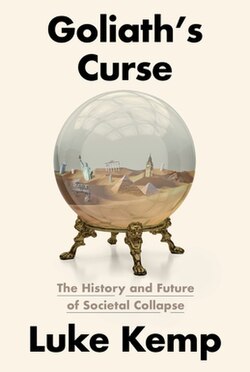
Goliath’s Curse: The History and Future of Societal Collapse, by Luke Kemp: Parts of this book I loved and parts I found unhelpful.
I loved its collection of history and anthropology, which seems more thorough than those of Jared Diamond’s Collapse and Graeber and Wengrow’s The Dawn of Everything. It covers more examples more thoroughly than I would have in my book, many of which give evidence to my description of how our culture formed as it did and why we’re stuck. By “as it did,” I mean dominated by dominance hierarchy, imperialism, and pollution.
It describes how we tend to see civilization through its achievements but not how life was for most people. Much of what we call civilization, he calls Goliaths: “systems of violence … a collection of hierarchies in which some individuals dominate others to control energy and labor.” He suggests that their collapses don’t have to cause people in them to suffer, such as if they shared control. He gives dozens, maybe hundreds of examples.
He partly describes how dominance hierarchies form. I found the descriptions in What Is Politics? more compelling and useful, just not as professionally edited or with as many references.
Regarding how people did things we’d like to think we wouldn’t, like to create systems that harm people or just directly harm people, he did what Isabel Wilkerson did in Caste: he resorted to the passive voice, implying some group of bad people that the reader and he must be better than. Occasionally he referred to people with the dark triad (Wikipedia: The dark triad is a psychological construct of personality traits … Machiavellianism, sub-clinical narcissism, and sub-clinical psychopathy.).
I think he thinks, and wants the reader to think, “They’re bad people, unlike us. We have to stop them. The bad things in today’s world result from bad people like them. Good people like me and my tribe have to stop them. We’re so good.” He misses the input from the psychology Philip Zimbardo reported in The Lucifer Effect: most people under similar circumstance would do similar things. They’d create legitimizing myths to handle their uncomfortable emotions from violating their values. Corollary: we’re doing such things, operating under similar legitimizing myths.
I didn’t find his solutions compelling. I found them disappointing. He just rehashed ideas that aren’t working and are based on “those bad people are doing bad things that we good people have to fight to stop.” They’re the usual progressive proposals that people suggested before his research. There are reasons the don’t work. For one thing, the people he polarizes against aren’t the bad people he makes them out to be. He didn’t incorporate that dominance hierarchies began with people doing what the situation called for, like to protect grain from being wasted or taken.
I plan to refer to the research in this book from mine, thereby saving duplicate work, but warn against much of its editorializing and rehashed proposed solutions.
I’m glad I read it and look forward to meeting and talking to Luke. I’ve already spoken to one friend who knows him. The book mentioned a few podcast guests.