
This week I finished more books than usual, partly resulting from the rain of the past two weeks, restricting how much time I could spend using the computer:
 Tonight in Jungle Land: The Making of Born to Run, by Peter Ames Carlin: Growing up in Philadelphia in the 1970s and 80s, listening to classic rock and album oriented rock meant knowing Bruce Springsteen. I recently read his memoir, Born to Run and a few years ago watched a recording of his Broadway show.
When I learned of this book, about the making of his album Born to Run, I knew I had to read it. I knew he was driven to create a great album and worked everyone in the band and studio to realize his vision. I didn’t know he specifically wanted to make the greatest rock album of all time. Many would say he did. I also didn’t know the stakes, that his label was going to drop him.
I had to read it because his intent and drive for that record are touchstones for me on my next book. I view it as a work of art, since I view leadership as a performance art and the book is a strategic element in my mission of changing American and global culture, to restore lost values. Bruce had to express himself genuinely, honestly, and vulnerably. I intend to match. I also plan to learn to perform in person to inspire people similarly, though I’m not yet sure exactly how.
I recommend the book, whether you love Bruce or not, at least if you want to express yourself beyond how most people do.
 Revolution: The Birth of the Greatest Nation in the History of the World, by podcast guest Eric Metaxas: I’ve come to see Eric many times since he lives in Manhattan too, though it took a while since we recorded our podcast episode together. I should probably be careful since probably many readers are environmentalists and progressives or at least on the political left and Eric strongly supports Trump, plus is strongly evangelical. It’s no secret that people on the left push away not only people on the right, but people who even talk to them.
I’ve come to like talking to people with different views than mine and learning from them. Doing so has become one of my life’s greatest changes. I’m through with the old me who was too fragile to connect with them and instead argued with or avoided them. I was fragile and, frankly, bigoted. I’ve come to like Eric.
Eric is very smart. His writing is engaging, fun, often funny, and clever. More importantly, he writes from his heart. I’ve never read a book like this one, which recounts stories, as part of one big story, of the American Revolution. Despite its roughly 600 pages, it can’t be fully comprehensive, but covers many people and stories I didn’t know about. With my recently reading biographies and watching documentaries of Samuel Adams, Thomas Jefferson, George Washington, Benjamin Franklin, the Declaration, James Madison, Common Sense, and probably others not at the top of my head, I knew many of the stories in this book, but I still learned plenty more.
The point wasn’t the facts, though. Eric gave a full picture of the revolution overall, which works on individual people and documents miss. He conveys the stakes and what people were facing: terrible odds, untrained soldiers, no way to pay them, the greatest navy in history, and more.
A big part of his message is that all the founders were strongly Christian and driven by values he describes as coming from Christianity. Some might prefer less, but I didn’t have a problem with that message. On the contrary, understanding and knowing Eric, it unleashed his energy and enthusiasm.
The Law, by Frédéric Bastiat: I read this book about two years ago, but it’s short and came up in a book club I participated in. More importantly, I found it valuable and knew I’d benefit from refreshing my memory. Bastiat makes a compelling case for government limited to protecting justice, meaning just protecting people from being deprived of life, liberty, and property by others. He opposes governments providing services beyond such protection, since doing so requires taking resources from people to provide them, empowers government to take from others (legal plunder), and motivates people to grow and use government ever more, exacerbating the problem.
I recommend the book. It’s short enough that pamphlet describes it better.
I noticed this time that he missed the source of legal plunder. He identifies that humans contain motivation to selfishness and false philanthropy, something close to what we today call virtue signalling. He doesn’t specify the dynamics of dominance hierarchy. I expect to cover them in my book, so you have to wait for it for me to clarify more. Sorry to make you wait.
I quoted him in Sustainability Simplified and will likely quote him again in my upcoming book. The past quote is in my post Unexpected quotes in my book, plus a few I missed. I’m taking the liberty of putting more quotes here for reference. I highlighted the part in bold.
Men naturally rebel against the injustice of which they are victims. Thus, when plunder is organized by law for the profit of those who make the law, all the plundered classes try somehow to enter—by peaceful or revolutionary means—into the making of laws. According to their degree of enlightenment, these plundered classes may propose one of two entirely different purposes when they attempt to attain political power: Either they may wish to stop lawful plunder, or they may wish to share in it.
Woe to the nation when this latter purpose prevails among the mass victims of lawful plunder when they, in turn, seize the power to make laws!
Until that happens, the few practice lawful plunder upon the many, a common practice where the right to participate in the making of law is limited to a few persons. But then, participation in the making of law becomes universal. And then, men seek to balance their conflicting interests by universal plunder. Instead of rooting out the injustices found in society, they make these injustices general. As soon as the plundered classes gain political power, they establish a system of reprisals against other classes. They do not abolish legal plunder. (This objective would demand more enlightenment than they possess.) Instead, they emulate their evil predecessors by participating in this legal plunder, even though it is against their own interests.
Later:
Legal plunder has two roots: One, as we have just seen, is in human selfishness; the other is in false philanthropy.
and:
Then abolish this law [enabling legal plunder] without delay, for it is not only an evil itself, but also it is a fertile source for further evils because it invites reprisals. If such a law—which may be an isolated case—is not abolished immediately, it will spread, multiply, and develop into a system.
The person who profits from this law will complain bitterly, defending his acquired rights. He will claim that the state is obligated to protect and encourage his particular industry; that this procedure enriches the state because the protected industry is thus able to spend more and to pay higher wages to the poor workingmen.
Another translation:
Abolish this law without delay; it is not merely an iniquity—it is a fertile source of iniquities, for it invites reprisals; and if you do not take care, the exceptional case will extend, multiply, and become systematic.
No doubt the party benefited will exclaim loudly; he will assert his acquired rights. He will say that the State is bound to protect and encourage his industry; he will plead that it is a good thing for the State to be enriched, that it may spend the more, and thus shower down salaries upon the poor workmen. Take care not to listen to this sophistry, for it is just by the systematizing of these arguments that legal plunder becomes systematized.
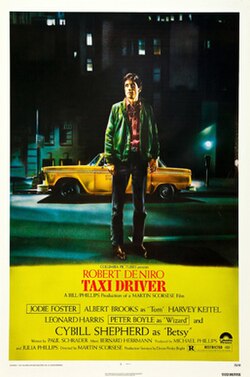 Taxi Driver, directed by Martin Scorcese, starring Robert De Niro, Jodie Foster, Cybill Shepherd, Harvey Keitel: I watched this movie a long time ago, but not since my new passion for movies that was kicked off by watching Yi Yi.
I see why everyone considers this movie one of the greatest. The script, directing, and acting would be great in any time. In 1976, they must have hit people like a ton of bricks. De Niro matched Brando. The grit. The detail.
Still, the content was like a still life made by a great artist but of rotting meat. I found this picture, which sort of captures what I’m saying, but it’s too clean:

New York City and its then decay play major roles. It reminded my of my first trip here from Philadelphia, which my dad took me on. I remember Times Square then, with porn theaters and bums, but also limousines and skyscrapers. As you’d expect from me, I was looking in the movie for how much litter and garbage there was.
There was a lot less garbage on the streets then, even portrayed by a movie trying to make the city look trashed. Moreover, what litter there was wasn’t plastic. Paper and metal might not be benign, but they don’t poison us and cross the blood brain barrier or placentas. Plus people weren’t all carrying plastic water bottles, coffee cups, and takeout everywhere.
I read and watched a bunch of reviews. They talk about masculinity. As usual, they describe De Niro’s character as unable to stay sane in society. It’s fiction, so we can’t comment on him as an actual person, but several times he tries to connect with people to share his struggles. At each turn he is spurned, with nobody connecting. Wizard just tells him he’ll be fine when he shares that he’s thinking of doing harmful things. When he says he can’t sleep to the guy interviewing him, the guy says there are porn movies for insomnia. Betsy walks out of the theater. Of course taking her to a porn movie is far from acceptable, but as best I could tell he just didn’t know better. Who knows what he had to face in Vietnam, but he knew how to handle guns and I doubt he got treatment for it.
I’m sure I’ve written here before the double standard: when there is conflict between society and women, the predominant message I hear is that we have to fix society; when there is conflict between society and men, the predominant message I hear is that men have to fix themselves.
I didn’t come across any reviews suggesting that society could support struggling men more, especially those traumatized in defending the nation, then snubbed by the people he opens up to, or tries to.