
This week I finished:
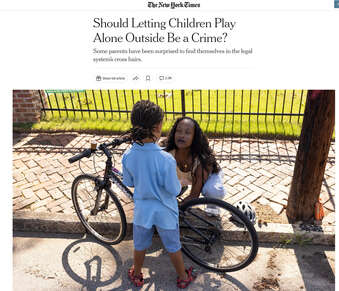 Should Letting Children Play Alone Outside Be a Crime?, by Ian Frisch in the New York Times: Reading this article prompted me to comment in an online community and to follow up with a string of other articles.
The article recounted stories of people reporting to police seeing children without parents watching them, followed by police and the government pursuing the parents. It described an ongoing trend of children being rendered unable to develop independence and social emotional skills.
I found the article on the StrongTowns community site. Its founder and podcast guest Chuck Marohn was going to record a podcast episode on it and was soliciting comments from the community. I wrote:
From the NY Times article: “Some experts point out that preventable accidents can occur when a child is given too much independence, and that the new laws could make protecting children more challenging. Last May, a mother and father were charged with involuntary manslaughter after their 7-year-old son was hit by a car and killed while crossing a busy road with his 10-year-old brother in North Carolina. “In such cases, adults must be held accountable for their responsibilities to ensure a safe environment for their children,” the Gastonia Police Department said in a statement.”
Following the link to the statement: “The 76-year-old driver will not face any charges.” !!!!
That article continued: “Gastonia police declined to comment to NBC News, but said in a statement that “there is no evidence of speeding or wrongdoing on the part of the driver, therefore no charges have been filed. The driver continues to be cooperative and the incident remains under active investigation by the Gastonia Police Department’s Traffic Division.””
No evidence of wrongdoing? The dead child.
The article also said: ““adults must be held accountable for their responsibilities to ensure a safe environment for their children,” police said in a statement.”
I guess that adult responsibility must fall to us to redesign communities so that cars killings children isn’t normal.
Here’s the StrongTown podcast episode:
The Times article mentioned podcast guest Peter Gray, who was also mentioned in a book I finished last week, Civilized to Death by Christopher Ryan, whom I recorded an episode with this week two (to be posted within a week or two, after editing). The double mention prompted me to read some of Gray’s work:

Play as a Foundation for Hunter-Gatherer Social Existence (2009) and Decline in Independent Activity as a Cause of Decline in Children’s Mental Well-being (2023), by podcast guest Peter Gray: I can’t recommend Peter’s Play article. Peter is a developmental/evolutionary psychologist with a special interest in play. The article appeared in The Journal of Play‘s first volume.
Peter began (after an overview and disclaimers to avoid misunderstanding) by describing what makes play play:
Play is activity that is (1) self-chosen and self-directed; (2) intrinsically motivated; (3) structured by mental rules; (4) imaginative; and (5) produced in an active, alert, but nonstressed frame of mind.
He then showed how immediate-return hunter gatherer social interactions were pretty close to play. By play he doesn’t mean just fun and games, nor did he mean they didn’t need to work or didn’t face struggle and suffering, but in how they interacted and made decisions in groups, they followed those four characteristics. Since around 99 percent of our human ancestors lived that way, human have mostly played where we now live under systems of dominance and lack of freedom.
My description didn’t do his paper justice. I recommend reading it.
The second paper of his I read this week treated the well-known and well-established rises in anxiety, fragility, and other degradation of social and emotional skills in children. Many attribute these trends to social media, smart phones, and the pandemic. He and his coauthors acknowledge that they may have contributed, but suggest that lack of time and activity with other kids independent of adult supervision contribute significantly.
I recommend this paper too, after the one above.
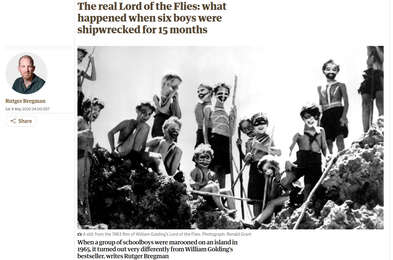 The real Lord of the Flies: what happened when six boys were shipwrecked for 15 months (2020), by Rutger Bregman in The Guardian: I usually don’t post here about short articles in the mainstream media, but both Peter Gray’s work and Christopher Ryan’s refer to this story.
I was assigned the book The Lord of the Flies in high school, or maybe junior high. It tells of boys without supervision descending into savagery. Ryan and Gray point out how useful such a story is for teachers and schools, in order to reinforce their authority, without which students might lose their humanity.
The book was not only fiction, it turns out that some actual boys actually did shipwreck on an island only they did the opposite of what the novel suggested. They collaborated and mutually aided each other.
It’s hard not to ask how much of our beliefs of the need for state authority constraining our freedom is based on speculation if not outright lies. My upcoming book answers that question and suggests how we can live instead.
True Blue to an Artistic Vision (2001), by Mimi Avins in The Los Angeles Times: Unrelated to the above pieces, I looked up the source of a quote I refer to a lot, which I made bold in the quote below, attributed to Picasso.
I found the quote in a lovely piece about three performance artists who stuck with their passions and grew a small piece of street theater into a global powerhouse without, at least as of then, losing their genuineness and authenticity. They are Blue Man Group.
The article uses views by Dustin Hoffman, who took his son to see them:
“By definition, an actor has to have a job to practice his craft,” [Dustin] Hoffman says. “These guys had somehow beaten that hurdle. Picasso expressed what they did. At one point, he said, ‘If they took away all my paints, I’d use pastels, if they took away my pastels, I’d use crayons, if they took away my crayons, I’d use a pencil. If they put me in a cell, and stripped me of everything, I’d spit on my finger and draw on the wall.’ And that’s what I thought Blue Man Group had accomplished. ‘You can’t stop me’ seemed to be the subtext of what they were doing. ‘I can stand in the middle of the street and cover myself with paint and I will perform.’ ”
I remember a college friend first recommending them to me, which would be between 1990 and 1993, saying something like, “Lots of people will like them, but you, Josh, will love them.” Then many people started saying similar things about their appeal matching something about them.
Well, after three decades, I still haven’t seen them. I saw Stomp, which may have been similar, and Bring on Da Noise Bring on Da Funk, also mentioned in the article, but not Blue Man Group. They’re still performing, all over the world, but not New York City any time soon.
I mention the article for its description of artists working hard, maintaining their integrity in the face of pressure to compromise and sell out. As of 2001, according to the article, they stayed true to themselves, which we can learn from.
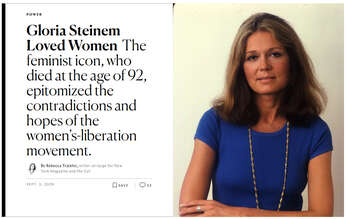 Gloria Steinem Loved Women, by Rebecca Traister in New York Magazine: Most people last week talking about a celebrity passing were talking about Dolly Parton. I didn’t know much about Parton and knew more about Gloria Steinem.
I met Gloria Steinem in 2023 at an event with podcast guest Bill Ryerson. My mom subscribed to Ms Magazine, I think since its first issue. I certainly remember issues around the house growing up. I also read her memoir My Life on the Road after meeting her.
This piece was long, by a writer at the magazine Steinem helped found and from which Ms was launched. It’s not comprehensive, but covers a lot of her life, her struggles, her interactions with people and institutions, and her legacy.