
This week I finished:
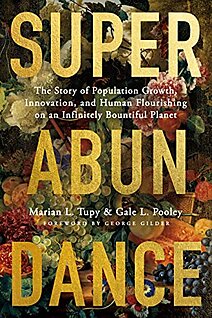 Superabundance: The Story of Population Growth, Innovation, and Human Flourishing on an Infinitely Beautiful Planet, by Marian Tupy and Gale Pooley: This book follows in the spirit of Julian Simon, whose book Ultimate Resource 2 I just reread. Since I understood that book much more going through it again not to dismiss it but to learn from it, I reread this one too.
It’s easy to see this book as mostly economic. Most of the middle of it looks at scarcity and abundance through prices of goods and services. It measures prices in time, which after getting used to makes sense.
The book is about freedom and liberty, though. It says so on the inner front book flap and the book builds up to it in the end. All the progress it describes comes from people and our ability to innovate past problems, but we need liberty and freedom to realize that potential.
This book quotes and refers to a cadre of authors that all seem to refer to each other: Michael Schellenberger, Steven Pinker, Matt Ridley, Nobel Laureate William Nordhaus, Ted Nordhaus, Jesse Ausubel, and a few others. I think Julian Simon is the progenitor of them all. Pinker referred to them in his book Enlightenment Now as “It has been called Ecomodernism, Ecopragmatism, Earth Optimism, and the Blue-Green or Turquoise movement, though we can also think of it as Enlightenment Environmentalism or Humanistic Environmentalism.”
I expect my book will refer to this book. Stay tuned for what I write.
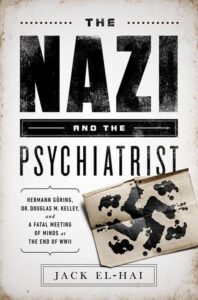 The Nazi And The Psychiatrist: Herman Goring, Dr. Douglas M. Kelley, and a Fatal Meeting of Minds at the End of WWII, by Jack El-Hai: A TV movie was made based on this book last year called Nuremberg. I’m in touch with the team to bring the author to my podcast. I was very interested since it came out around when I was reading Philip Zimbardo’s work on the psychology of people induced to act against their values.
Douglas Kelley was a psychiatrist spent more time with Herman Goring than anyone else. This book and his work relate to my book. I’m going to take the liberty of quoting some parts relevant to my work. In particular, Kelley found that these high-level Nazis weren’t that different from regular people but were influenced by their situations. He had originally wanted to find things that made them psychologically different.
If Kelley had hoped to discover a Nazi “germ,” a deviant personality common to the defendants, there was little evidence of one. Instead, he found in their personalities traits that he called neuroses, not uncommon psychiatric flaws that could certainly trouble the Nazis and increase their ruthlessness, but did not put them outside the boundaries of the normal. Kelley believed that countless men like Göring, unburdened by conscience and driven by narcissism, spent their days “behind big desks deciding big affairs as businessmen, politicians, and racketeers. . . . Shrewd, smooth, conscienceless speakers and writers like Goebbels, slick, big-time salesmen like Ribbentrop, and all the financial and legalistic hangers-on can be counted among the men whose faces we know by sight.”
…
His long proximity to the prisoners had convinced him that they exhibited several qualities: unbridled ambition, weak ethics, and excessive patriotism that could justify nearly any action of questionable rightness. Moreover, the Nazis, even the most elite and powerful among them, were not monsters, evildoing machines, or automata without soul and feelings. Göring’s concern for his family, Schirach’s love of poetry, and Kaltenbrunner’s fear under stress had moved Kelley and persuaded him that his former prisoners had emotions and responses like other people
…
Anyone who dismissed them “because we look with disgust and hatred upon their activities and upon their actions, to sell the Third Reich short,” was making a big mistake. Their relative normalcy left a portentous hanging question. How could their inexplicable conduct be understood? Without comprehending the Nazis or identifying their psychoses, Kelley could only reluctantly conclude that enormous numbers of people had the potential to act as the war criminals had.
…
“Insanity is no explanation for the Nazis,” he wrote. “They were simply creatures of their environment, as all humans are; and they were also—to a greater degree than most humans are—the makers of their environment.”
…
Nothing came of the committee’s examination of the Rorschachs. Harrower was among those who did not provide the interpretation they had promised. In 1976 she explained this dropping of the ball by recalling that the tests “did not show what we expected to see, and what the pressure of public opinion demanded that we see—that these men were demented creatures, different from normal people as a scorpion is different from a puppy. What we saw was a wide range of personalities, from severely disturbed neurotics to the superbly well adjusted.”
…
So in the end Kelley remained the only investigator willing publicly to declare that people like the worst of the Nazis live among us.
…
He wanted people to see that anyone could become those men, that America could become Germany. The United States was at a crucial moment of change, and the understanding he had brought home from Nuremberg could shine a light on the right path to follow. The Nazis, he warned, were you and me—given the slightest twist of fate. In broadly optimistic postwar America, he sounded slightly paranoid.
It’s difficult to realize that if you lived in their time and place, you could have become like them, but research seems to show it.
The point isn’t to make you feel bad but to point where to look for sources of problems: not for other Hitlers but for breakdowns of the protections of democracy.
Academic papers about property and John Locke: I reread Susan Liebell’s piece
- “The Text and Context of ‘Enough and as Good’: John Locke as the Foundation of an Environmental Liberalism”
I also read
- “The Original Understanding of ‘Property’ in the Constitution” by Paul J. Larkin Jr. in the Marquette Law Review from 2016
- “The Framers’ Understanding of ‘Property'” also by Paul J. Larkin, Jr., a review of the above piece in the Heritage Foundation’s EDWIN MEESE III CENTER FOR LEGAL & JUDICIAL STUDIES.
The founders’ and Locke’s views on property as embodied in the Constitution factor heavily in my book.
Videos on Quaker history: I’ve been studying abolitionism since at least the pandemic, since it’s a role model movement for the cultural change I see us needing to restore the liberty, freedom, equality, democracy, and national security we’re losing by not enforcing the Constitution. Quakers played major roles in starting the movement, especially Benjamin Lay at the beginning.
Growing up in Philadelphia, I knew many friends and family members who went to Friends schools, which were Quaker. Podcast guest Mat Johnson knew my stepbrother and stepsister at Green Street Friends School, for example. Some globally historical abolitionism events happened walking distance from my home.
It occurred to me that I could attend a Quaker meeting. I figured they’d welcome people. I looked up and found one in Manhattan, about a twenty-minute walk from my home. I visited a couple times, which prompted me to learn more about their history. I didn’t dive deep, but watched the videos below.
[They are appearing spaced out on my screen, probably because of a bug. I’m trying to fix it. Sorry if you have to scroll over a bunch of white space, but there are five videos]