
I’ve written lately about my writing process, trying to explain what is taking so long. I figure people know that the process of writing for any writer includes editing, rewriting, research, reading, and more. Still, I figure people wonder how long can those processes take.
I’ve been developing different models to characterize my process. I wrote a few weeks ago about how many times I’ve started introductions. The introduction isn’t just the start of the book, in my case, it also reflects and describes the structure I envision for the book. When I say I tried a new introduction, it means I started a new structure.
For background, the structure is like the composition or overall vision. You can’t get far working on one part or another absent an overall vision. Maybe you can in fiction, where you might start with some characters in a situation and the writer sees how they develop. I took a few improv classes, and you do something like that process in an improv performance, which is playing.
In my case, I’m helping people to stop violating their values and to restore those lost values to their lives. Such a task is fraught with emotion, and intense emotions. Almost anything I communicate will evoke emotional intensity, all the more if I promote changing behavior.
Most of all, this post is about doing reps. Leadership is a performance art and we learn to perform by doing reps. Whether lifting weights, learning to play piano, learning to draw, … anything active, social, emotional, expressive, and performance based. I’m doing the reps.
Do the reps.
It’s that simple.
Model 1: Traversing an emotional mine field
One model I see for what I’m doing in writing, and communicating my vision and mission in general, is crossing an emotional mine field. Each time I step on something that evokes intense emotion, it’s like hitting an emotional land mine with each person. They explode and I have to restart from the beginning, remembering where that emotional land mine was for that person at that time.
After years of communicating my vision and message, I’ve learned where many emotional land mines are for many different people and groups of people. Still, I keep hitting them. Each person is unique so a path that doesn’t hit emotional land mines for one may cause me to step on one for another.
On the other side of the emotional mine field is people living in the new culture, or rather with past, lost values restored.
Model 2: Completing levels on video games
I haven’t played video games for decades (by contrast, I have walked into a live minefield, though also decades ago), but I understand that many of them have levels and to reach the next level, you have to figure out and overcome challenges. Commonly, I hear, you have to defeat the boss character.
Video game players tell me that if you just go up to the boss and try to fight him or her, you’ll lose. You have to figure out all the power packs, weapons, other characters to ally with, and other things that enable you to win. You have to try over and over until you learn the combination of resources, skills, combinations to beat the boss and reach the next level. You might also talk to other players who figured it out for help.
The next level is people living in the new culture, or rather with past, lost values restored.
Model 3: Groundhog Day
This model is based on the movie Groundhog Day, starring Bill Murray. I think nearly everyone within ten or twenty years of my age has seen it, or at least knows its foundation. Murray’s character keeps waking up every morning to Groundhog Day in Pennsylvania.
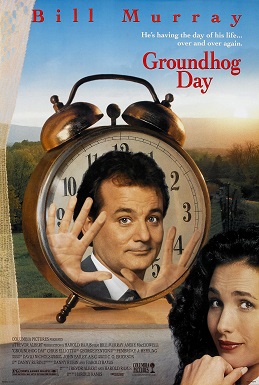
First he can’t believe what’s happening and suspects he’s being tricked. Later he tries to personally benefit, like to manipulate a woman into sex. After a while he wants to exit and tries suicide. After each try, he wakes up again on Groundhog Day.
People have estimated how long he repeats the day, Since he learns virtuoso skills in playing piano, speaking foreign languages, and sculpting art, it’s decades.
After enough cycles of rebirth, he ends up not trying, but living by giving the best of himself selflessly, like creating love and helping neighbors. Then he wakes up the next morning.
Sometimes I feel like Murray’s character. No one tells him why what he’s doing isn’t working nor what success would look like or even if there is an exit to his trials. He doesn’t have a choice, though. He just keeps restarting. There isn’t much variation since he starts from one hotel room in a small town… or is there? Is there more variation in human experience in twenty-four hours than a person can exhaust in tens of thousands of replays?
In my case, is there no end to possible ways to compose the book’s structure and write it, as part of an overall vision for a movement based in effective leadership leading to cultural restoration.
I believe that if I do my work effectively, I’ll create a brief, clear book that people will think so simple that I couldn’t have taken more than a few weeks to write it. If so, then I’ll know I’ve succeeded. If only one or two people who have created great works acknowledge that they know the work such simplicity and effectiveness must have taken, I’ll feel satisfied with all this time and effort.