
I’ve called Limits to Growth the science book of the decade 2000-2009, in particular the 30-year update. From what I learned in math and science in college and graduate school, it approached our environmental situation how I would, and they followed through. Having an idea in principle of what to do in this case was a tiny fraction of implementation.
They had to refine the algorithms, code them, look up the numbers to put in for all the physical measurements, determine what numbers they’d have to assume, justify their assumptions, debug, interpret their results, figure out how to present them, write, edit, publish, and more.
Since reading it, I’ve read many more books on the environment and talked to many people. Some of those books and people appreciated the book and took it to heart. Many more criticized it. I didn’t keep track, so I may have forgotten instances, but I don’t remember any criticisms indicating that the critic had read the book.
Almost all critics mischaracterized their findings. The main mischaracterization was to call their simulations predictions. Another was to call them Malthusian, which they didn’t back up. I think they connect mention of population decline descends from Malthus, as if there were no other way to consider it than following him.
Recently I read a piece from 1973 by a Nobel economist Robert Solow, Is the End of the World at Hand?. Despite its snarky tone, it looks like he actually read the book, the first edition, which came out the year before. Ironically, I found the piece referred to by a piece on Paul Erlich.
I quote several parts at length below. I won’t go into length about why I don’t find his approach and results compelling, but the main one is that he seems to consider pollution and degradation improperly priced, that they an externality that could be fixed more cheaply than the damage if left unfixed. He doesn’t distinguish between what I call Type 1 and Type 2 pollution and depletion. Regular readers know I consider Type 2 pollution and depletion qualitatively different than Type 1. In particular, Type 2 violate the Declaration and Constitution, thereby making markets based in them coercive, not free.
If we don’t enforce the minimum necessary for liberty, freedom, equality, democracy, and national security, we won’t have meaningful markets amid too much coercion. I see more problems too.
I’m posting about it because I’m glad to see at least one critic seems to have read it. I wouldn’t be surprised if most critics only read others’ criticisms implying they’d read something they hadn’t.
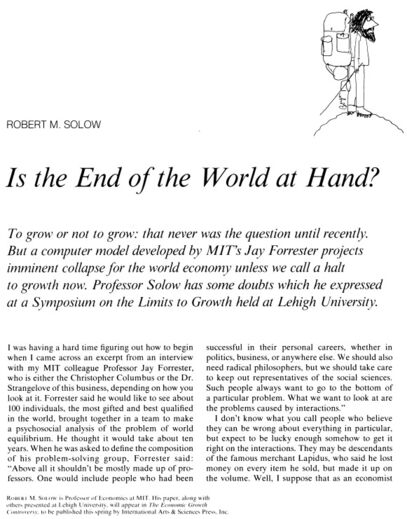
Selections from Solow’s Is the End of the World at Hand?
The characteristic conclusion of the Doomsday Models is very near the surface. It is, in fact, more nearly an assumption than a conclusion, in the sense that the chain of logic from the assumptions to the conclusion is very short and rather obvious. The basic assumption is that stocks of things like the world’s natural resources and the waste-disposal capacity of the environment are finite, that the world economy tends to consume the stock at an increasing rate (through the mining of minerals and the production of goods), and that there are no built-in mechanisms by which approaching exhaustion tends to turn off consumption gradually and in advance. You hardly need a giant computer to tell you that a system with those behavior rules is going to bounce off its ceiling and collapse to a low level…
Once you grasp the quite simple essence of the models, this should come as no surprise. It is important to realize where these powerful conclusions come from, because, if you ask yourself “Why didn’t I realize earlier that the end of the world was at hand?” the answer is not that you weren’t clever enough to figure it out for yourself. The answer is that the imminent end of the world is an immediate deduction from certain assumptions, and one must really ask if the assumptions are any good…
I don’t want to argue for any particular counterstory; all I want to say now is that the overshoot-collapse pattern is built into the models very near the surface, by assumption, and by implausible assumptions at that.
This is not an argument for laissez-faire. We may feel that the private decisions of buyers and sellers give inadequate representation to future generations. Or we may feel that private interests are in conflict with a distinct public interest—strip-mining of coal is an obvious case in point, and there are many others as soon as we begin to think about environmental effects. Private market responses maybe too uncoordinated, too slow, based on insufficient and faulty information. In every case there will be actions that public agencies can take and should take; and it will be a major political struggle to see that they are taken.
A footnote on the first page: “Robert M. Solow is Professor of Economics at MIT. His paper, along with others presented at Lehigh University, will appear in The Economic Growth Controversy, to be published this spring by International Arts& Sciences Press, Inc.”What one gets from the Doomsday literature is the notion that air and water and noise pollution are an inescapable accompaniment of economic growth, especially industrial growth. If that is true, then to be against pollution is to be against growth. I realize that in putting the matter so crudely I have been unjust; nevertheless, that is the message that comes across. I think that way of looking at the pollution problem is wrong.
A correct analysis goes something like this. Excessive pollution and degradation of the environment certainly accompany industrial growth and the increasing population density that goes with it. But they are by no means an inescapable by-product. Excessive pollution happens because of an important flaw in the price system. Factories, power plants, municipal sewers, drivers of cars, strip-miners of coal and deep-miners of coal, and all sorts of generators of waste are allowed to dump that waste into the environment, into the atmosphere and into running water and the oceans, without paying the full cost of what they do. No wonder they do too much. So would you, and so would I. In fact, we actually do—directly as drivers of cars, indirectly as we buy some products at a price which is lower than it ought to be because the producer is not required to pay for using the environment to carry away his wastes, and even more indirectly as we buy things that are made with things that pollute the environment.
This flaw in the price system exists because a scarce resource (the waste-disposal capacity of the environment) goes unpriced; and that happens because it is owned by all of us, as it should be. The flaw can be corrected, either by the simple expedient of regulating the discharge of wastes to the environment by direct control or by the slightly more complicated device of charging special prices—user taxes—to those who dispose of wastes in air or water. These effluent charges do three things: they make pollution-intensive goods expensive, and so reduce the consumption of them; they make pollution-intensive methods of production costly, and so promote abatement of pollution by producers; they generate revenue that can, if desired,be used for the further purification of air or water or for other environmental improvements. Most economists prefer this device of effluent charges to regulation by direct order. This is more than an occupational peculiarity. Use of the price system has certain advantages in efficiency and decentralization. Imposing a physical limit on, say, sulfur dioxide emission is, after all, a little peculiar. It says that you may do so much of a bad thing and pay nothing for the privilege, but after that, the price is infinite. Not surprisingly, one can find a more efficient schedule of pollution abatement through a more sensitive tax schedule.
But this difference of opinion is minor compared with the larger point that needs to be made. The annual cost that would be necessary to meet decent pollution-abatement standards by the end of the century is large, but not staggering. One estimate says that in 1970 we spent about $8.5 billion (in 1967 prices), or 1 percent of GNP, for pollution abatement. An active pollution abatement policy would cost perhaps $50 billion a year by 2000, which would be about 2 percent of GNP by then. That is a small investment of resources: you can see how small it is when you consider that GNP grows by 4 percent or so every year, on the average. Cleaning up air and water would entail a cost that would be a bit like losing one-half of one year’s growth, between now and the year 2000. What stands between us and a decent environment is not the curse of industrialization, not an unbearable burden of cost, but just the need to organize ourselves consciously to do some simple and knowable things. Compared with the possibility of an active abatement policy, the policy of stopping economic growth in order to stop pollution would be incredibly inefficient. It would not actually accomplish much, because one really wants to reduce the amount of, say, hydrocarbon emission to a third or a half of what it is now. And what no-growth would accomplish, it would do by cutting off your face to spite your nose.
The end of the world—a matter of timing
In the end, that is really my complaint about the Doomsday school. It diverts attention from the really important things that can actually be done, step by step, to make things better. The end of the world is at hand—the earth, if you take the long view, will fall into the sun in a few billion years anyway, unless some other disaster happens first. In the meantime, I think we’d be better off passing a strong sulfur-emissions tax, or getting some Highway Trust Fund money allocated to mass transit, or building a humane and decent floor under family incomes, or overriding President Nixon’s veto of a strong Water Quality Act, or reforming the tax system, or fending off starvation in Bengal—instead of worrying about the generalized “predicament of mankind.”