Everyone in New York City knows that in game 4, the Knicks overcame the greatest deficit in NBA finals history to win. No one can get enough of seeing OG Anunoby tip the ball in with 2 seconds on the clock.
Basketball is a team sport and every second of the game counted, but if you want to win in life, and I don’t mean defeat others, I mean to reach your full potential, to help everyone around you, it’s worth noting a few points about Anunoby on this play. Here’s the video, if you haven’t seen it enough. Then I’ll show a few points we can learn from.
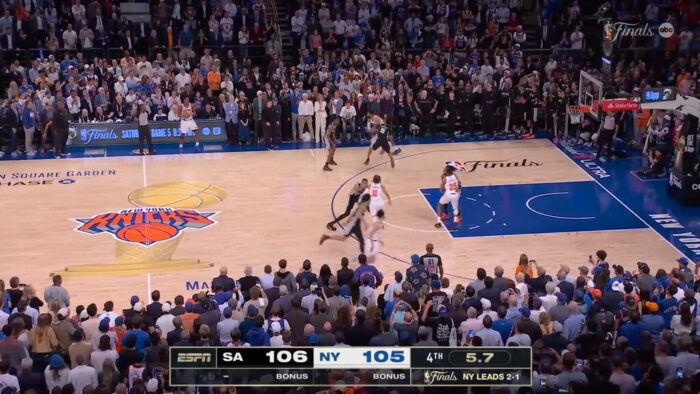
Moment 1: With 5.7 seconds on the clock Anunoby has the ball on the sideline, looking to pass the ball in. He is literally off the court, the farthest away from the basket, and not moving.
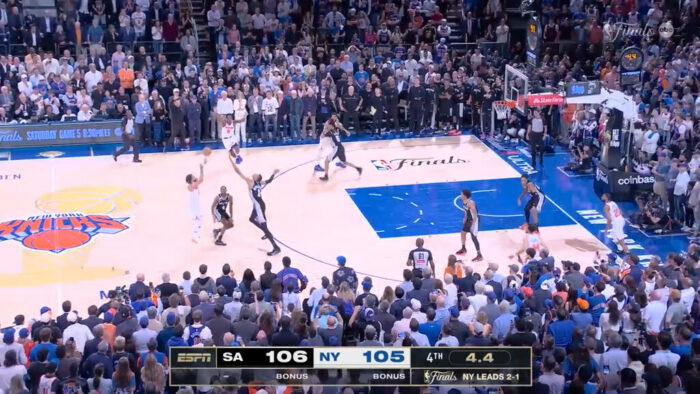
Moment 2: With 4.4 seconds on the clock (and Madison Square Garden lit by the stadium-wide flash that I think goes off for the official photographer), Jalen Brunson shoots a 3-point attempt.
Note Anunoby. He’s moving backward in case Brunson needs an outlet to pass. Besides Brunson, he’s again the farthest from the basket, moving away from the basket. Everyone but Brunson has a better chance at a rebound than Anunoby.
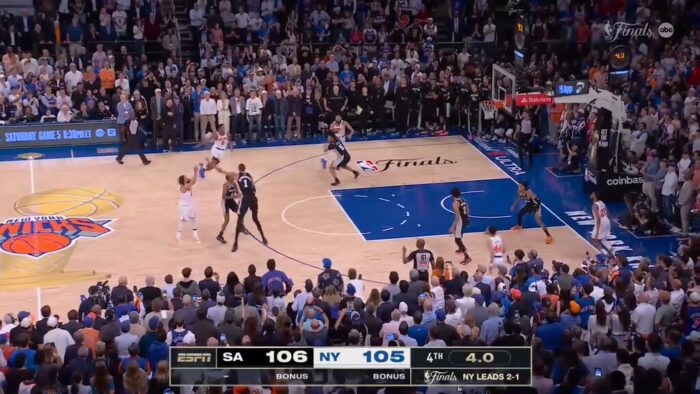
Moment 3: with 4.0 seconds left—that is, 0.4 seconds from the last moment—Anunoby has switched direction. Nobody knows if the shot will go in or where it will go if it doesn’t, but look at Anunoby’s body. Compare it with every other player on the court.
He wants the ball. He believes he can make a difference despite everyone else being better positioned.
Moment 4: With 3.3 seconds, Anunoby is still almost the farthest from the basket, about the top of the key. The two Spurs farthest from the basket are moving toward it, but he’s sprinting.
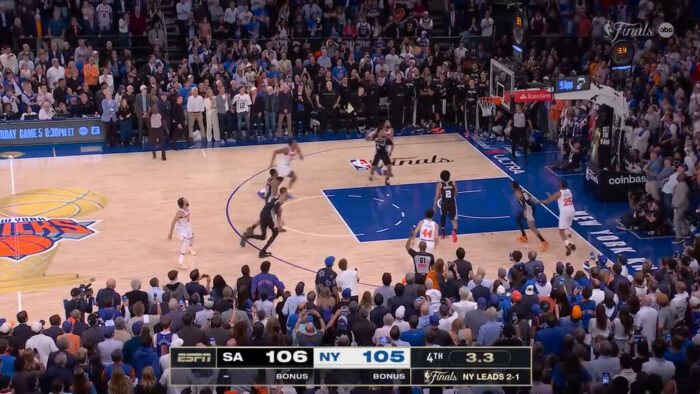
Moment 5: 2.9 seconds left. Three Spurs are still closer to the basket than Anunoby.
If the ball doesn’t go in, they have an easier job. Their team is up by a point. All they have to do is knock the ball anywhere. He doesn’t have time to catch the ball and take a new shot.
His only option would be to tip it in, which would require finesse amid being bumped by other players, fine-tuning how and where he jumps and moves based on how the ball bounces out and spins, which includes infinite variations.
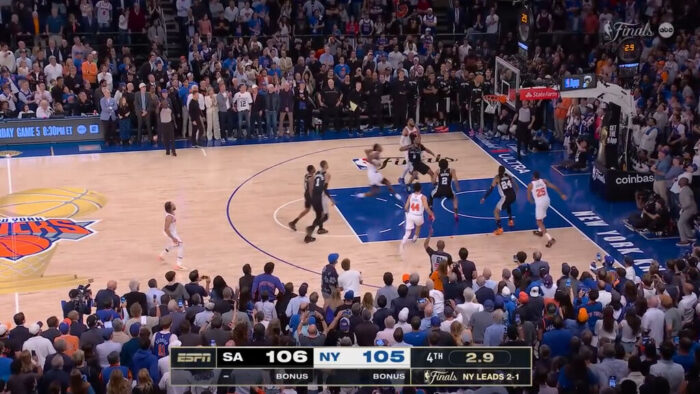
Moment 6: 2.5 seconds. Anunoby starts his jump. Two Spurs are still closer to the basket. Again, compare his body to theirs.
Who wants it more?
Who is active?
Who is passive?
Who is guided by a vision?
Note that all the players are professionals. They’ve all practiced their whole lives, preparing for this moment. All their bodies and skills are honed for a moment like this. Yet one player is leading.
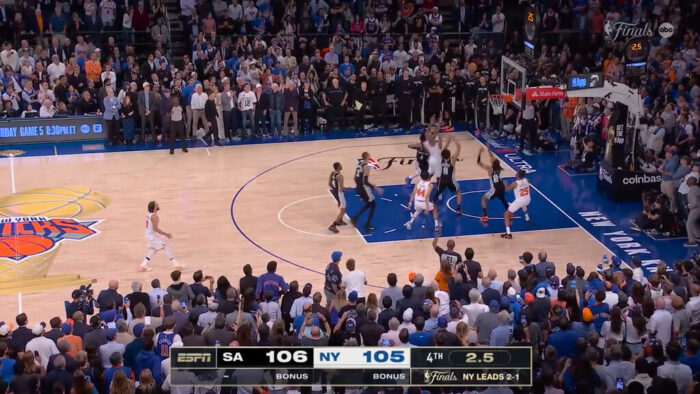
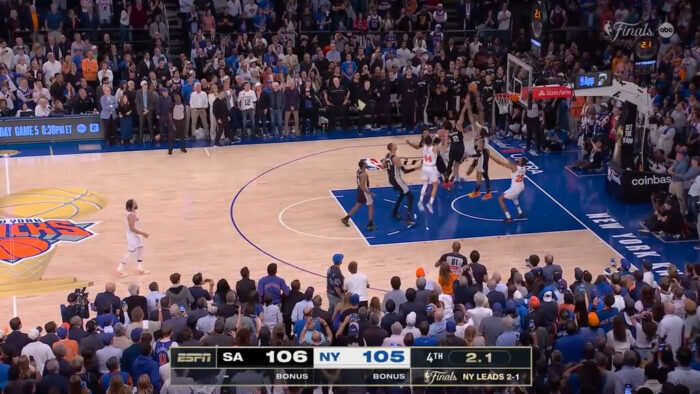
Moment 7: 2.1 seconds. Anunoby is not the tallest player on the court. Not all of his body is closer to the basket than at least one Spur, but his fingertips alone touch the ball. With finesse and countless fine-tunings of every part of his body, he guides the ball from a many possible paths into a very small subset that take it into the net.
He wasn’t born with this skill, determination, and vision. He developed these things and more through practice. Beyond physical skills and ability, he delivered with mental and emotional skills, also refined and developed through practice.
Few of us can develop the physical ability to reach the NBA, but all of us can develop mental and emotional skills like his.
I work on ending pollution and depletion, to restore lost values to our culture to enable liberty, freedom, equality, democracy, and national security. Everyone acts as if there’s nothing we can do or promote strategies that will fail and move us backward. I’m using Anunoby as a role model.
John Starks
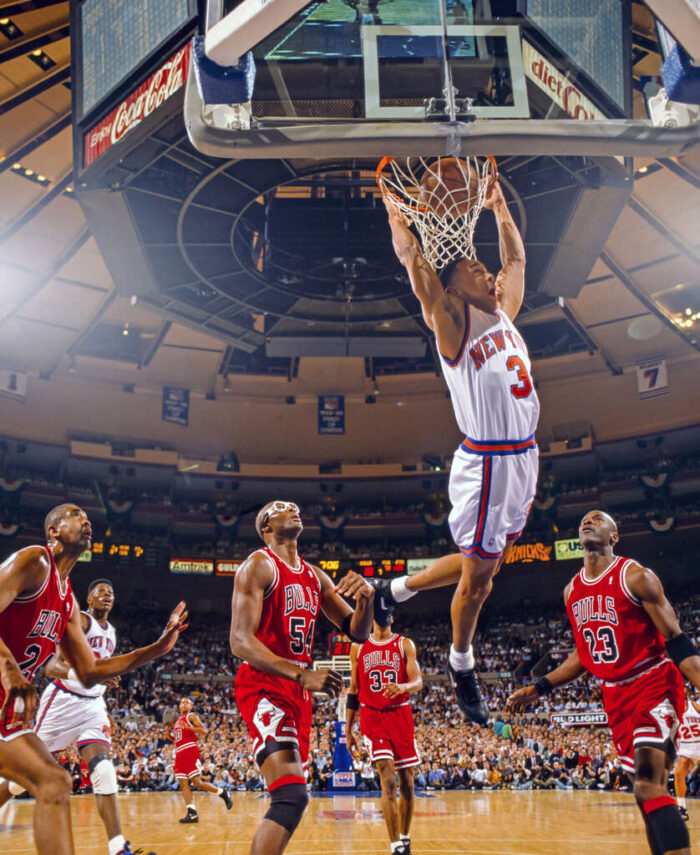
For those Knick fans with longer memories, they may enjoy being reminded of John Starks doing something similar over the Bulls, including one Michael Jordan. Maybe Anunoby channeled him: