
I’m posting more about artificial intelligence, maybe enough to make a category for it. I posted that I hesitated to post my last one with this explanation: “I held back on posting it because of the question in the last paragraph. I’m finishing the third volume of The Gulag Archipelago and studying the effects of dominance hierarchy, which artificial intelligence is forming. People who criticized Stalin didn’t fare well. Should we worry about criticizing the people and machines who may be at the top of a steepening dominance hierarchy?”
I doubt I have to worry, but reflecting on something thoughtfully and calmly isn’t worrying.
Besides AI, I also post a lot about dominance hierarchies. They form when there is a necessary resource that can be controlled with no alternative. Media, including social media and search, fits that criterion, even if communicating to large numbers of people isn’t necessary like oxygen or food. AI is becoming like social media on steroids in terms of this criterion.
I’ve been meaning to make these diagrams representing the effects of technology and legislation on a dominance hierarchy—that is, at the highest level in our culture.
Dominance hierarchies are often represented as pyramids or triangles with the people with high rank at the top and those with low rank at the bottom since there are more people at the bottom than at the top. Here are a couple old representations (click to enlarge):
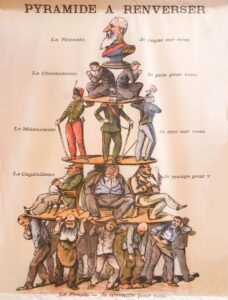
A German one from 1795:

Here’s a simplified version:

The effect of technology and legislation
What happens with new technology and laws? As I’ve written about posts on AI, technology and laws are tools. People you agree with aren’t the only people to use them. Everyone does. Some tools help people without affecting the hierarchy, like paper clips. Others do affect the hierarchy.
In a dominance hierarchy, the technology and laws that affect the hierarchy and endure will be ones that benefit those with rank. Over the course of history, the effect of technology and laws is to enable fewer people with high rank to control resources affecting more people with low rank:

The result of technology and legislation
The result is a tighter, taller hierarchy:

The US Declaration and Constitution created a democratic hierarchy, which is different than a dominance hierarchy in that the people at the top get rotated out by the votes of people at the bottom, among other difference. Having a democratic hierarchy in government doesn’t prevent dominance hierarchies from forming in industry, religion, media, and so on.
The US increasingly looks like the pinched hierarchy above, growing ever steeper:

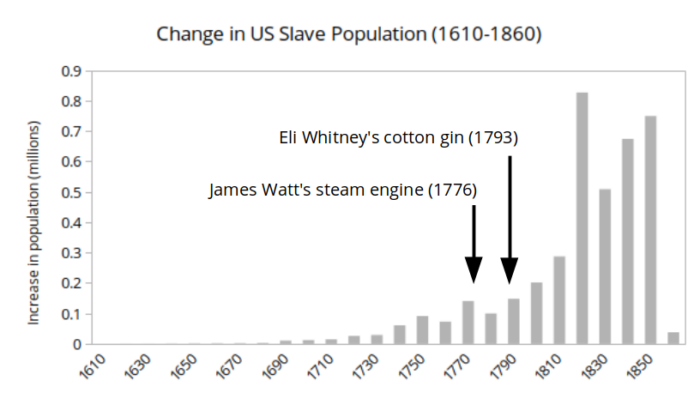
This graph illustrates this point with technology. The cotton gin and steam engine were both designed to reduce the need for labor. The people who owned them didn’t value less labor, they valued more profit and more control over their resources—mills in England and cotton-producing land in the North American colonies and states. The result: the dominance hierarchy became more pinched and steep—that is, fewer people at the top with more wealth and more people at the bottom with less freedom or wealth.
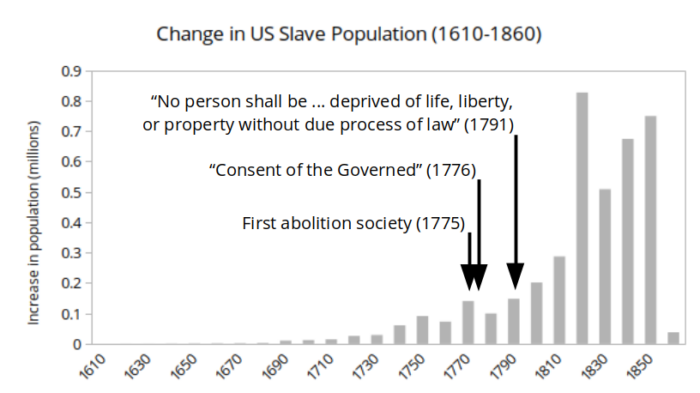
This graph illustrates the point with legislation—to be precise, legislation that was not enforced. It seems obvious to me that slavery violates the consent of the governed and deprives people of life, liberty, and property without due process of law, as well as property rights as understood by the drafters, ratifiers, and public, but they weren’t enforced.
Much legislation is simply designed to keep society stable, which causes the effect above, but even legislation that would help but isn’t enforced contributes to the effect above.
I tend to think of the Declaration and Constitution as different than just legislation. We’ll see below how they can help when enforced.
The effect of AI
AI is a powerful tool, arguably more powerful than nearly any so far. Even with a competitive market, a small number of people control access to this resource, which many people find necessary. It looks like it will move the US and world to something like this, where a very small number of people control everyone else. (It should look wider at the bottom. I’ll have to touch up the image. My graphics skills aren’t great.)

Where have we seen such a steep dominance hierarchy?
The clearest time I can think of where we saw such a steep dominance hierarchy was in the USSR under Stalin. To be absolutely clear, I’m not comparing anyone operating AI with Stalin. Anyone who implies I am seriously misunderstands me or is seriously trying to misrepresent me.
What I’m concerned about is the effects Philip Zimbardo documented in The Lucifer Effect and that we all experience when we find ourselves controlling access to resources others depend on: we believe we are helping them. When there isn’t enough to go around, we also believe we help them by controlling that resource more. Colloquially: power corrupts.
I predict that whatever use you find for AI, however much it helps you, all those effects for individuals or institutions and groups, the overall effect on society will be to tighten and enforce dominance. I think it’s reasonable for people to be concerned if they speak out online against a trend that reads everything online.
We’ll see.
Saving grace
AI also pollutes and depletes more than most technologies, which violates the Declaration, Constitution, and property rights as understood by their authors, ratifiers, and public. Maybe our government will come around to enforcing its charters. It’s what I’m working on. I don’t oppose technology. I love technology. I oppose violating the Constitution and Declaration. I hope you do too.
The graph that produces the most hope and motivation that I know of
The two graphs above that illustrated the effect of technology and legislation on dominance hierarchy may have generated hopelessness. Most attempts to solve our environmental problems are based in technology and laws. What do we do if they don’t work?
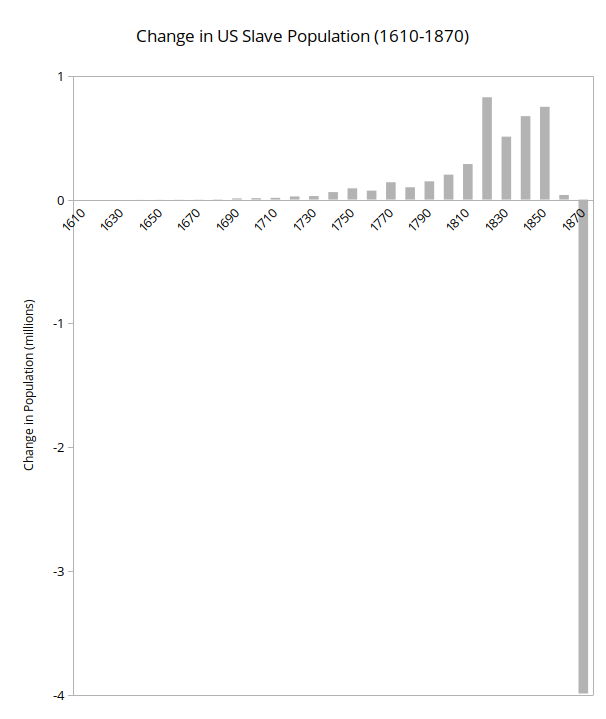
When there are no winning moves, change the game. In the case of slavery, doing so is simple, though wasn’t easy in practice. There is no way a nation can enable slavery and defend freedom. People tried compromise and balance for generations. All those moves failed.
The solution: change from a dominance hierarchy to a democratic hierarchy. The US was intended to be a democratic hierarchy and was to some extent, but over time the dominance hierarchy of slavery in the market and several states grew to where it challenged the democratic hierarchy.
Look at what happened when the requirements for democratic hierarchy were enforced. What I consider the graph that produces the most hope and motivation that I know of. It doesn’t show projections. It shows what actually happened. What this nation did before in stopping violating the Declaration, Constitution, and property rights it can do again.
This Post Has 0 Comments